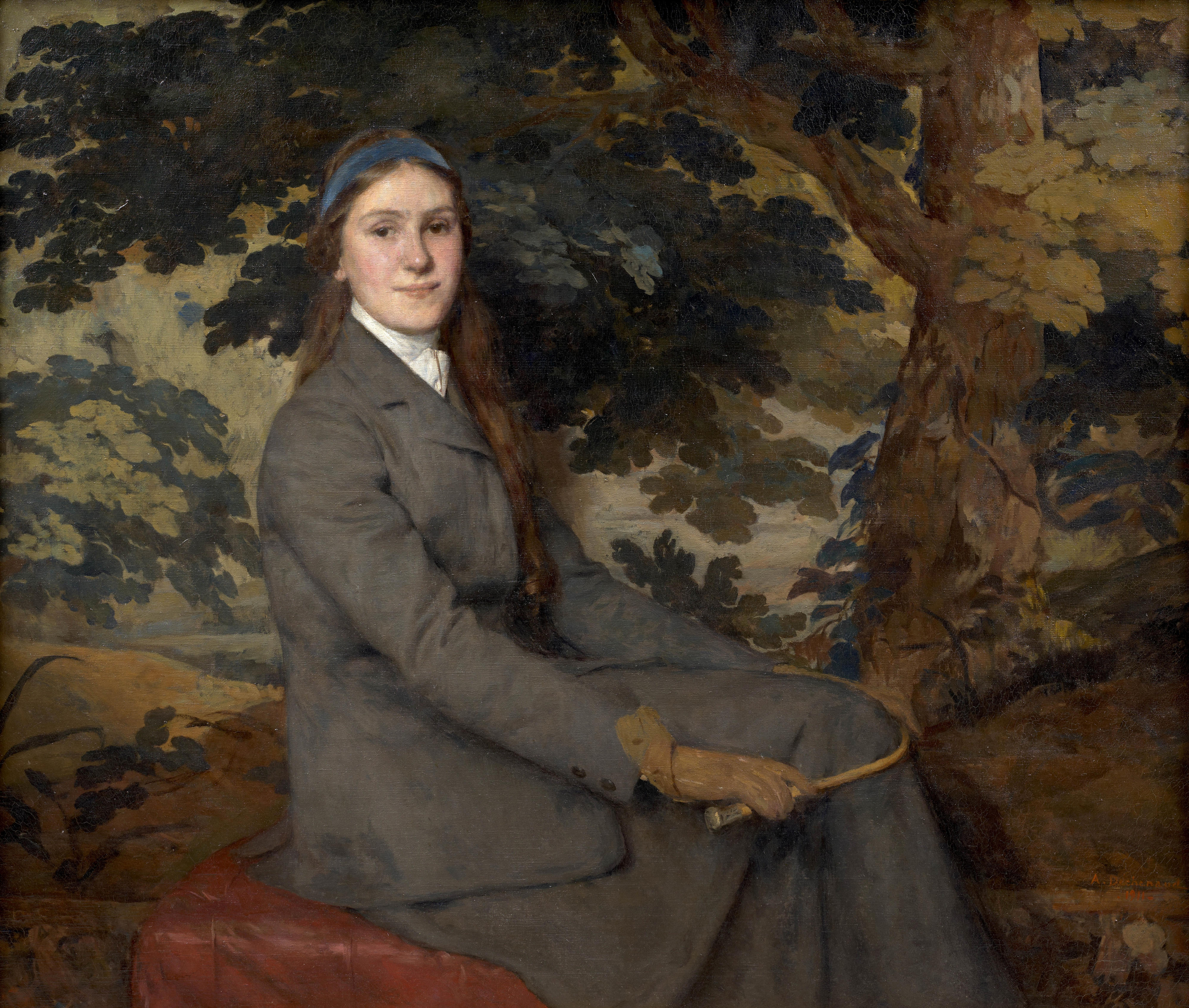
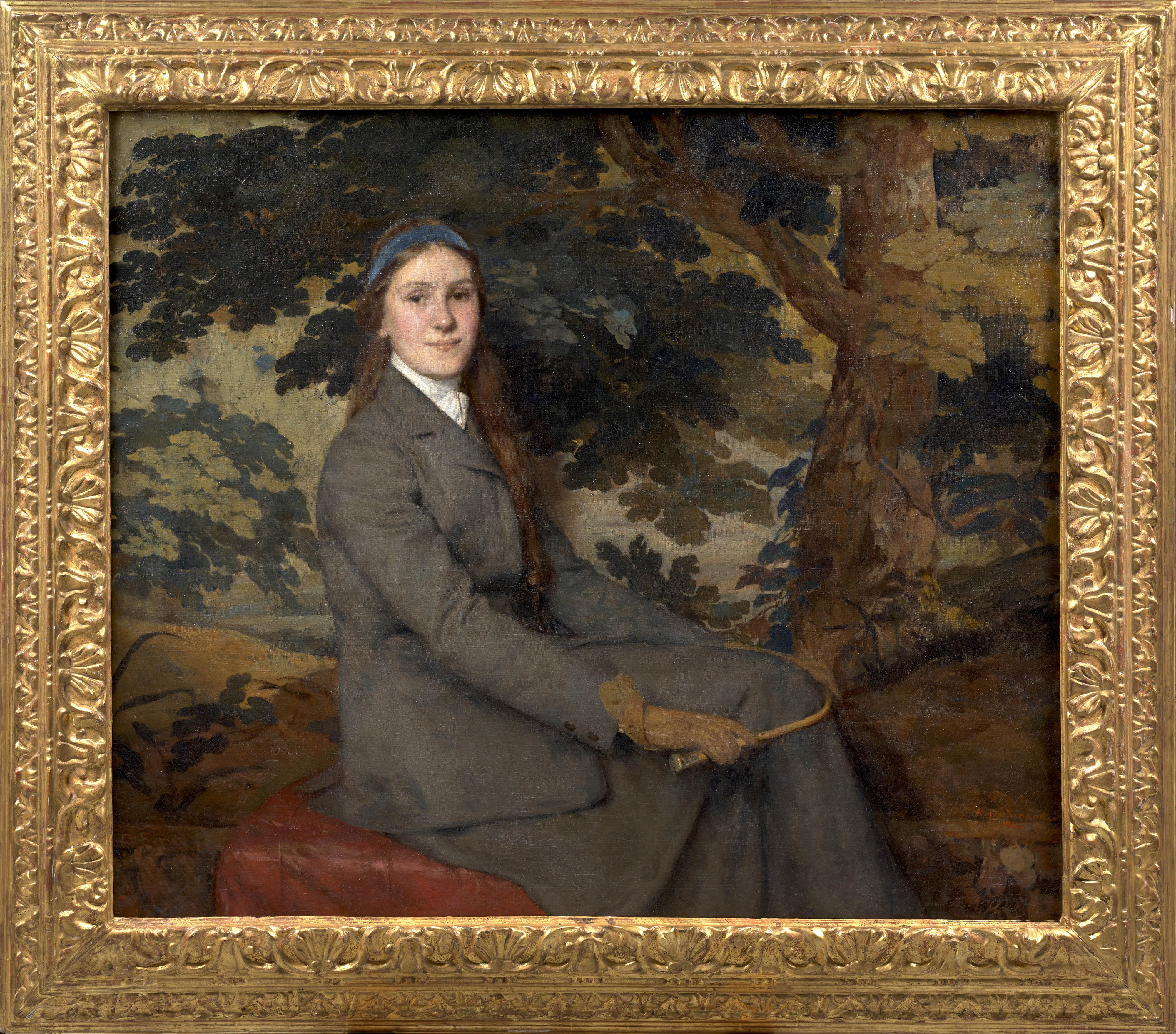

Portrait of Mademoiselle Odile Chedanne, daughter of the architect Georges Chedanne, in side-saddle
1911
Oil on canvas
110 x 130 cm (43 1/4 x 51 1/8 in.)
Framed: 141 x 161.5 x 8.5 cm (55 1/2 x 63 5/8 x 3 3/8 in.)
Provenance
Collection of architect Georges Chedanne (Maromme 1861–1940 Paris), until at least 1928,
Private collection, Bordeaux.
Literature
Bulletin de l’Académie des Beaux-Arts, 3eme T 1927, p. 39.
Georges Lecomte, 'Artistes contemporains. Adolphe Déchenaud', La Revue de l’art ancien et moderne, 26th year, June 1922, vol. XLII, n° 237, p. 262.
Description
Adolphe Dechenaud trained at the Académie Julian under the painter Jean-Joseph Benjamin-Constant (1845–1902), who was known for his Orientalist subjects, both in Europe and in the United States. The classical and exoticising style was evident in Dechenaud’s early work, treating dramatic religious or mythological subjects. However, in his mature works, the painter developed a more naturalistic style with a greater sense of humanity, becoming known for genre scenes and especially portraiture, which was popular among the Paris bourgeoisie as well as depicting fellow artists and family members.
In 1894, Dechenaud won the Prix de Rome, sharing the Grand Prize with the painter and illustrator August Leroux (1871–1954). He travelled to the Eternal City that same year, where taking up residence at the Villa Medici, remaining there until 1898. On his return to France, he exhibited for the first time in the Salon of 1899, and received medals for his works in the following two Salons. In 1908 the artist was made a Chevalier of the Legion d’Honneur and became a member of the Institut in 1918. In 1928, the year before his death, the Salon des Artistes Français organised a retrospective of his work. Today, paintings by Dechenaud are in the collections of notable museums across France, including the Musée d’Orsay (Portrait de Victor Laloux, Portrait de Dujardin-Beaumetz), the Musée des Beaux-Arts de Rouen (Groupe d’amis), Musée des Beaux-Arts de Marseille (Portrait du Sculpteur Constant Roux), and the Musée des Ursulines, Mâcon (Philemon and Baucis, Portrait of the Artist’s Mother).
The present work portrays Odile Chedanne, the daughter of the famed architect Georges Chedanne (1861–1940). Painted in 1911, the sitter is depicted as a charming and confident young woman, in riding gear, posed in front of a landscape tapestry. The work is typical of Dechenaud’s style from these years, blending a timeless clarity with modern sensibility. Staged in a seemingly domestic setting, the physical proximity of the sitter is emphasised by the bounded sense of space, with the tapestry filling the entire width of the canvas, allowing no hint of the surrounding room. The young woman’s angled position, with her head turning casually towards the viewer as if she has just noticed our presence, and the playful manner with which she bends the riding crop around her knee, imbue the portrait with an endearing informality.
Dechenaud also painted a portrait of Odile’s father, Georges Chedanne, most renowned as the designer of the Galeries Lafayette in Paris, but also responsible for several other major projects, often in the Art Nouveau style, including the French Embassy in Vienna. Dechenaud’s portrait of Chedanne is today preserved in the Musée des Beaux-Arts de Rouen (fig. 1). Chedanne was also resident at the Villa Medici in the early 1890s, just prior to Dechenaud taking up residence; it was likely during this time that he sat for Dechenaud. The friendship clearly endured, with the present work made over 15 years later.
The portrait of Odile Chedanne was praised by the contemporary critic Georges Lecomte in his review of contemporary artists in the year 1922. He lists this work as an example of the artist’s ‘unforgettable portraits, stunning in their truthfulness, their character and their elegance’ (inoubliables portraits, superbes de vérité, de caractère et d’élégance). There is a real sense of the sitter’s presence in the work, beyond mere visual representation. The portrait is a fine example of an artist during the ascendency to become one of the most respected portraitists of his generation.
Fig. 1 – Adolphe Dechenaud, Portrait de M. Chedanne, oil on canvas, 97 x 78 cm. Rouen, Musée des Beaux-Arts, 948.4.67.