
Francisco Goya
b. 1746, Fuendetodos
d. 1828, Bordeaux
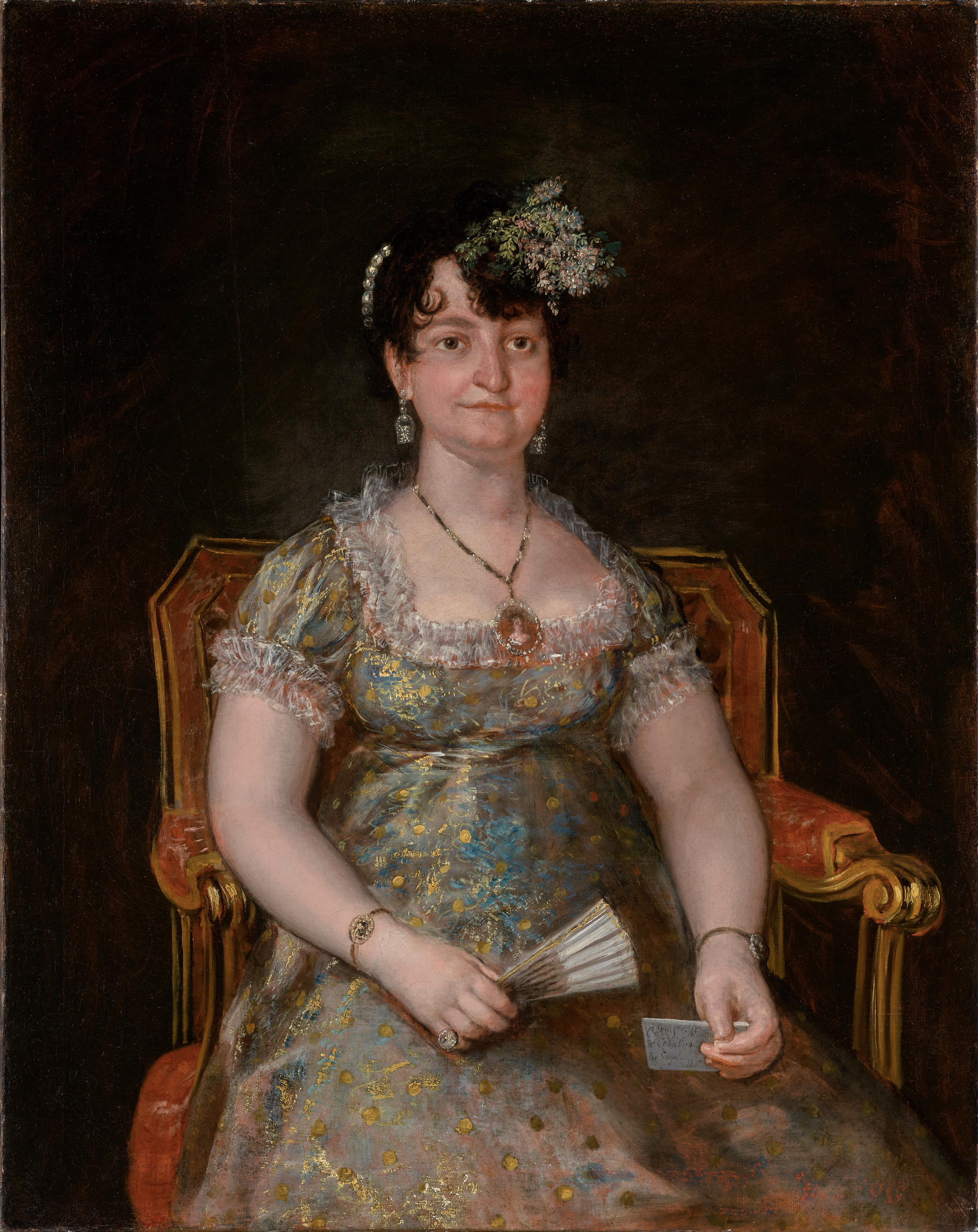
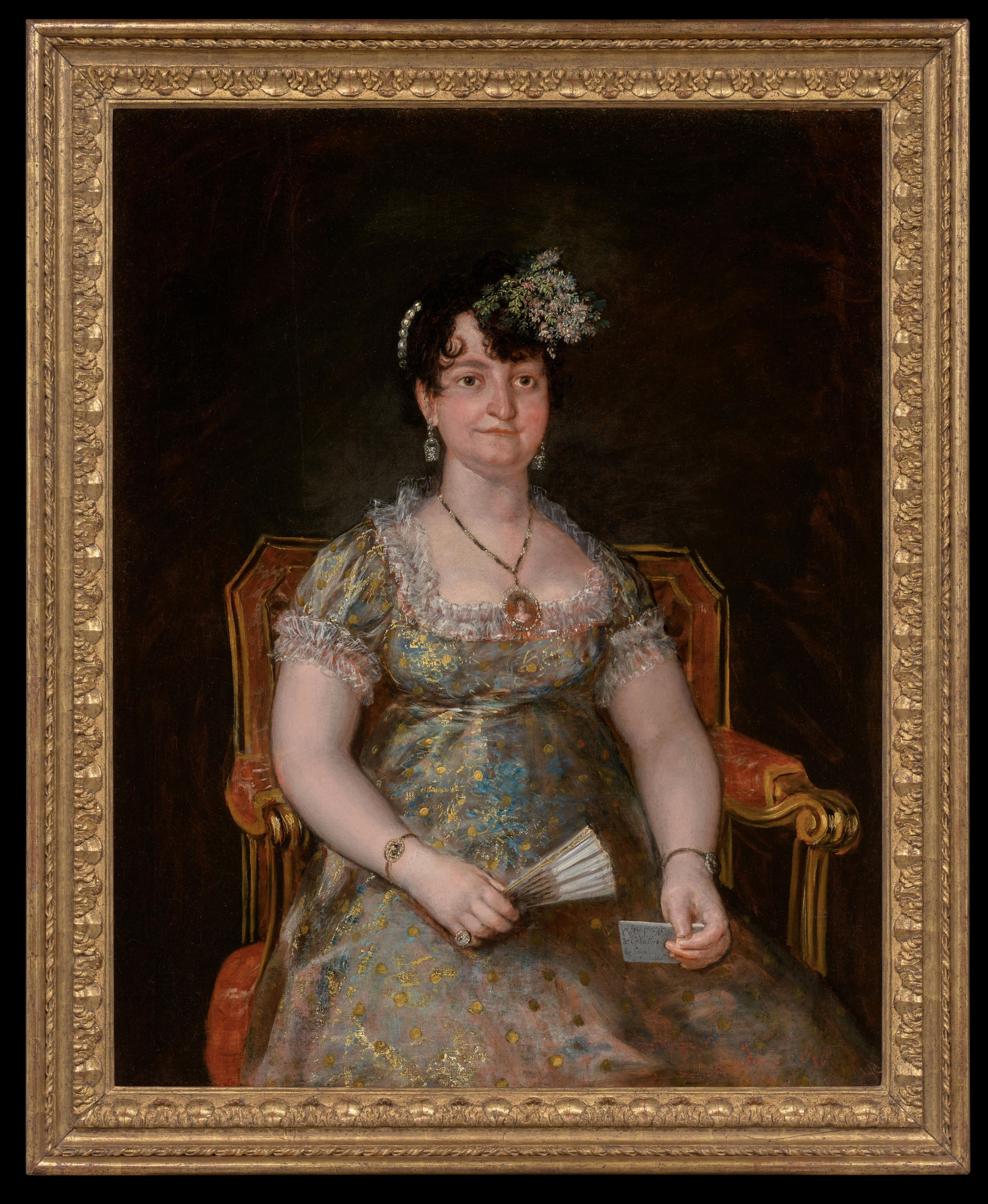
Portrait of Maria Soledad Rocha Fernandez de la Peña, Marquesa de Caballero
1807
Oil on canvas
104.5 x 84 cm (41 1/8 x 33 in.)
Framed: 121.3 x 100 x 8 cm (47 3/4 x 39 3/8 x 3 1/8 in.)
Provenance
The sitter, Maria Soledad de la Rocha Fernandez de la Peña (1774–1809),
Her brother, Joaquin de la Rocha y Fernandez de la Peña (1777–?),
His daughter, Doña Juliana de la Rocha y Laguna,
Her daughter, Doña Ramona Dolores de Barrantes y de la Rocha (1834–1863),Her son, Ramon Montero de Espinosa y Barrantes (1859–1901),
His wife, Leonor de Mendoza y Diaz de Junguitu (Viuda de Montero de Espinosa) (?–1929),Her son, Fernando Montero de Espinosa y Mendoza (1891–1959),
with Tomas Harris, 1933 (Published in The Art News 29 April 1933),
with Apolinar Sanchez Villalva, until 6 January 1936 when sold to,
Count of Barbate, Serafin Romeu y Fages (c. 1880–1937),
His wife, Maria Sebastiana Limon Caballero. (? – 1967),
Her great-niece, Rosario Martinez de Campos Rodriguez de la Boeta (? – 2022)
By descent to the current owners, since 2022.
Note: the painting has recently been examined by Juliet Wilson-Bareau, the leading expert on Goya and curator of major Goya exhibitions at the Prado (1993) and the Royal Academy (1994), and Dr Xavier Bray, director of the Wallace Collection and co-author of the catalogue of the exhibition, Goya Portraits (London, National Gallery, 2015), both of whom confirmed that in their opinion it is the prime version.
Literature
A. de Beruete y Moret, Goya, composiciones y figuras, Madrid, 1917, p. 154 (as the prime version).
A. Mayer, Francisco de Goya, Munich, 1923, p. 188, no. 218 (as the prime version).Catálogo ilustrado de la exposición de pinturas de Goya: celebrada para conmemorar el primer centenario de la muerte del artista, exhibition catalogue, Madrid, 1928, p. 26, no. 22, illustrated pl. 2.
X. Desparmet-Fitzgerald, L´Oevre Peint par Goya, Catalogue raisonée, 1928-50, vol II, p. 169, no. 45 (as a replica).
'Goya Portrait on Our Cover Was Shown in Prado', The Art News, 29 April 1933, p. 4, illustrated on cover.
P. Gassier and J. Wilson, Vie et Oeuvre de Francisco de Goya, Fribourg, 1970, p. 274, no. 860 (as a replica).
J. Gudiol, Goya, 1971, vol I, p. 340, no. 543; vol. IV, figure 879 (as the prime version).
R. De Angelis, La obra pictórica completa de Goya, Barcelona, 1975. no. 47, p. 120, no. 481 (not inspected firsthand, names both, indicates no prime).
J. Camon Aznar, Francisco de Goya, vol. III, 1797–1812, Zaragoza, 1981, p. 158 (names both, but indicates that Beruete believes this is the prime version).J. Gudiol, Goya. 1746-1828. Biografia, Estudio analítico y Catalogo de sus Pinturas. Barcelona, 1985, vol. I, no. 511; vol. II, figure 493 (as the prime version).
J. L. Morales y Marin, 'Retrato de Doña Maria Soledad de la Rocha Fernández de la Peña por Francisco de Goya y Lucientes', Goya: revista de arte, 253–254, 1996, p. 75–76 (as the prime version).
A. I Gutiérrez and R. R. Asenjo (eds.), 'La marquesa de Caballero', Ciencia & Esencia, V, Francisco de Goya. Un genio en desarollo, 2024, pp. 64-69.
Description
This masterful portrait depicts María Soledad Rocha Fernández de la Peña (1774-1809), lady-in-waiting to Queen María Luisa de Parma, who was also portrayed by Goya. The portrait was paired with that of her husband, José Antonio Caballero, who had been Minister of Grace and Justice to King Charles IV since 1798. The pendant is now in the Huntington, California (fig. 1). In 1807, Caballero inherited the title of Marqués from his uncle, at which point he probably commissioned Goya to undertake these portraits of him and his wife.
Here, the sitter wears a short-sleeved empire-style dress popularised by Queen María Luisa, with lace embellishments on the sleeves and neckline, executed with rapid flourishes of the brush, that add to the elegance of the costume. She sports a prominent necklace with a cameo, likely depicting the Queen, and in her right hand she holds a card with an inscription that confirms the sitter’s and painter’s names, and the date of execution.
Caballero and María Soledad had married in 1800, and the latter died prematurely on 29 December 1809, only two years after this portrait was made. The present work and its pair must have been separated shortly thereafter. Caballero remarried just eleven weeks later and the three children that Maria Soledad bore him all died in childhood. Neither Caballero’s three surviving daughters from earlier marriages nor his fourth wife would have had any sentimental connection to the portrait, and indeed when it resurfaced in 1917 it was owned by the widow of a direct descendant of Maria Soledad’s brother.
Since Caballero remarried quickly and Maria Soledad’s family line was extinguished in 1813, the painting likely went to the older of her two brothers, Joaquin de la Rocha y Fernandez de la Peña. Joaquin’s only surviving child, Juliana de la Rocha y Fernandez de la Peña inherited it after he died. Juliana, in turn, had only one child who survived to adulthood, Ramona Dolores de Barrantes y de la Rocha, who married Fernando Montero de Espinosa y Herrera in 1854. The first mention of the portrait appears in 1917, when it is listed as owned by ‘la señora viuda de Montero de Espinosa’ – the widow Montero de Espinosa, named Leonor de Mendoza y Diaz de Junguitu. Her husband, who had died in 1901, was Ramon Montero de Espinosa y Barrantes. Ramon was the only son of Fernando and Ramona Dolores to survive to adulthood, and he was the great-grandson of Maria Soledad’s brother Joaquin de la Rocha y Fernandez de la Peña.
Leonor lived 28 years after Ramon’s death. Shortly before she passed away, Goya’s portrait of Maria Soledad was exhibited for the first time at the Prado’s Goya centenary exhibition in 1928 (see attached Documents 1, 1A, 1B). When Leonor died the following year, her son Fernando Montero de Espinosa y Mendoza inherited the picture, as documented in the loan form insurance paperwork and catalogue entry of the Exposicion Iberoamericana held in Sevilla in 1929, where it was exhibited (Docs. 2, 2A). He sold it or consigned it to Tomás Harris, the British art dealer and World War II spy. Harris advertised the Goya on the cover of the 29 April 1933 edition of Art News (Doc. 3). He must have sold it or consigned it as well to Apolinar Sanchez Villalva, a Spanish art dealer who sold the painting on 6 January 1936 to the count of Barbate (Doc. 4). The count of Barbate, Mr Serafin Romeu y Fagés died the following year, and the painting passed to his wife, Maria Sebastiana Limon Caballero. They had no descendants but Maria Sebastiana had four great nieces (granddaughters of her sister Josefa, whose mother, when widowed, had become a nun). One of these great nieces of Maria Sebastiana was Rosario Martinez Campos Rodriguez de la Boeta, mother of the current owners.
Critical history - Portraits of Maria Soledad Rocha Fernandez de la Peña
Like the Budapest portrait of José, the Munich portrait of Maria Soledad (fig. 2) got a head start in the literature. It was first exhibited in Madrid in 1900 and was published by Lafond in 1902 and Von Loga in 1903, as well as by Oertel, Calvert, Stokes and Beruete y Moret. Once the ex-Harris picture – the pendant to the ex-Cintas portrait – was discovered, however, its provenance and its superior quality vaulted it into prime status. Aureliano de Beruete y Moret was the first to see it in 1917. In his notes to Goya, Composiciones y Figuras he wrote (trans.), ‘On page 103 of Goya, Pintor de Retratos, and listed as no. 237, I cited the Portrait of the Marquesa de Caballero, dated 1807 and in the collection of the Duque de Andría. Later I was able to study another version of this portrait. It is in the collection of the widow Montero de Espinosa, also in Madrid. The documentation for this painting seems to indicate that it is the prime version, and that of the Duque de Andría a replica.’ The documentation Beruete y Moret refers to remains a mystery, but it presumably established the direct line of descent from the sitter to the owner.
Six years later, August Mayer followed Beruete y Moret in declaring the ex-Harris painting as the initial version. This explains why our painting was then selected for the Prado exhibition in 1928 and the Iberoamericana of Seville in 1929 instead of the Munich portrait, which makes us conclude a change in the prime version idea by the main scholars. Beruete y Moret was no longer the Prado director when the exhibition was organised (he served 1918–22) but it is clear his idea was also followed by the next director Alvarez de Sotomayor (1922–31).
Xavière Desparmet Fitzgerald’s catalogue raisonné once again played a critical role in the reversal of fortunes of the two versions. Unlike the typo in the case of the male portraits, her motives here seem less innocent: she owned the Munich painting in the 1920s and ‘30s and had placed it with the dealer Demotte at the time she was writing the catalogue entry. She elevated her picture to the prime version and downgraded the ex-Harris canvas to a replica.
The ex-Harris picture has not been seen since the 1930s, thus no authors writing after Desparmet Fitzgerald have known it firsthand. The Munich portrait entered the museum in 1968, just before the next wave of Goya scholarship blossomed in the 1970s. Still, Jose Gudiol’s 1971 four-volume catalogue raisonné correctly assessed the ex-Harris painting as prime and the Munich one as a replica. Subsequent authors, including Gassier and Wilson and Morales y Marin, accepted the picture they saw in Munich as autograph, while noting the existence of another version they had not seen. Camon Aznar presents the Montero de Espinosa version, stating there is another version in the collection of the Duke of Andria and specifying Beruete believes the Montero de Espinosa is the prime version.
The Munich painting was shown in small exhibitions at the Prado in 1981 and in Munich and Vienna in 1982 with little discussion in the accompanying catalogues. In 1996 it was included in the major 250th anniversary Goya retrospective at the Prado. The catalogue entry pulls no punches, noting the coarse hands that lack energy, the simplicity of the jewellery, the awkward positioning of the sitter in space, and her blank expression. It recalls the negative impression – dry and unwilling technique – that this version suggested. These shortcomings are explained by the author as the means by which Goya expressed his distaste for the sitter. When photos of the two versions are placed side by side, however, it becomes clear that they are the very areas in which the Munich copyist failed to capture the brilliance of Goya’s original, the ex-Harris painting.
A weak copy of the portrait of Maria Soledad was offered for sale at Sotheby’s New York on 13 October 1989, lot 90A, with incorrect provenance and literature. It was catalogued as ‘Goya and studio’ and went unsold. Judging from the photograph in the sale catalogue, it likely originated outside Goya’s studio (Doc. 5).
Fig. 1 : Francisco Jose de Goya y Lucientes, Portrait of José Antonio Caballero, Second Marqués de Caballero, Secretary of Grace and Justice, 1807, oil on canvas, 105 × 84.1 cm, The Huntington Library, Art Museum, and Botanical Gardens, California.
Fig. 2: Francisco Jose de Goya y Lucientes, Marquesa de Caballero, 1807, oil on canvas, 104.7 x 83.7 cm, Neue Pinakothek München. Replica or copy of the painting discussed above.