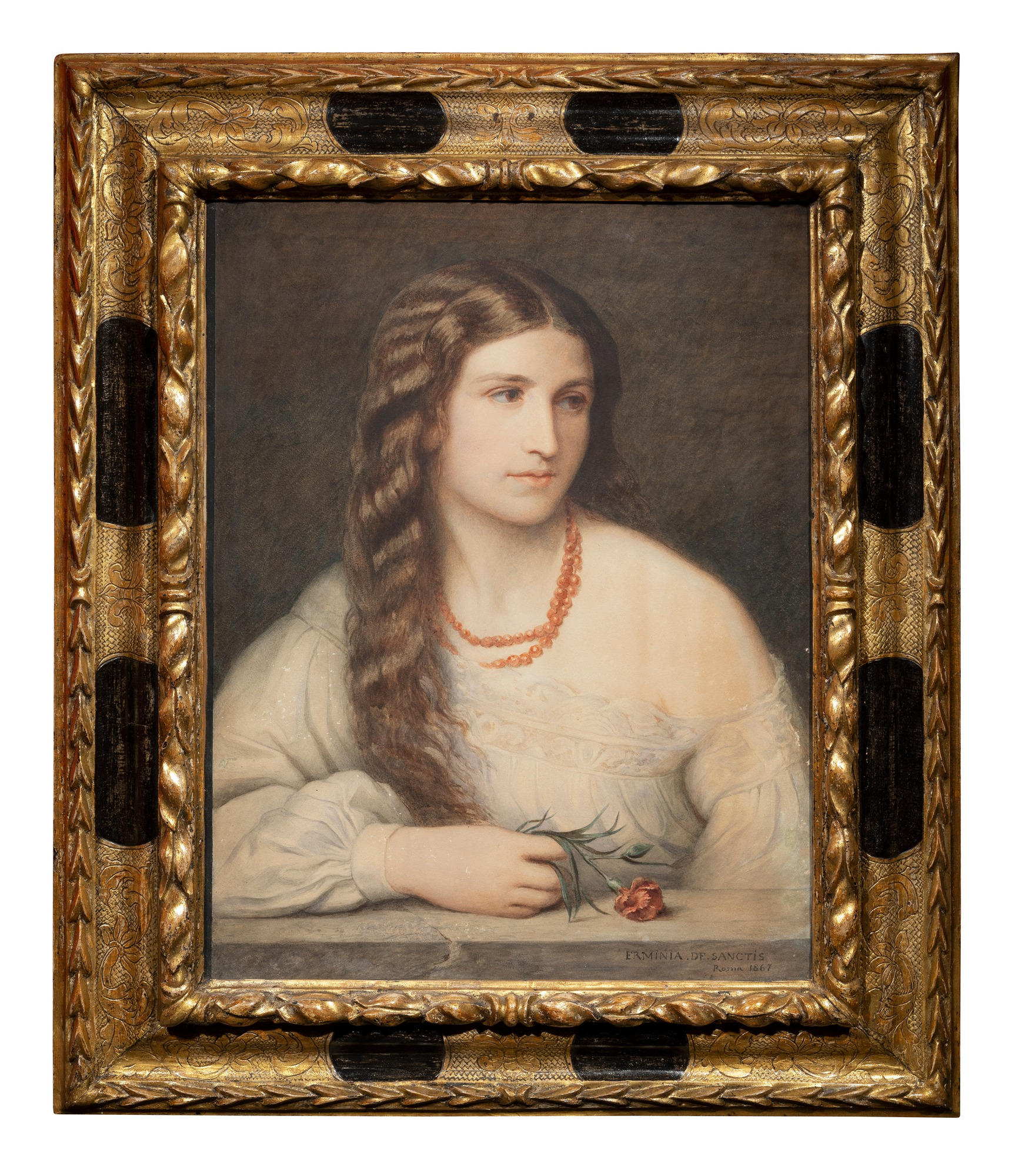


Erminia de Sanctis
b. 1840, Rome
d. 1919, Rome
Portrait of Medora (Carolina Rapazzini)
1867
Gouache on paper applied to panel
65.5 x 61 cm (25 3/4 x 24 in.)
Provenance
Corsini collection, Florence;
(Sotheby’s, Florence, Palazzo Corsini, 27 September 1994, lot 716);
Private collection, Italy.
Description
The present gouache on paper, which is both signed and dated, was executed by Erminia de Sanctis, the sister of the Roman painter Guglielmo de Sanctis (1829–1911) and a pupil of Tommaso Minardi, who specialised in the historical genre scenes and portraiture. The work comes from the noble Florentine Corsini collection; a label on the back places it with Elisabetta Corsini Stori (1876–1961) and moreover it was sold by Sotheby’s at a special sale of works from the Corsini collection held at Palazzo Corsini in Florence.
The work depicts the opera singer Carolina Rapazzini in the guise of Medora, the protagonist of Giuseppe Verdi’s opera Il Corsaro, a tragic melodrama in three acts from the libretto by Francesco Maria Pace, in turn based on the novella by George Byron, which debuted on 25 October 1848, at the Teatro Grande in Trieste. The subject here can be identified on the basis of comparison with a portrait, titled Medora precisely, painted by Guglielmo de Sanctis in 1864 and now preserved in the Museo dello Spedale degli Innocenti in Florence. The soprano was made famous by her performance of the role of Medora, the mistress of Corrado, captain of the Corsairs. Here, she is represented with lusciously unfurled hair lady, wearing a robe of diaphanous white cloth, emblematic of her innocence, though it sensuously tumbles from one shoulder. Around her neck are two strands of coral, and in one hand she holds a carnation, a symbol of youth, vitality, and the promise of love.
The figure takes its cue, with its thin white chemise and loosely flowing hair, was clearly inspired by examples from the Italy’s illustrious artistic past, in particular the beauties painted by Titian and other Venetian artists of the Renaissance. At the same time, more modern works, like Francesco Hayez’s Melancholy (Pinacoteca di Brera, Milan), seem to have offered models for the artist. Indeed, the sitter’s air of neglect or sadness not only reflects Hayez’s example, but is moreover appropriate to the character of Medora. The opera’s passionate heroine, who met her death owing to her conflicted feelings for Corrado, is nevertheless pervaded with a sense of grace and beauty, as if in an almost serene, accepting awareness that she will soon meet a tragic fate.
Erminia de Sanctis shared a studio in Via Margutta 33 in Rome, together with her brother Guglielmo. Both were significant protagonists in the Roman art scene of the second half of the nineteenth century. The strong bond between the two can be seen in the numerous paintings that the painter dedicated to his sister, and in the stylistic and compositional similarities between many of their works. Devoted mainly to the practice of watercolour, in which she painted portraits and still lifes, Erminia’s works were in great demand in her own time, especially among foreign customers.