

Victoria Dubourg
b. 1840, Paris
d. 1926, Buré
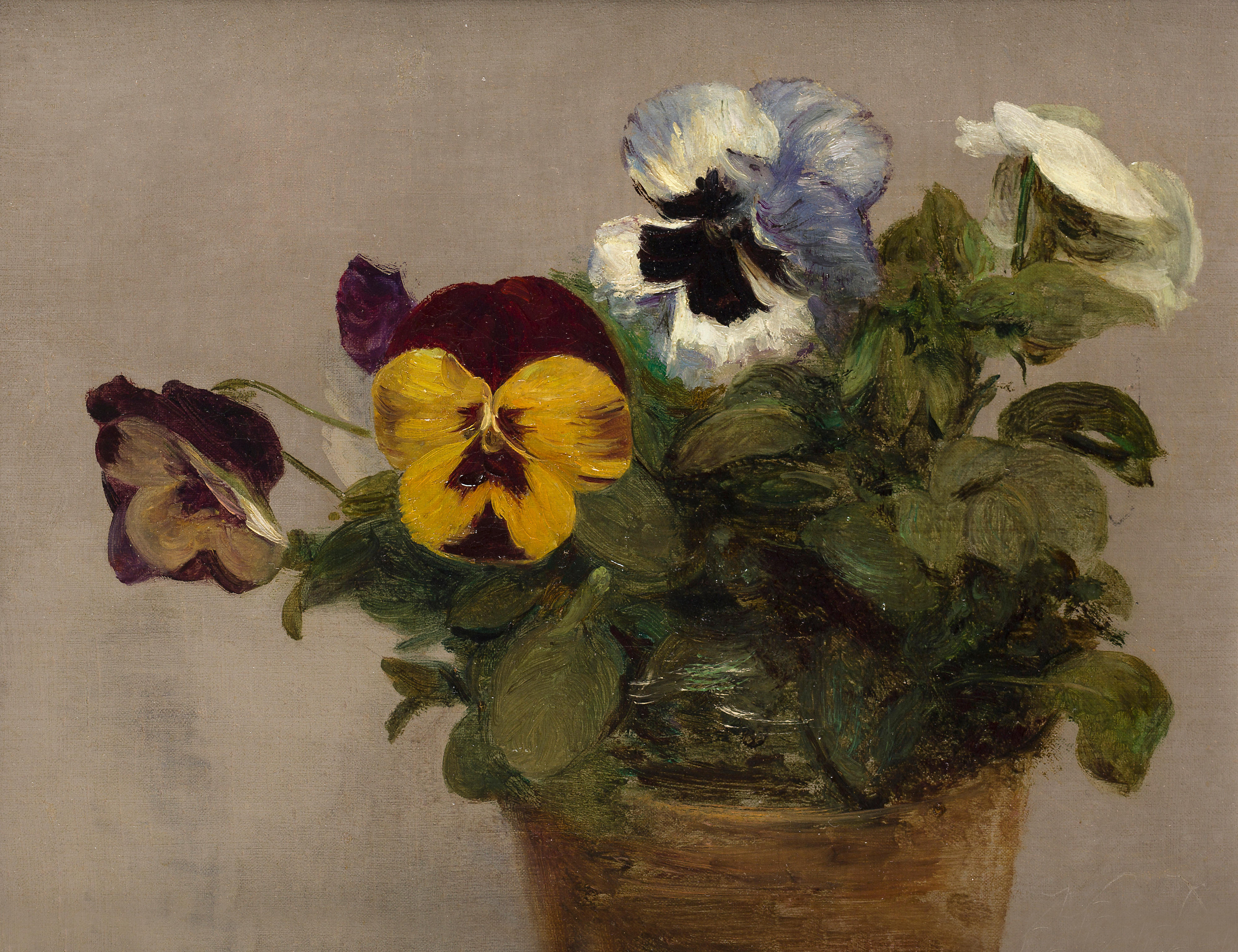
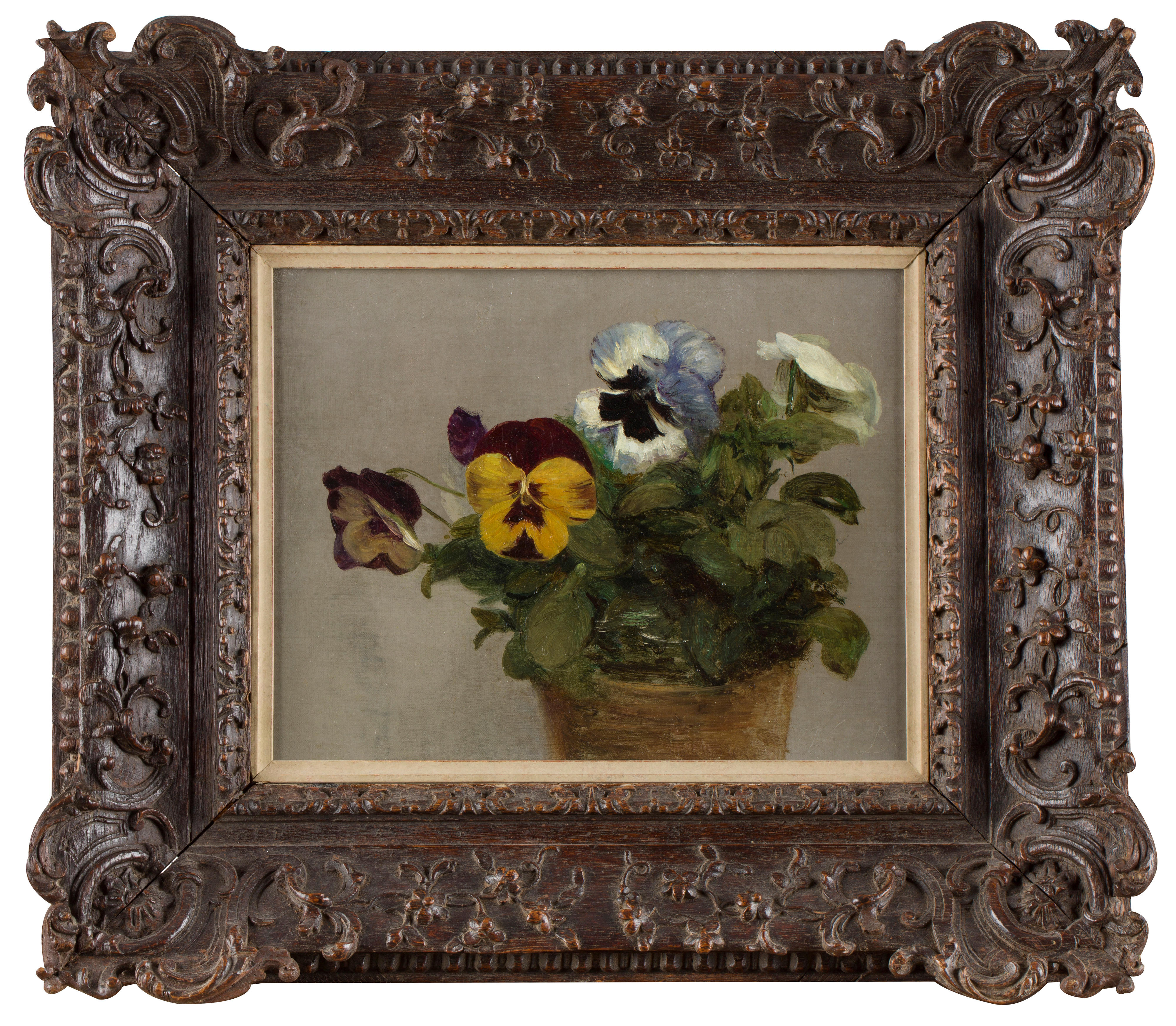
Potted Pansies
c. 1870s
Oil on canvas
21 x 26.8 cm (8 1/4 x 10 1/2 in.)
Provenance
Literature
Description
With the execution of King Louis XVI in 1793, the Louvre was transformed from a palace into an art museum, offering public access to the collection of the deposed monarchs. Artists flocked to the galleries, drawing inspiration from the art of the past. For the burgeoning number of female artists active in the nineteenth century, the Louvre offered a unique opportunity to further their artistic education, as at the time they were forbidden to study at the École des Beaux-Arts (School of Fine Arts) until 1897. Victoria Dubourg was among one of the women who obtained a permit to study the masterworks at the museum.
Meanwhile, Dubourg trained privately in the studio of artist Fanny Chéron (b. 1830) and established an independent practice in Paris by the early 1860s. Archival documentation demonstrates that place Dubourg worked at the Louvre in 1866, at which time she received an commission from the Ministry of Fine Arts to execute a replica of Pietro da Cortona’s seventeenth-century painting of the Virgin and Child with Saint Martina, for which she was paid 800 francs. This commission was part of an extensive initiative undertaken during the reign of Napoleon III, during which many of the Louvre’s holdings were copied and sent to churches and administrative offices throughout the country. Dubourg later executed a similar request to copy Titian’s Pilgrims of Emmaus, granting her a further occasion to study and copy works in the Louvre’s collection.
Such commissions offered significant financial compensation to women artists of the day, as well as providing a rare place for women—whose training was typically conducted in more private settings—to assemble and to form acquaintances with the fellow artists alongside whom they painted. In 1869 Dubourg met her future husband and collaborator, Henri Fantin-Latour (1836–1904), while both were copying Correggio’s Mystic Marriage of Saint Catherine of Alexandria (1526–27). Both artists actively socialised with the sphere of progressive artists who frequented the museum, including Édouard Manet (1832–1883), a guest at their 1875 nuptials, Berthe Morisot (1841–1895), and Edgar Degas (1834–1917), who painted Dubourg’s portrait (the painting is in the Toledo Museum of Art, while a sketch survives in the Fine Arts Museums, San Francisco).
Dubourg and Fantin-Latour became renowned for their still lifes of flowers in the latter half of the nineteenth century. Their attraction to still-life painting reflected the genre’s resurgence throughout the 1850s and 1860s and the Louvre’s acquisition of older paintings in this vein. For example, the museum began to display more works by the eighteenth-century still-life painter Jean Baptiste Siméon Chardin, like La Brioche, 1763, which entered the collection in 1869.
Modern studies of Dubourg’s production have been rather limited, typically exploring her biography as a sort of addendum to that of her husband, whose works Dubourg fastidiously documented in a catalogue raisonné published in 1918, seven years after Fantin’s death. They shared a studio space at 8 Rue des Beaux-Arts in Paris and together sourced fresh blooms to paint from the family estate in Buré, Normandy, which Dubourg inherited from an uncle. Though Dubourg and Fantin-Latour developed a similar style from working side by side, Dubourg signed the prodigious number of pictures she displayed at the annual Paris Salons and other international art exhibitions using her maiden name, perhaps in an effort to assert her unique artistic identity.
Yet despite the greater inclusion of women artists in the nineteenth-century art world, their participation was not uniformly appreciated, prompting the ire of critics like Léon Lagrange, who disparaged the amount of “petticoats perched on the ladders” he encountered during a visit to the Louvre in an article of his 1860. Lagrange’s reproachful remarks nevertheless indicate the extent to which the Louvre provided a locale for female artists to be recognized publicly for their professional achievements, study the techniques of artists of the past, and act as an invaluable resource to further their advancement in a competitive Parisian art world.
As the work resides in its original frame from the French art dealer Paul Durand-Ruel, it seems likely that the work dates from the 1870s, when Durand-Ruel acquired several works by Dubourg and Fantin-Latour.