
Francisco Pradilla Y Ortiz
b. 1848, Zaragoza
d. 1921, Madrid
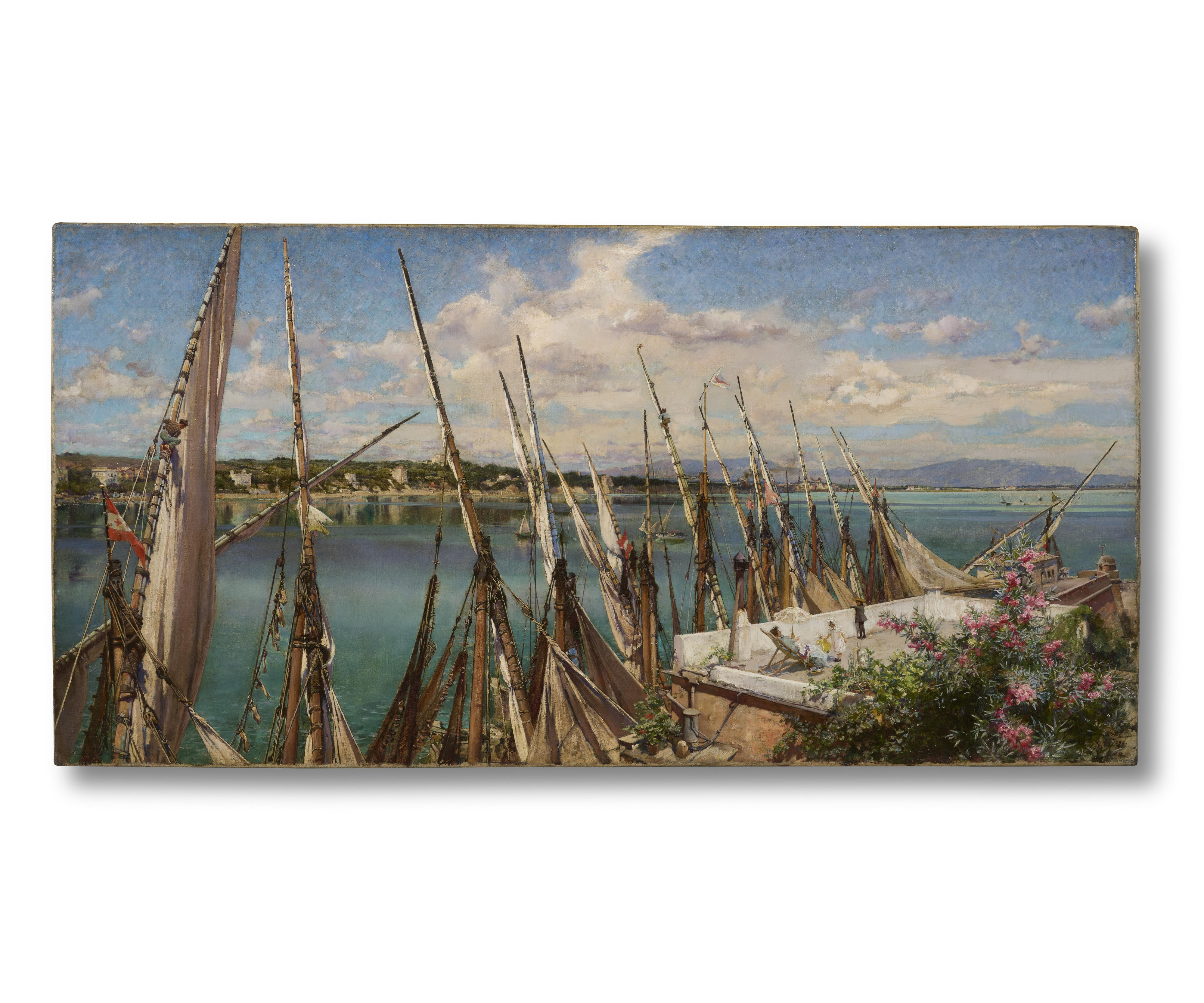
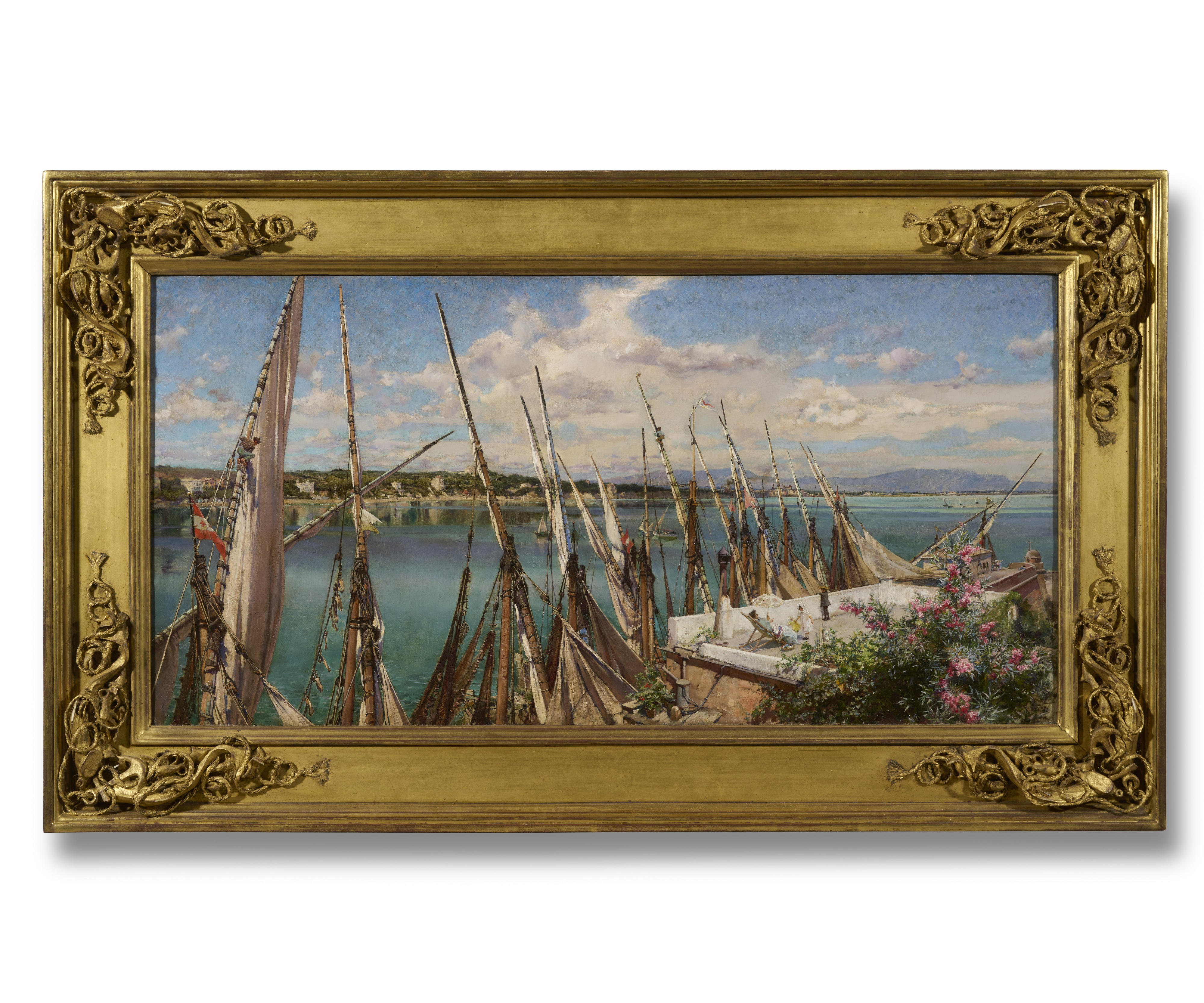
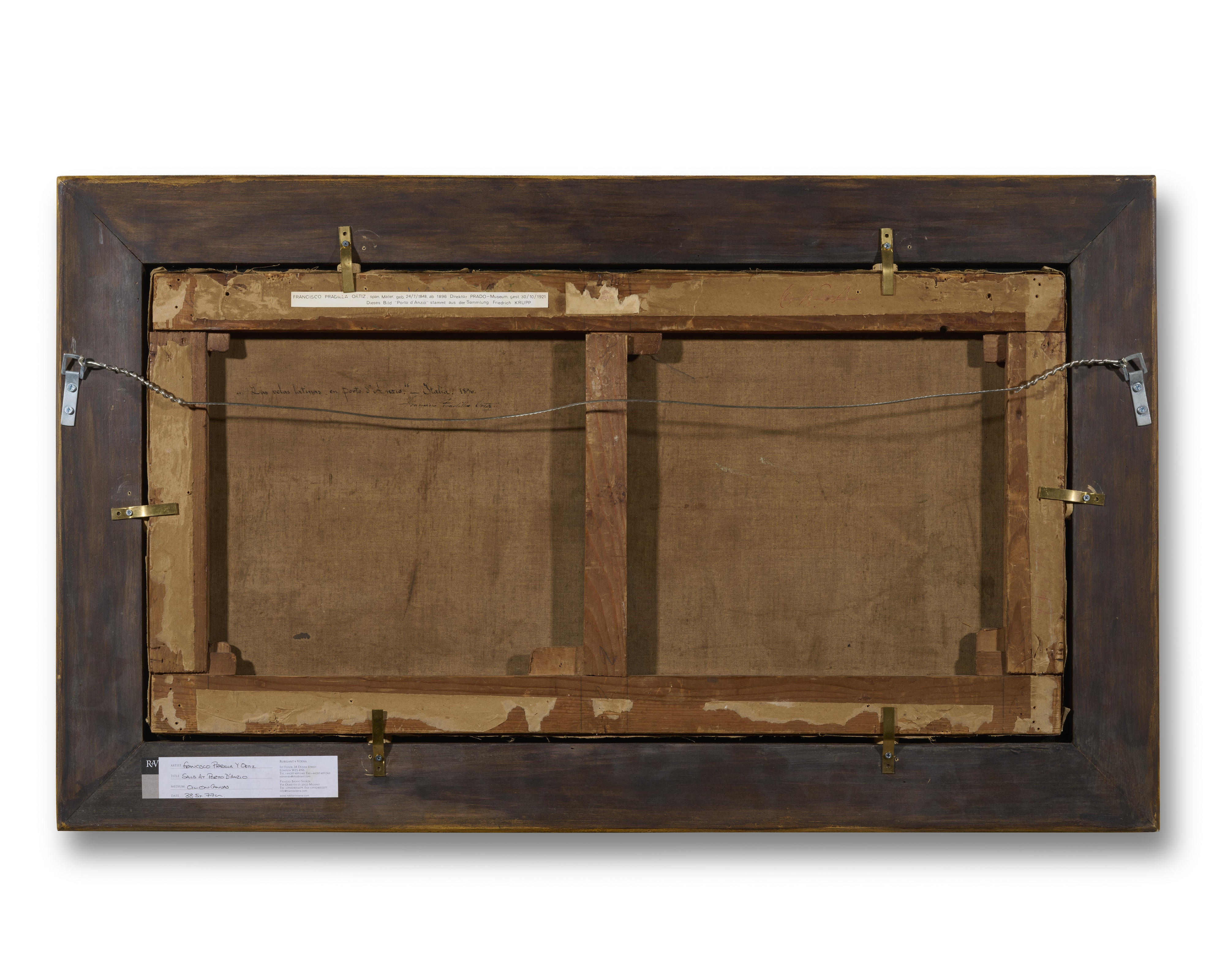
Sails at Porto d'Anzio
1896
Oil on canvas
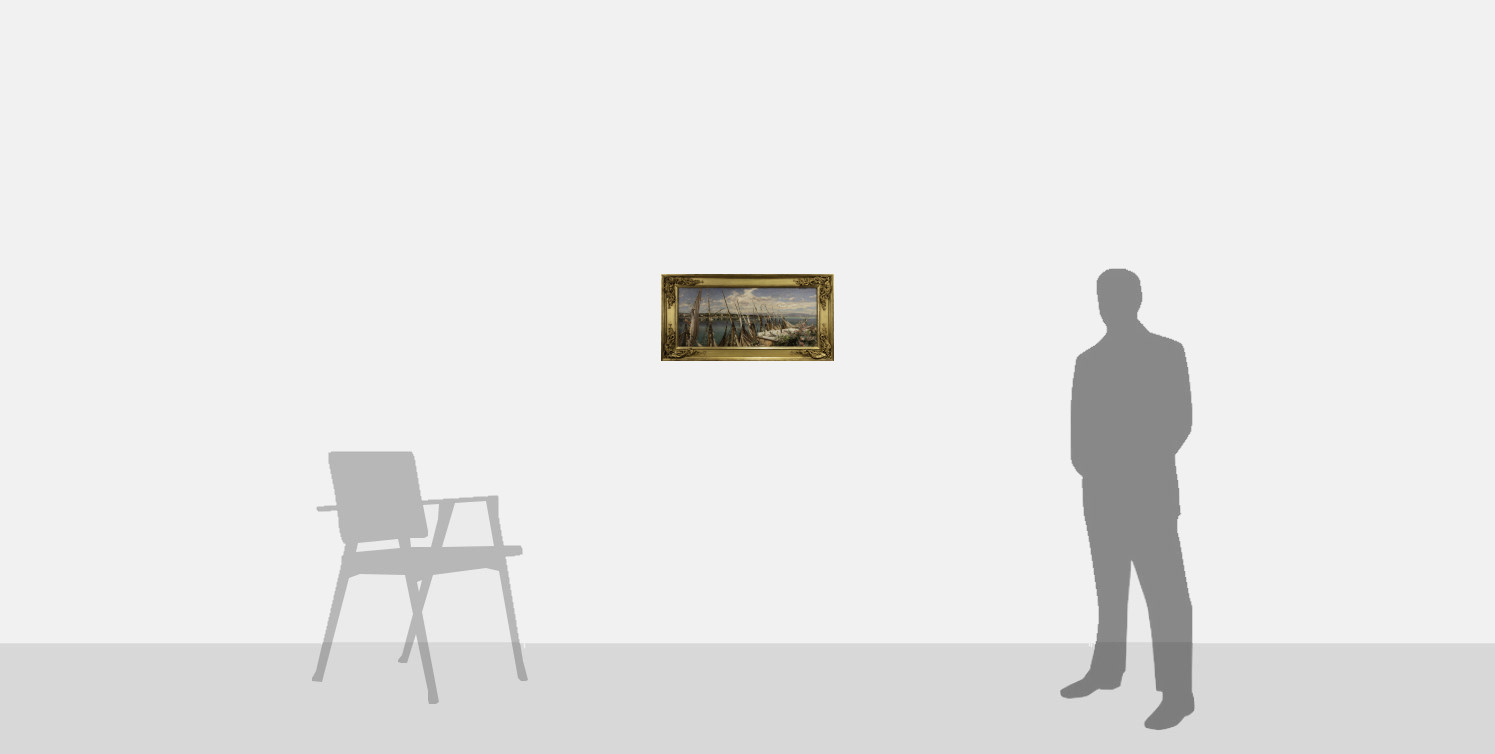
38.5 x 77 cm (15 1/8 x 30 1/4 in.)
Framed: 55 x 93 cm (21 3/4 x 36 5/8 in.)
Provenance
Friedrich Alfred Krupp collection, Germany.
Description
Francisco Pradilla y Ortiz was born to a poor family in Zaragoza, Spain. After being accepted to the local Institute of Zaragoza, he was unable to pay for his own supplies and tuition and had to end his studies there. Pradilla joined the workshop of the stage scenery painter Mariano Pescador. The work gave him the much needed money to attend the Fine Arts School in the Academia di San Luis in Zaragoza and, eventually, move to Madrid.
There, he continued to make a living painting scenery for theatres. His ambition and talent eventually won him a place in the School of Painting and Sculpture at the Academy of Fine Arts of San Fernando in Madrid. In addition to his classwork, the records of the Prado show that, beginning in 1869, he regularly visited the collection in order to copy Old Master paintings. Pradilla was heavily influenced by Velázquez, Titian, El Greco and Ribera, all of whom are well represented in the Prado Collection. Even late in life, he regularly copied Old Master paintings in order to improve his own. This was accompanied by his lifelong dedication to the study of Greek and Roman texts, along with Spanish historical documents which inspired many of his paintings. He was well noted by friends for a large library of rare books and an ability to speak several languages.
Pradilla was among the first group of students given government scholarships to study at the new Spanish Academy in Rome, founded in 1873, but opened to students in 1874. The Spanish School in Rome would become the most important centre for artistic training for Spanish painters in Italy and Pradilla would become one of its most influential students (1874-1877) and teachers (1877-1896). The culmination of each student’s study at the Spanish Academy in Rome was a large, multi-figural history painting. In Pradilla’s case his final painting, Doña Juana La Loca (Joanna the Mad), for the Academy would be an internationally-praised work, and touring several European nations as a masterpiece. While a student, Pradilla travelled extensively, visiting Venice, Florence, Milan, Pisa, Paris, and six cities in Germany.
He returned to Madrid shortly before the end of January, 1897, after being named Director of the Prado Museum. He held that post until August, 1898, when he resigned in order to dedicate himself totally to painting in a large studio at his neo-Arabic home along the Paseo de Rosales. Pradilla had obtained this mansion, in which he would pass away on 1 November, 1921, shortly after his arrival in Madrid.
By the end of his life, Francisco Pradilla y Ortiz had served as the Director of the Prado Museum, won numerous international awards, including the French Legion of Honor, and held the position of the Director of the Spanish Academy in Rome. He is best remembered for having taught the painter Joaquín Sorolla y Bastida in Rome, and for galvanising a new generation of history painters in Spain. Retrospectives of his life and works were held in Madrid (1948 and 1985) and Zaragoza (1985). Three of his major works are now held in the Prado, but the majority are held in private hands or regional museums and government buildings, especially in his native Zaragoza.
Throughout his long career and wide ranging corpus Pradilla was interested in all artistic movements of the time. Starting out from decadent romanticism, he was able to assimilate naturalist influences from French landscape artists, while understanding the preciosity of the period's painting from Rome. Pradilla's inspiration from, and interest in all that passed before his eyes resulted in his painting a wide range of subjects and themes, from large historical scenes to the local customs and characters around him.
During his time in Italy he frequently travelled the countryside and created a large number of landscape paintings, many of which were on small boards, in which his expression was often limited to sensations of colour and stormy or early morning light, as if they were sketches. Some of his landscapes were almost "preciosista" (small, highly detailed works), while others were impressionistic. The present painting was executed in 1896, the year that he retired from teaching at the Spanish Academy in Rome, and is typical of his light-flooded, detailed scenes. The tangle of sailing masts that reach across the foreground nearly mask the backdrop of the idyllically serene coastal scene stretching round to the town of Nettuno, with the foothills of the Abruzzo Apennines in the far distance. To the left of the painting, a young man sits halfway up a mast fixing a sail. To the right, a lady relaxes in a deck chair, shielding herself from the sun with a parasol, as two young children play near her. A shock of pink oleander springs up from in between the roofs, creating a fantastically bright contrast with the white of the sails and the rooftop. The looseness of the background in both the sea and sky contrast the refined depictions of the sails, flowers and people in the foreground. The warm light falls across the foreground again setting them apart from the cold multi-layered blues and greens of the sea and the dappled azures and clouds of the sky. The realistic renderings of Pradilla’s landscapes, as evident especially in this work, are testament to his fine observational skills and the acute attention to detail gives his paintings a certain signature style, something that during his time became known as the “stile Pradilla.”
see Open Document folder.
The artwork described above is subject to changes in availability and price without prior notice.
Where applicable ARR will be added.
There, he continued to make a living painting scenery for theatres. His ambition and talent eventually won him a place in the School of Painting and Sculpture at the Academy of Fine Arts of San Fernando in Madrid. In addition to his classwork, the records of the Prado show that, beginning in 1869, he regularly visited the collection in order to copy Old Master paintings. Pradilla was heavily influenced by Velázquez, Titian, El Greco and Ribera, all of whom are well represented in the Prado Collection. Even late in life, he regularly copied Old Master paintings in order to improve his own. This was accompanied by his lifelong dedication to the study of Greek and Roman texts, along with Spanish historical documents which inspired many of his paintings. He was well noted by friends for a large library of rare books and an ability to speak several languages.
Pradilla was among the first group of students given government scholarships to study at the new Spanish Academy in Rome, founded in 1873, but opened to students in 1874. The Spanish School in Rome would become the most important centre for artistic training for Spanish painters in Italy and Pradilla would become one of its most influential students (1874-1877) and teachers (1877-1896). The culmination of each student’s study at the Spanish Academy in Rome was a large, multi-figural history painting. In Pradilla’s case his final painting, Doña Juana La Loca (Joanna the Mad), for the Academy would be an internationally-praised work, and touring several European nations as a masterpiece. While a student, Pradilla travelled extensively, visiting Venice, Florence, Milan, Pisa, Paris, and six cities in Germany.
He returned to Madrid shortly before the end of January, 1897, after being named Director of the Prado Museum. He held that post until August, 1898, when he resigned in order to dedicate himself totally to painting in a large studio at his neo-Arabic home along the Paseo de Rosales. Pradilla had obtained this mansion, in which he would pass away on 1 November, 1921, shortly after his arrival in Madrid.
By the end of his life, Francisco Pradilla y Ortiz had served as the Director of the Prado Museum, won numerous international awards, including the French Legion of Honor, and held the position of the Director of the Spanish Academy in Rome. He is best remembered for having taught the painter Joaquín Sorolla y Bastida in Rome, and for galvanising a new generation of history painters in Spain. Retrospectives of his life and works were held in Madrid (1948 and 1985) and Zaragoza (1985). Three of his major works are now held in the Prado, but the majority are held in private hands or regional museums and government buildings, especially in his native Zaragoza.
Throughout his long career and wide ranging corpus Pradilla was interested in all artistic movements of the time. Starting out from decadent romanticism, he was able to assimilate naturalist influences from French landscape artists, while understanding the preciosity of the period's painting from Rome. Pradilla's inspiration from, and interest in all that passed before his eyes resulted in his painting a wide range of subjects and themes, from large historical scenes to the local customs and characters around him.
During his time in Italy he frequently travelled the countryside and created a large number of landscape paintings, many of which were on small boards, in which his expression was often limited to sensations of colour and stormy or early morning light, as if they were sketches. Some of his landscapes were almost "preciosista" (small, highly detailed works), while others were impressionistic. The present painting was executed in 1896, the year that he retired from teaching at the Spanish Academy in Rome, and is typical of his light-flooded, detailed scenes. The tangle of sailing masts that reach across the foreground nearly mask the backdrop of the idyllically serene coastal scene stretching round to the town of Nettuno, with the foothills of the Abruzzo Apennines in the far distance. To the left of the painting, a young man sits halfway up a mast fixing a sail. To the right, a lady relaxes in a deck chair, shielding herself from the sun with a parasol, as two young children play near her. A shock of pink oleander springs up from in between the roofs, creating a fantastically bright contrast with the white of the sails and the rooftop. The looseness of the background in both the sea and sky contrast the refined depictions of the sails, flowers and people in the foreground. The warm light falls across the foreground again setting them apart from the cold multi-layered blues and greens of the sea and the dappled azures and clouds of the sky. The realistic renderings of Pradilla’s landscapes, as evident especially in this work, are testament to his fine observational skills and the acute attention to detail gives his paintings a certain signature style, something that during his time became known as the “stile Pradilla.”
see Open Document folder.
The artwork described above is subject to changes in availability and price without prior notice.
Where applicable ARR will be added.