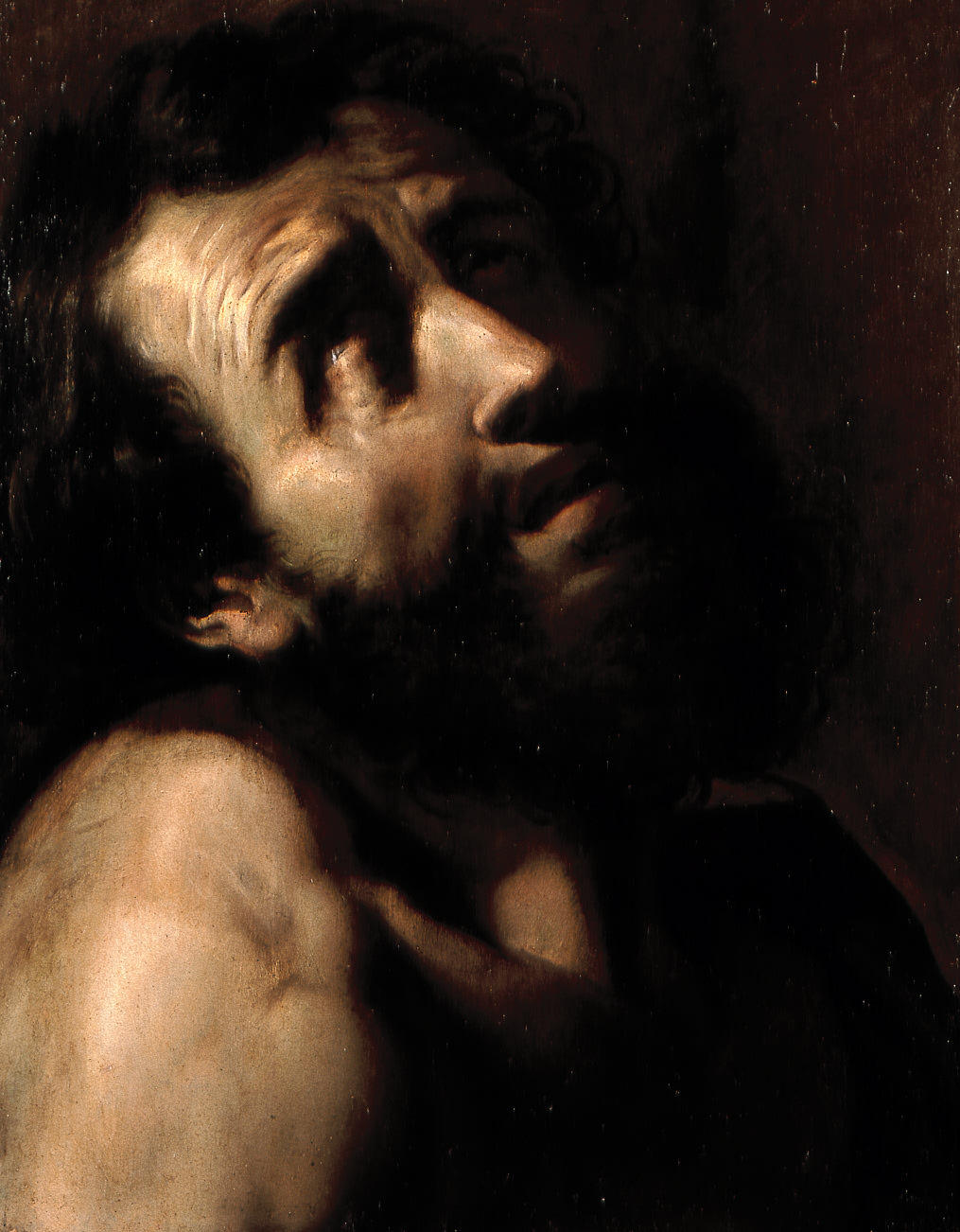


Daniele Crespi
b. 1597/98, Busto Arsizio, Lombardy
d. 1630, Milan
Saint Bartholomew
c. 1620
Oil on wood panel
50 x 39.9 cm (19 3/4 x 15 3/4 in.)
Provenance
Koelliker collection, Milan.
Literature
Nancy Ward Neilson, Daniele Crespi, Soncino, 1996, p. 64, no. 75, p.135, no. 8D.
Francesco Frangi and Alessandro Morandotti, Dipinti lombardi del Seicento: Collezione Koelliker, Milan, 2004, p. 190, no. 34.
Andrea Spiriti, ed., Daniele Crespi, un grande pittore del Seicento lombardo, exh. cat., Civiche Raccolte d’Arte di Palazzo Marliani Cicogna, Busto Arsizio, 2006, pp. 194−195.
Description
Daniele Crespi’s career was frustratingly short, as he succumbed to the plague in 1630 at age of only thirty-two, and his career was largely confined to Lombardy with a small extant output. Yet despite these limitations, Crespi’s impact on Lombard painting was profound, forging a new path from the highly exaggerated, mannered style of painters of the previous generation, including Cerano and Procaccini, towards the classicism, clarity, and directness of the Baroque visual language which was to define the rest of the seventeenth century.
In the present painting, Crespi paints a subject popular in Counter–Reformation Italy and Spain. Profoundly moving, the work portrays the apostle Saint Bartholomew’s final moments before he is to be flayed alive. The viewer is meant to empathize with Bartholomew, whose body seemingly bursts through the surface of the canvas, his face and shoulders touched by a mystical light that illuminates his flesh. His upturned gaze and open mouth bespeak an intense communion with the divine, while at the same time, his contorted physique and agonized expression allude to his torment, even though its instruments and those carrying it out are excluded from the scene. By focusing the scene entirely on the saint, the viewer cannot help but empathize with his anguish, and be transfixed by Bartholomew’s active faith.
This work by Crespi is one of two variants. The second work, which appeared on the art market in 2007, includes a secondary figure of a soldier. Both paintings were first published by Nancy Ward Neilson, who correctly described them as being on panel rather than on canvas. Neilson hypothesized that the head represented was that of Saint Bartholomew and connected it to Crespi’s lost Martyrdom of Saint Bartholomew altarpiece, known through two copies (one of which is in the sacristy of Santa Maria del Paradiso, Milan).1 Indeed the presence of a soldier armed with a knife in the other version supports the figures’ identification with Bartholomew in both panels.
Except for the presence of the soldier, both compositions are almost identical. The fact that two such similar paintings exist would suggest that neither are actually fragments, contrary to what might at first have been supposed. The looser handling of the other variant picture would point to it being the prime version; it was perhaps painted first, in preparation for Crespi’s altarpiece, kept in the studio by the artist and ‘finished’ later by adding the figure of a soldier as an afterthought. The present painting, meanwhile, might attest to the success of the figure of the saint in the altarpiece and in the variant, produced as a more highly finished work for a client desirous of a similar image. Both paintings are datable to around 1620, when Crespi’s work comes particularly close to that of his compatriot Giovanni Battista Crespi, called il Cerano.
1. Neilson 1996, p. 71, cat. no. A11, reproduced on p. 231, fig. 86B.
The artwork described above is subject to changes in availability and price without prior notice.
In the present painting, Crespi paints a subject popular in Counter–Reformation Italy and Spain. Profoundly moving, the work portrays the apostle Saint Bartholomew’s final moments before he is to be flayed alive. The viewer is meant to empathize with Bartholomew, whose body seemingly bursts through the surface of the canvas, his face and shoulders touched by a mystical light that illuminates his flesh. His upturned gaze and open mouth bespeak an intense communion with the divine, while at the same time, his contorted physique and agonized expression allude to his torment, even though its instruments and those carrying it out are excluded from the scene. By focusing the scene entirely on the saint, the viewer cannot help but empathize with his anguish, and be transfixed by Bartholomew’s active faith.
This work by Crespi is one of two variants. The second work, which appeared on the art market in 2007, includes a secondary figure of a soldier. Both paintings were first published by Nancy Ward Neilson, who correctly described them as being on panel rather than on canvas. Neilson hypothesized that the head represented was that of Saint Bartholomew and connected it to Crespi’s lost Martyrdom of Saint Bartholomew altarpiece, known through two copies (one of which is in the sacristy of Santa Maria del Paradiso, Milan).1 Indeed the presence of a soldier armed with a knife in the other version supports the figures’ identification with Bartholomew in both panels.
Except for the presence of the soldier, both compositions are almost identical. The fact that two such similar paintings exist would suggest that neither are actually fragments, contrary to what might at first have been supposed. The looser handling of the other variant picture would point to it being the prime version; it was perhaps painted first, in preparation for Crespi’s altarpiece, kept in the studio by the artist and ‘finished’ later by adding the figure of a soldier as an afterthought. The present painting, meanwhile, might attest to the success of the figure of the saint in the altarpiece and in the variant, produced as a more highly finished work for a client desirous of a similar image. Both paintings are datable to around 1620, when Crespi’s work comes particularly close to that of his compatriot Giovanni Battista Crespi, called il Cerano.
1. Neilson 1996, p. 71, cat. no. A11, reproduced on p. 231, fig. 86B.
The artwork described above is subject to changes in availability and price without prior notice.