
Bernardo Zenale
b. c. 1460, Treviglio
d. 1526, Milan
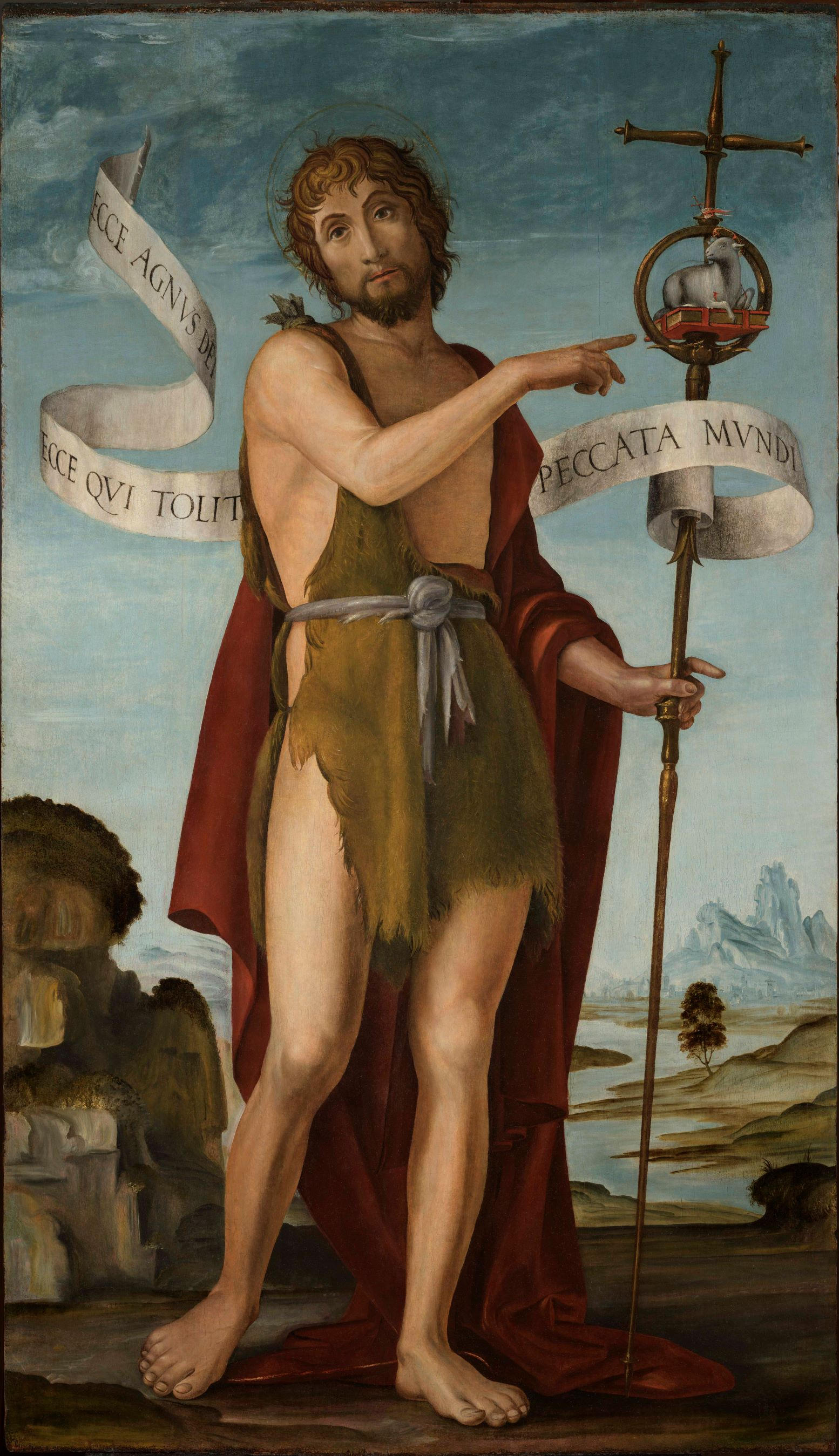
Saint John the Baptist, Standing Full Length in a Landscape
c. 1508–1510
Oil on panel
152.4 x 86.4 cm (60 x 34 in.)
Provenance
Downside Abbey, Stratton on the Fosse, Somerset,
Sotheby's, London, May 7 2020, lot 7
Description
This large panel is almost entirely filled by the monumental figure of Saint John the Baptist, depicted standing in a wild landscape with a winding river and distant mountain range. The work was omitted from studies on Lombard painting throughout the twentieth century and it was only after an auction at Sotheby's in 2020, where it was presented with the correct attribution to the painter Bernardo Zenale, that it became the subject of extensive study by Professor Stefania Buganza, which we summarise here.
The first record of the painting dates to the beginning of the 1900s. It belonged to the politician Sir Henry Hoyle Howorth (1842–1923), a member of Parliament from 1886 to 1900 and a man of culture with wide interests in antiques and history. In 1905 he donated the painting, then attributed to Lazzaro Bastiani, to Downside Abbey, a Benedictine settlement located in Somerset. The abbey kept the panel until its recent sale at Sotheby’s. It is not known when Hoyle Howorth came into possession of the painting, but correspondence between him and Charles Fairfax Murray (1848–1919), a famous art historian and marchand amateur, reveals that Fairfax Murray had seen the panel during one of his numerous visits to Florence in the last decades of the nineteenth century.
As Stefania Buganza notes, the panel has a pronounced Leonardesque character, evident in the soft naturalism in the modelling of the saint's face, his elegant and sinuous posture and the nuanced detail with which the landscape is depicted. These stylistic clues, maintains Buganza, allow us to narrow the panel’s date range with great precision, to approximately between 1508 and 1510. This period saw some of the artist's greatest achievements, from the Cantù polyptych (1507), now divided between the J.P. Getty Museum, the Poldi Pezzoli Museum and the Bagatti Valsecchi Museum, as well as the Compianto in Brescia and the Denver altarpiece. With these works, Zenale claims his place as one of the most original voices of the early Renaissance in Lombardy, on an equal footing with Bramantino, Solario and the young Luini. Moreover, his contemporaries were well aware of the artist’s high standing if what Vasari reports is correct, writing, "Bernardino da Trevio ... according to Lionardo da Vinci he was a rare master". It should also be remembered that Vasari, often disparaging towards colleagues from other schools of painting, speaks with admiration of Zenale as an "Engineer and architect of the Cathedral and a great draftsman".
This precise date has also allowed Buganza to propose
a hypothesis for the original provenance of the painting. In 1509 the first
chapel on the right at Certosa di Garegnano, a complex founded in 1349 on the
northern outskirts of Milan, was consecrated and dedicated to Saint Antonio
Abate and Saint John the Baptist. The ceiling of the chapter house at Certosa still
displays frescoes that can be traced with certainty to Zenale’s workshop. This hypothesis
requires further research, but the compelling set of circumstances suggests that
this solution to the painting’s origins is highly probable.