

Francesco Fontebasso
b. 1707, Venice
d. 1769, Venice
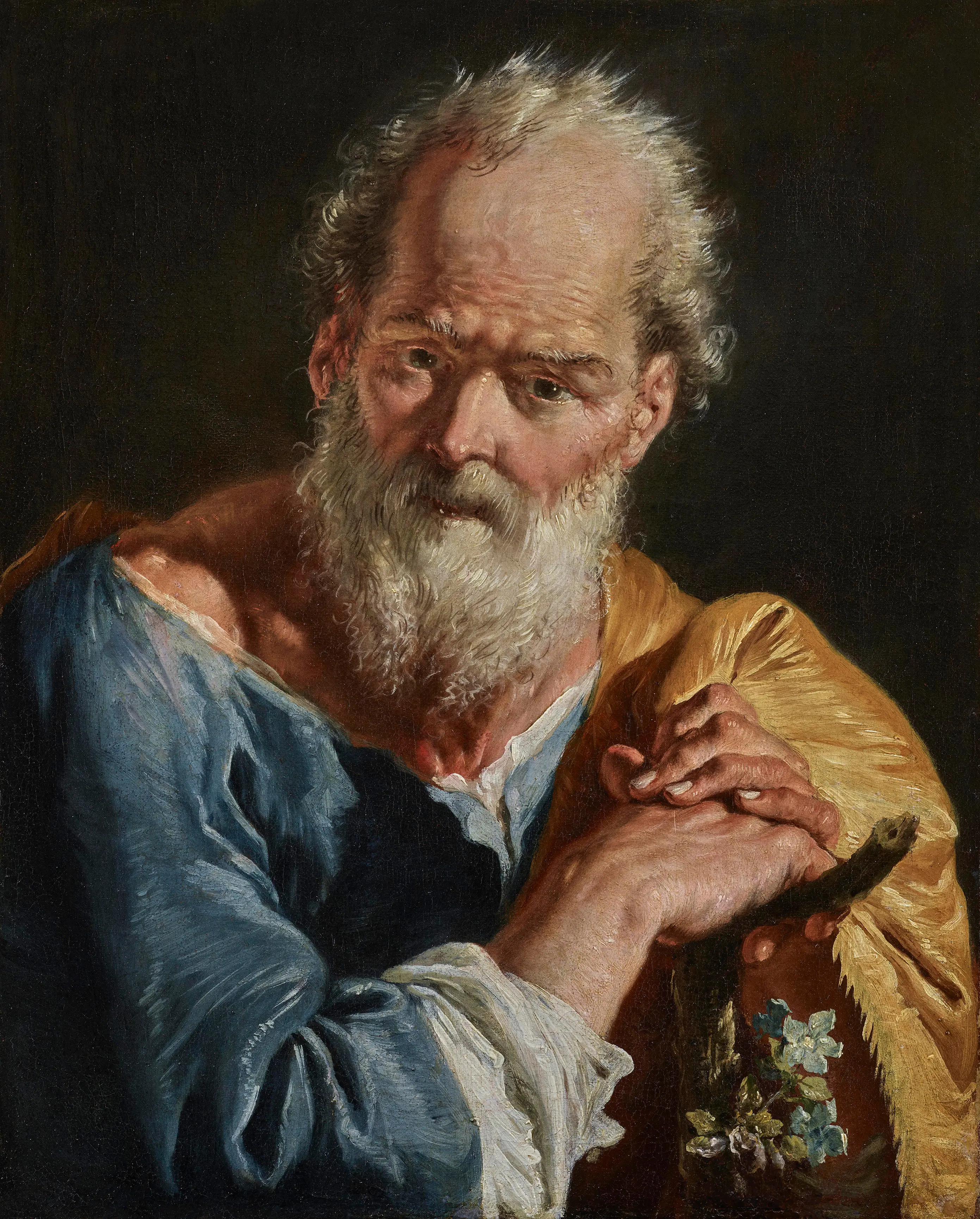
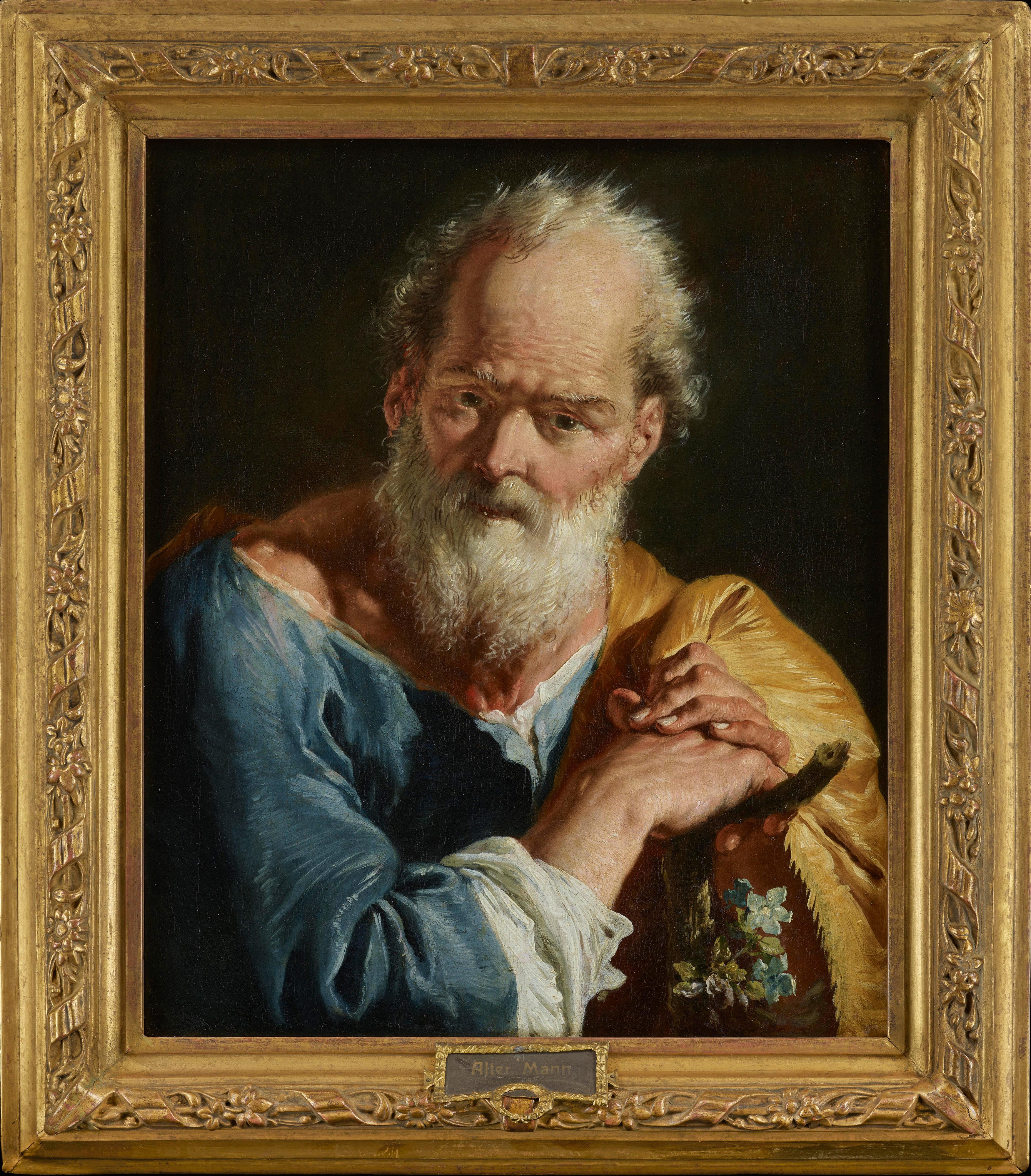
Saint Joseph
c. 1740–50
Oil on canvas
47.5 x 38.5 cm (18 3/4 x 15 1/8 in.)
Framed: 60.5 x 52 cm (23 7/8 x 20 1/2 in.)
Provenance
Herzogliches Museum Gotha (by 1835),
Foundation of the Duke of Saxe-Coburg and Gotha family, ducal art ownership, Callenberg Castle (until 2025).
Literature
C. Aldenhoven, Katalog der Herzoglichen Gemäldegalerie, Gotha 1890, p. 104, no. 543 (as by Francesco Fontebasso).
Description
Francesco Fontebasso (1707–1769) was an Italian Rococo painter, draughtsman and printmaker celebrated for his luminous color, fluid brushwork and dynamic compositions. Born in Venice, he was initially a key follower of Sebastiano Ricci (with whom he may have had his early training) and was strongly influenced by Giovanni Battista Tiepolo throughout his career. He was an adept painter of both fresco cycles and easel paintings, his works becoming highly sought after in his native city and beyond.
Fontebasso worked extensively in Venice and throughout northern Italy, undertaking decorative commissions for palaces and churches in Udine and Treviso as well as Venice. He was a founder member of the Academia Veneziana in 1755, becoming president in 1768. In 1761 he was invited to St. Petersburg, where he served as a court painter to Catherine the Great, contributed to the decoration of the Imperial Palace. In addition to painting, he produced accomplished etchings; his Various Bacchanales and Historical Scenes are, along with Tiepolo’s Capricci, the only Venetian series of etchings from this era.
This half-length depiction of Saint Joseph is remarkable in its intensity and realism. The saint is dressed in a yellow cloak and blue robe – a recurrent outfit for the saint in Fontebasso’s oeuvre – and leans on a staff which sprouts a sprig of flowers. The naturalistic details of the old man’s skin, wispy hair and beard, and his penetrating gaze show Fontebasso at his most perceptive. The dramatic fall of light from the right illuminates the figure and creates a stark contrast between the bright colours of Saint Joseph and his clothing, and the impenetrable dark of the background behind him. The energetic yet controlled brushwork exemplifies the artist’s virtuosic handling of paint, with parts of the fabric and skin described with repeated strokes in an almost hatched manner. Simultaneously, the slight stoop and curling hands distinguish Fontebasso’s ability in manipulating figures for expressive and narrative effect.
The intimate naturalism of this picture suggests that it was made from life. The same model appears in Fontebasso’s Trinità (Venice, private collection, fig. 1)[1], which Magrini relates to the likenesses in drawings in the Museum of Fine Arts, Budapest and the Courtauld Institute of Art (figs. 2–3). Indeed, a comparable figure appears in several of the master’s works, including The Flight into Egypt (Trentino, Diocesan Museum, fig. 4), The Adoration of the Shepherds (Houston, Museum of Fine Arts, fig. 5) and The Virgin appearing to Saint Jerome (Paris, Louvre, fig. 6). The Geometry Lesson, also in the Louvre (fig. 7), also depicts an aged man akin to our Joseph, this time as a secular subject.
The present painting is outstanding, however, for its profound psychological depth and physical veracity. It bears witness to Fontebasso’s acute observation on both physiognomic and emotional levels. Despite its identification as Saint Joseph, its finished quality and cropped format also links it to the Venetian tradition of teste di fantasia, with the artist likely drawing inspiration from the heads of Giovanni Battista Tiepolo (which famously also provided inspiration for his son, Giandomenico). This finished bust-length single-figure work is rare in Fontebasso’s oeuvre but not completely unprecedented: Magrini notes a Testa di Vecchio formerly attributed to Piazzetta, which is similar to our painting,[2] and San Francesco di Paolo in the Civic Museum of Padua.
The work has a rich provenance, formerly in the collections of the Dukes of Saxe-Gotha by the 19th century, where it was at first attributed to Guercino; the collections formed the basis of the Herzogliches Museum Gotha (Ducal Museum of Gotha) which was established in 1824; by 1890, Fontebasso was rightly identified as the author of the painting, as published in the catalogue of the ducal picture gallery by Carl Aldenhoven.
Fig. 1 – Francesco Fontebasso, Trinità, c. 1740–50, oil on canvas, 69 x 53 cm. Venice, private collection.
Fig. 2 – Francesco Fontebasso, Study of a head and two hands, graphite on pencil, 27.7 x 18.7 cm. Budapest, Museum of Fine Arts, inv. 5879 K.
Fig. 3 – Francesco Fontebasso, Annunciation, black chalk, pen and ink, wash and bodycolour on paper, 47.7 x 34.5 cm. London, Courtauld Gallery, D.1952.RW.226.
Fig. 4 – Francesco Fontebasso, The Flight into Egypt, 1759, oil on canvas, 164 x 128 cm. Trento, Diocesan Museum, inv. 3469.
Fig. 5 – Francesco Fontebasso, The Adoration of the Shepherds, c. 1755–60, oil on canvas, 45 x 59 cm. Houston, Museum of Fine Arts, inv. 73.1.
Fig. 6 – Francesco Fontebasso, The Virgin appearing to Saint Jerome, c. 1740–50, oil on canvas, 29 x 22 cm. Paris, Musée du Louvre, M.I.883.
Fig. 7 – Francesco Fontebasso, The Geometry Lesson, c. 1750–60, oil on canvas, 73 x 56.5 cm. Paris, Musée du Louvre, MNR 289 (on long-term loan to Tours, Musée des Beaux-Arts).
[1] Maria Magrini, Francesco Fontebasso, 1988, p. 199, no. 192, fig. 143.
[2] Ibid, p. 113, no. 1.