

Carlo Dolci
b. 1616, Florence
d. 1686, Florence
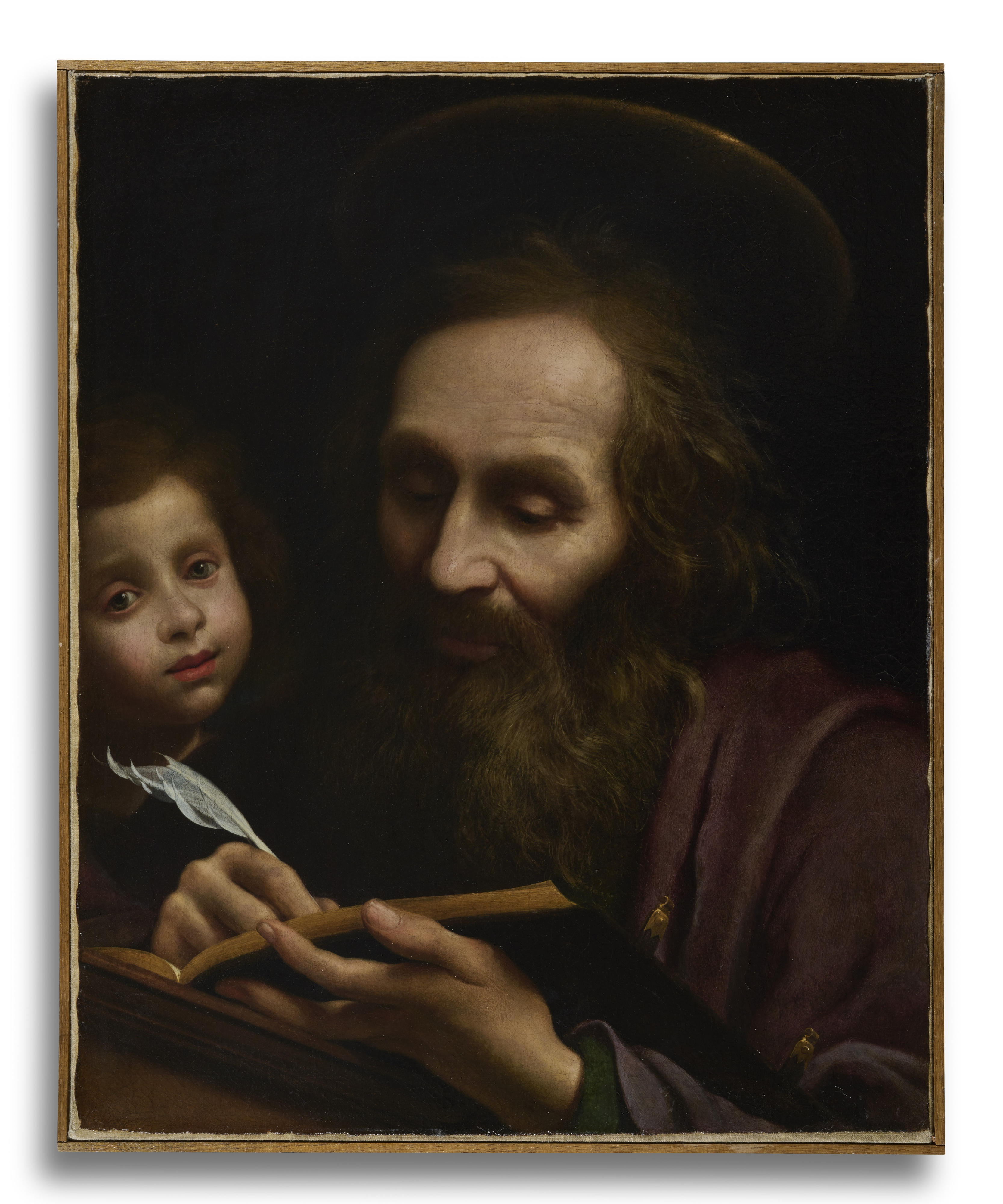
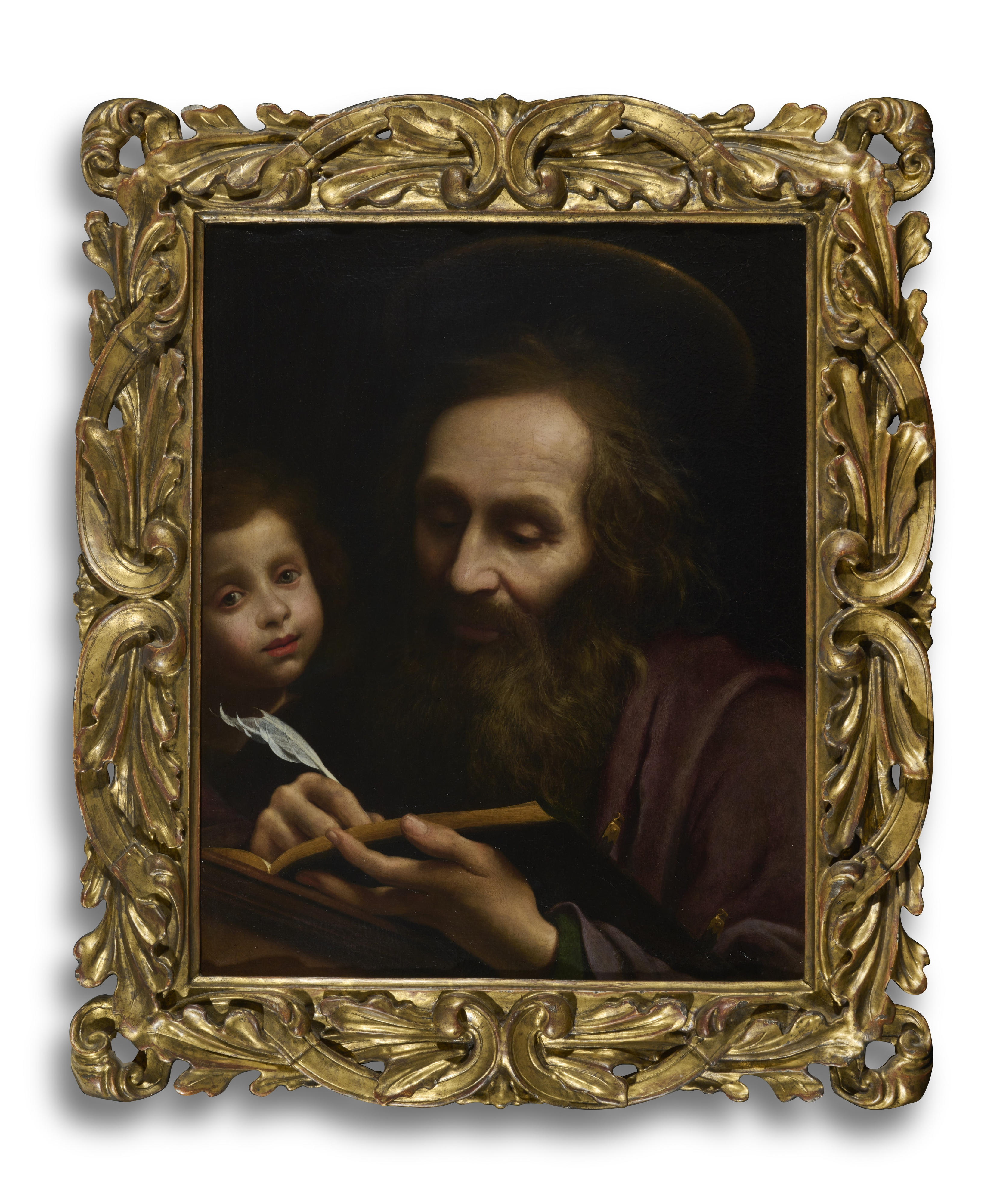
Saint Matthew and the Angel
1640s
Oil on canvas
57 x 46 cm (22 1/2 x 18 1/8 in.)
With frame: 73.5 x 62.5 cm (29 x 24 5/8 in.)
Provenance
Sotheby’s, London, 8 March 1972, lot 32,
Private collection.
Literature
F. Baldassari, Carlo Dolci, Turin, 1995, pp. 73-75, fig. 37a.
F. Baldassari, Carlo Dolci. Complete Catalogue of the Paintings, Florence, 2015, p. 143, fig. 48a.
Description
Meditation, piety and silence often characterise the protagonists of Carlo Dolci's paintings; they emerge from dark backgrounds in carefully rendered detail, with each element, from the fabrics they wear to the objects they hold to their very flesh delineated with extraordinary precision and refinement. As noted by his pupil and close friend, Filippo Baldinucci, Dolci was himself a reflective, meditative person and a careful observer of nature, and these facets of his character deeply informed his desire to create works which forge an emotional connection between the represented subject and the viewer.
The young Dolci trained at the grand ducal court in Florence in the early 1630s, and there came into contact with artists like Jacopo Vignali, as well as studying the painters of the previous generation such as Gregorio Pagani and Cigoli. By the early 1640s Dolci had reached full artistic maturity, producing refined and sophisticated works like the cycle of Evangelists on octagonal canvases (F. Baldassari, 2015, pp. 128-133, nos. 39-41) and the two versions of the Madonna and Child with a Lily (Musée Fabre, Montpellier and Alte Pinakothek, Munich, F. Baldassari, 2015, pp. 138-141, nos. 45-46).
Also belonging to this period is a series of Apostles, all executed on small-format panels (40 x 27 cm). These half-length figures, shown close-up, were painted by the artist for Francesco di Giovanni Quartesi in 1643. To date, four panels from this cycle are known. Saint Peter, Matthew and the Angel (of which this is another version), and James the Lesser are in the Ducrot collection in Rome, while Saint John the Evangelist is in the Pushkin Museum in Moscow (F. Baldassari, 2015, pp. 142-145, nos. 47-50). To these should be added a Saint Andrew and a Saint Thomas, for which payments are recorded, though the works remain untraced. As was often the case with his most successful works, Dolci replicated these figures in other versions, of which our painting is a fine example. John the Evangelist is repeated in a painting on copper now preserved at the John and Mable Ringling Museum of Art in Sarasota, Florida, while the Saint Matthew is replicated in the present work, on a slightly larger canvas than the panel in the Ducrot collection.
In this composition Dolci employed bold colours, especially in the saint's pink cloak, and creates a deliberate contrast between the absorbed attitude of the apostle, intent on writing the Gospel, and the languid pose assumed by the angel, whose gaze is turned toward the viewer, thus making him a participant in the dialogue between the two protagonists of the painting.