

Nicolas Regnier
b. c. 1590, Maubeuge, Spanish Netherlands
d. 1667, Venice
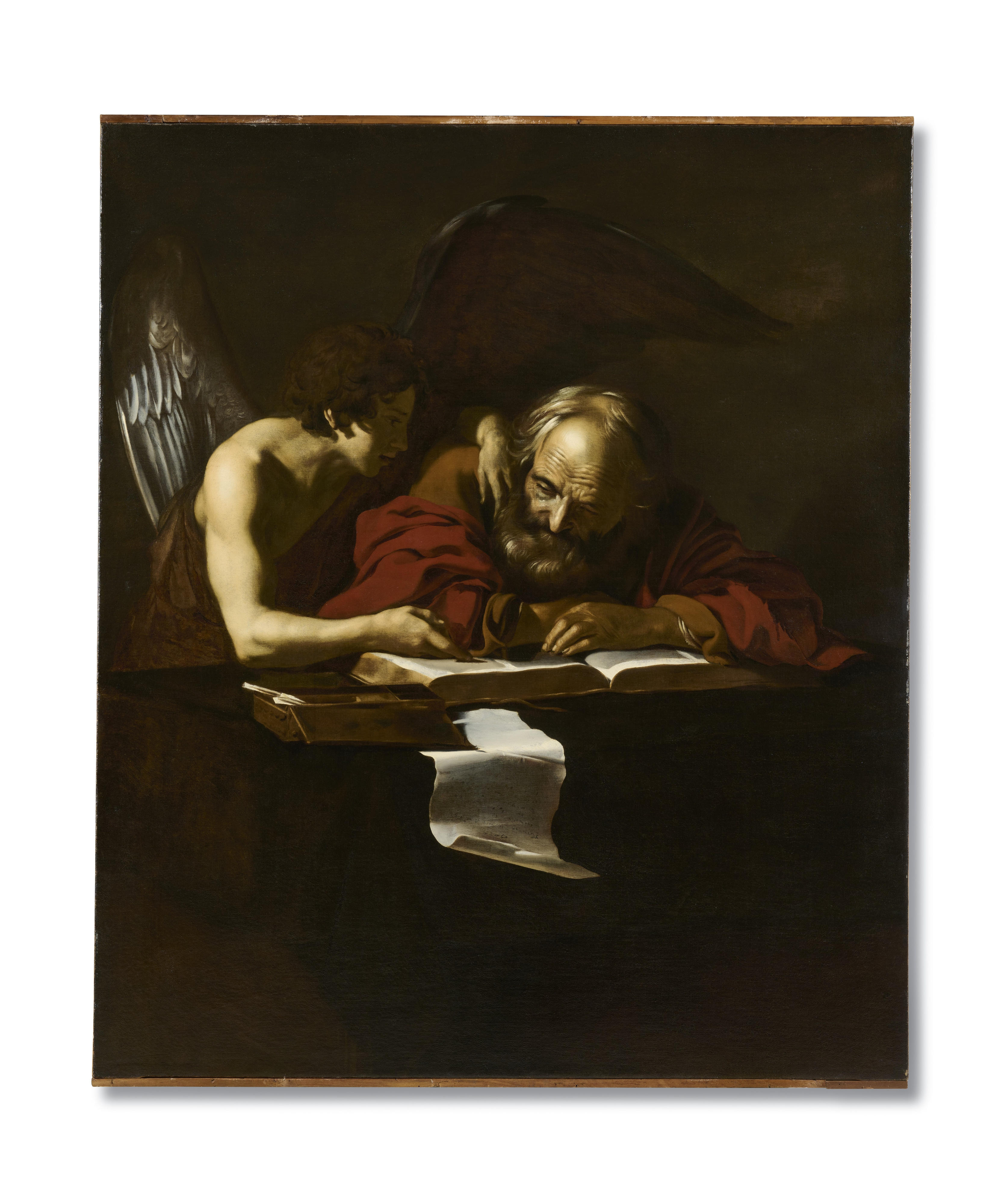
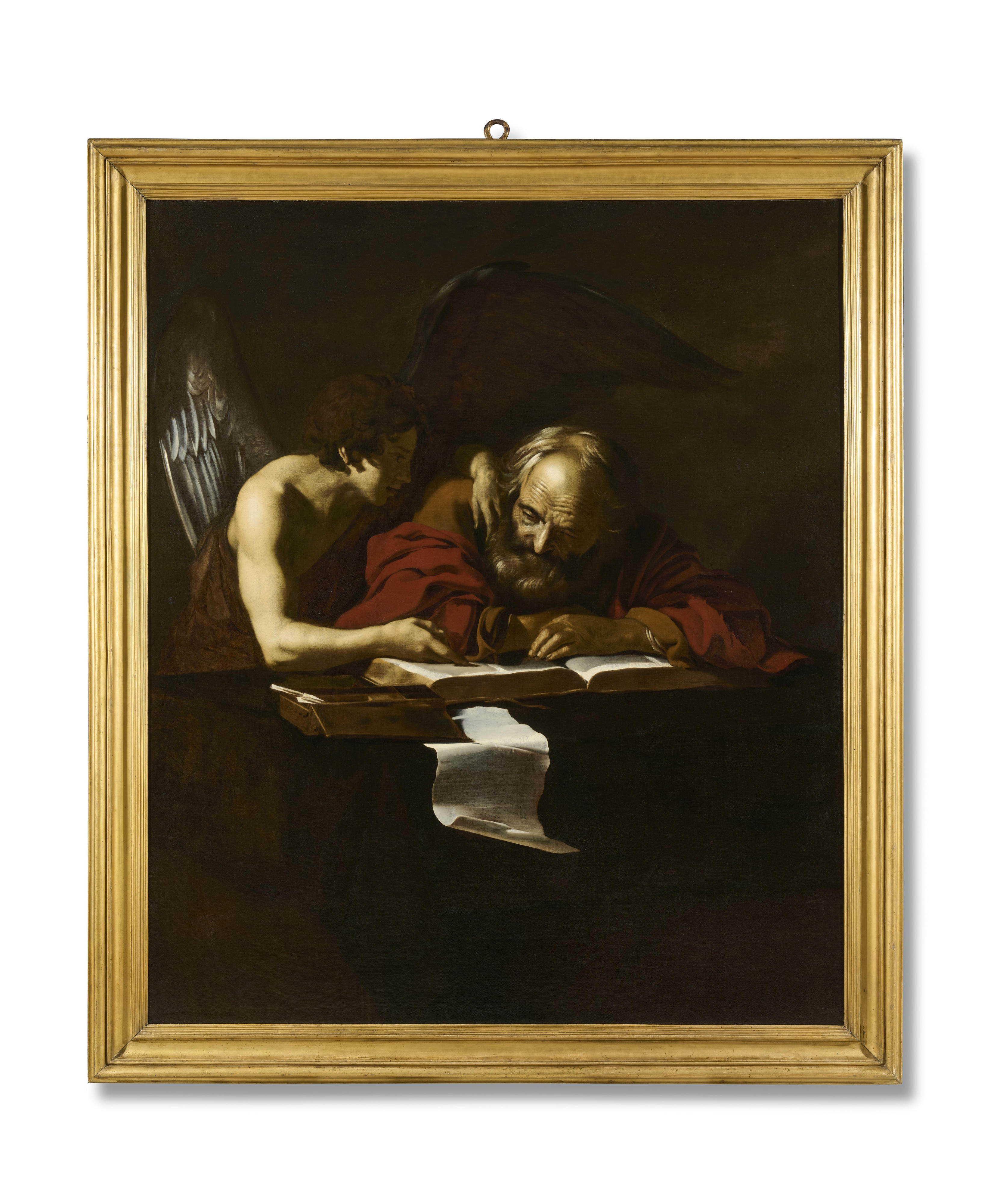
Saint Matthew and the Angel
c. 1615–17
Oil on canvas
165 x 141.5 cm (65 x 55 3/4 in.)
With frame: 190 x 160 x 10 cm (74 3/4 x 63 x 4 in.)
Provenance
Private collection, South America,
Koelliker collection, Milan.
Literature
A. Lemoine, Nicolas Regnier (alias Niccolò Renieri) ca. 1588–1667. Peintre, collectioneur et marchand d’art, Paris, 2007, p. 334, no. R 38bis.
N. Spinosa, Caravaggism and the Baroque in Europe, exhibition catalogue, London, 2007, pp. 20–21.
P. Cavazzini, 'Peintre à Rome au tournant de Seicento' in S. Levy, A. Lemoine and A. Collange Perugi (eds.), Nicolas Régnier l’homme libre v. 1588–1667, exhibition catalogue, Nantes, 2017, pp. 63, 100.
Description
So
closely is he associated with the brilliant group of French Caravaggisti active
in Rome in the early decades of the seventeenth century that Nicolas Régnier’s
Flemish origins and early tracaining in Antwerp are often forgotten.[1]
He was a pupil of Abraham Janssens, whose own work had already done much to
disseminate the early influence of the Italian Baroque in the North, and whose
pupils included some of the most important Flemish tenebrist painters.
Régnier’s biographer and friend Joachim von Sandrart noted that upon his
arrival in Rome, around 1615, he frequented the studio of Bartolomeo Manfredi,
who was to be a continued influence on his style.
Saint Matthew and the Angel dates
from around 1615–17. The figure of the elderly Evangelist is depicted slumped
over his writing desk as if just roused from sleep by an adolescent angel who
rests his hand on the saint’s shoulder. The composition and dramatic
chiaroscuro with which it is rendered recall the first Saint Matthew and the Angel that Caravaggio painted in 1602 for
the Contarelli chapel in San Luigi dei Francesi in Rome. Famously rejected
because of the supposedly indecorous pose of the saint, the painting was subsequently
purchased by Vincenzo Giustiniani, one of the greatest collectors of the day.
It is a picture which Régnier would have known very well; Giustiniani was one
of Régnier’s most important patrons, and the artist lodged in Palazzo
Giustiniani for part of his time in Rome. It certainly would have served
Régnier as an inspiration for his own depictions of the subject. Among the nine
canvases by the artist listed in the Giustiniani inventory of 1638, there is
one depicting “S. Matteo [di mano di Nicolò Ranieri]…. in tela alta palmi 11 ½
Larga 9 ½ incirca senza cornici .”[2]
The Giustiniani Saint Matthew has yet
to be identified (and cannot be associated with the present canvas), though
other treatments of this subject dating from the years prior to the artist’s
departure from Rome circa 1626 are extant. Perhaps the most compelling
comparison with the present work may be made with the example in the collection
of the Ringling Museum of Art, Sarasota, Florida, generally dated to around
1622–25 (fig. 1).
Previously attributed to the Neapolitan artist Battistello Caracciolo, the present
work was first given an attribution to Régnier at Sotheby’s in 2007 (New York,
25 January 2007, lot 48). In the same year, Annick Lemoine published the first
comprehensive monograph on the French artist. At the time she had only seen the
painting in the Sotheby’s catalogue and preferred to publish the painting in
the section of attributed works. Ten years later, on the occasion of
Robilant+Voena’s exhibition In Pursuit of Caravaggio, it was finally
possible for Lemoine to study the painting first-hand and she confirmed its
autograph status, dating it to the very early years of the artist’s stay in
Italy, around 1615–17. This attribution was further confirmed by Lemoine and
Patrizia Cavazzini in the catalogue of the monographic exhibition dedicated to Régnier
in Nantes in 2017.
[1] Régnier was born in the town of Maubeuge, then in the French speaking Flemish province of Hainaut, which was later ceded to France in the Treaty of Nijmegen in 1678.
[2] [Trans: "St. Matthew (by the hand of Nicolo Raineri) on canvas about 11 1.2 palmi high by 9 ½ across, unframed"]. The painting was hung in the same room with three other canvases representing the other evangelists by Domenichino, Reni and Albani. It might be supposed that the canvases formed an impromptu set, even though the Reni was of a slightly smaller size, and the other three were of matching measurements. Of all the canvases, only the Domenichino of Saint John the Evangelist is identifiable (see R. Spear, Domenichino, New Haven and London 1982, pp. 270–72). See also S. Danesi Squarzina, La collezione Giustiniani, Turin 2003, vol. I, pp. 343–44.