
Luca Giordano
b. 1634, Naples, Italy
d. 1705, Naples, Italy
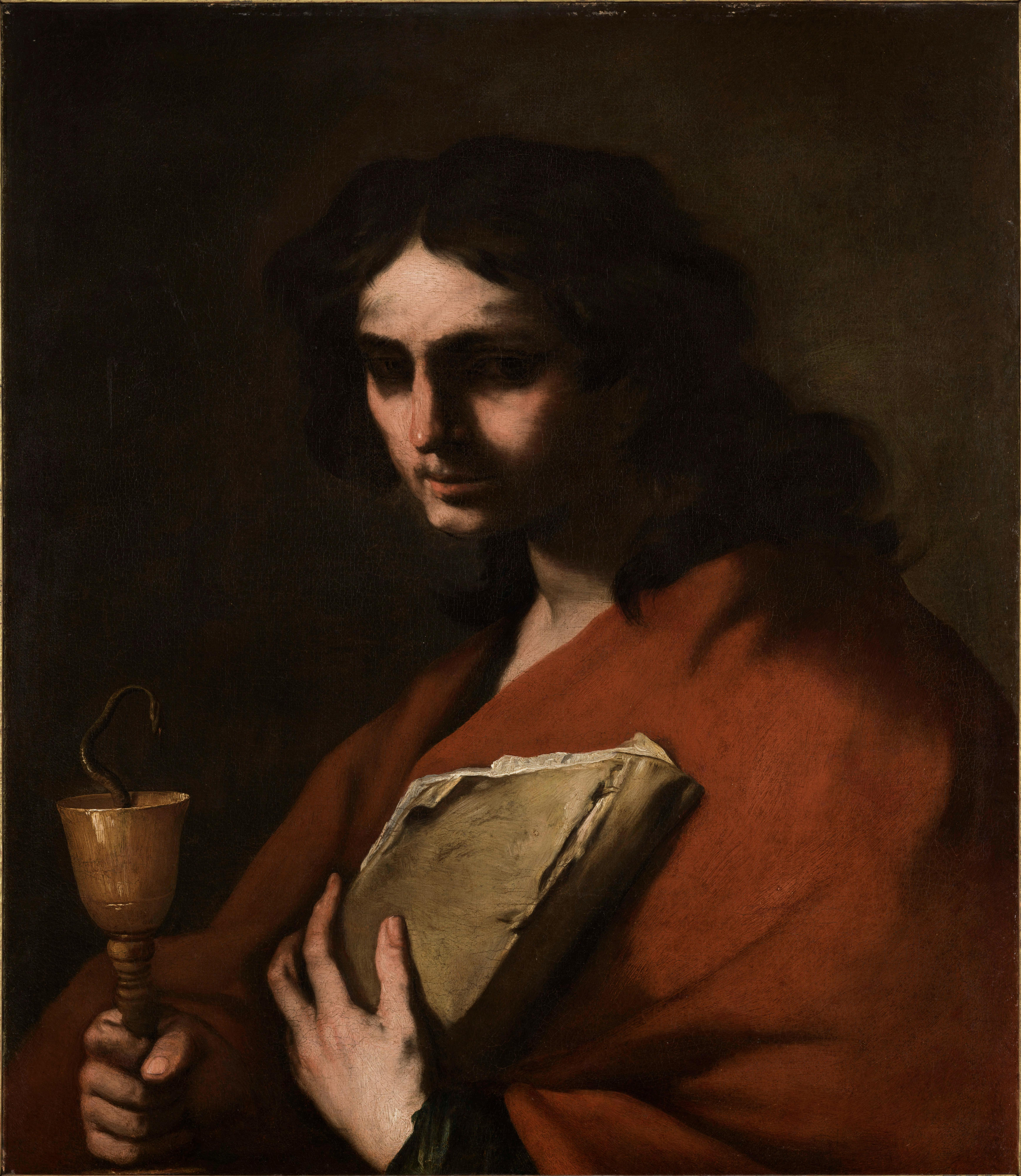
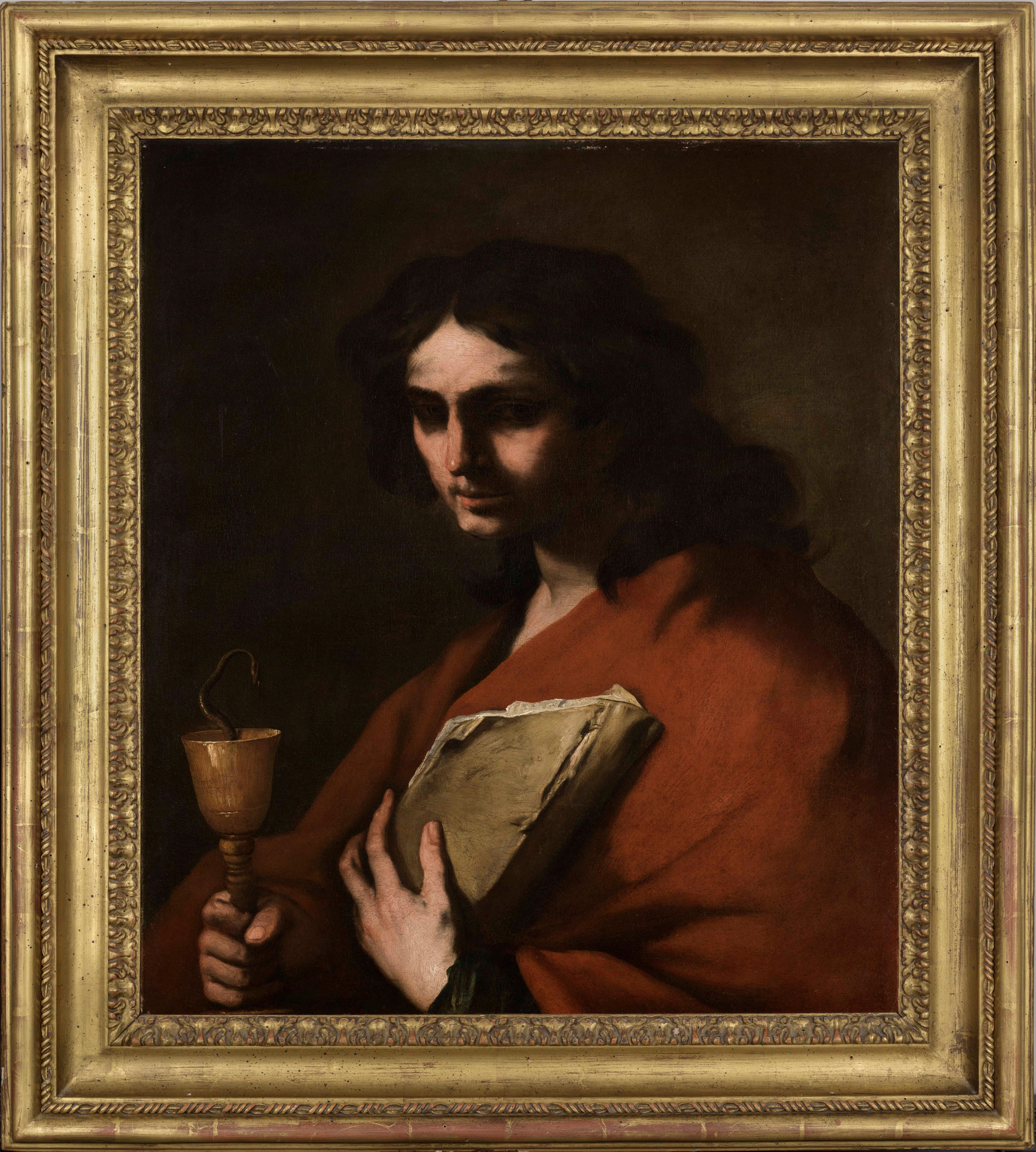
Self-portrait as Saint John the Evangelist
c. 1665
Oil on canvas
74 x 63 cm (29 1/8 x 24 3/4 in.)
With frame: 95.5 x 85 x 6.5 cm
Provenance
Literature
R. Lattuada, 'Un “San Giovanni Evangelista” giovanile di Luca Giordano per Lauro Magnani', in L. Stagno and D. Sanguineti (eds.), Il tempio delle Arti. Scritti per Lauro Magnani, Genoa, 2022, pp. 294-297.
Description
During his long career Luca Giordano painted many self-portraits; it has been noted that Giordano and Rembrandt were the artists who painted the largest number of self-portraits during the 17th century and that it is thus possible to follow the development of their physical appearance throughout their lives, with these works as evidence.
The earliest self-portrait by Giordano is generally considered the Self-Portrait as a Cynic Philosopher, now in the collections of the Alte Pinakothek in Münich (fig. 1). As early as by the middle of the 17th century, D’Argenville described this painting and its pendant as being a self-portrait of the artist and a portrait of his father. One of the most famous examples, and probably his last image, is the Self- Portrait of the Pio Monte della Misericordia in Naples, in which he depicts himself as an old man wearing glasses.
A recent survey of Giordano self-portraits has been published by Riccardo Lattuada (‘Breve saggio su autoritrattti e ritratti di Luca Giordano e qualche nota sugli autoritratti di Tiziano, Tintoretto, Annibale, Vouet, Cantarini, Bernini e Grechetto’, in G. Brevetti (ed.), La fantasia e la storia. Studi di storia dell’arte sul ritratto dal Medioevo al contemporaneo, Palermo, 2019, pp. 70 – 93).
More recently, the same scholar published the present painting: here Giordano chooses to represent himself as Saint John the Evangelist. The Saint is portrayed in his youth, dressed with a red cloak and holding a book in his left arm (a clear reference to his writings: the Gospel, the Book of the Apocalypse, and the Letters). In the other hand Saint John holds a chalice, from which appears a small snake. The chalice and the snake are also traditional attributes of this Saint: in the Legenda Aurea, Jacopo da Varagine recounts that, once arrived in Ephesus, John started to preach Christianity, and the goldsmiths and the priests of the Temple of Diana tried to kill him. Aristodemus, the high priest of Diana, asked to the Saint to worship Diana and gave him a goblet with poisoned wine. Before drinking the wine, Saint John made the sign of the cross over the goblet, causing a snake to appear from the vessel and slither away. Impressed by the miracle, Aristodemus and his followers turned to Christianity.
The present painting, as suggested by Riccardo Lattuada, should be dated to around 1660. Two stylistic features clearly appear in the work; the model of Jusepe de Ribera and his harsh naturalism, and the interest towards the Venetian school of painting and its taste for rich colourism. The same features appears in other works of the same period, such as the Penitent Mary Magdalen (with Lullo – Pampoulides, London) and another self-portrait, this time a Self-Portrait as a Stoic Philosopher (Private collection, fig. 2), where also the physical features are extremely similar.
Fig. 1: Luca Giordano, Self-Portrait as a Cynic Philosopher, c. 1650/53, oil on canvas, 131 x 103 cm. Münich, Alte Pinakothek.
Fig. 2: Luca Giordano, Self-Portrait as a Stoic Philosopher, Private Collection.