
Hyacinthe Rigaud
b. 1659, Perpignan
d. 1743, Paris
Self-portrait
c. 1711
Oil on canvas
81.5 x 64 cm (32 1/8 x 25 1/4 in.)
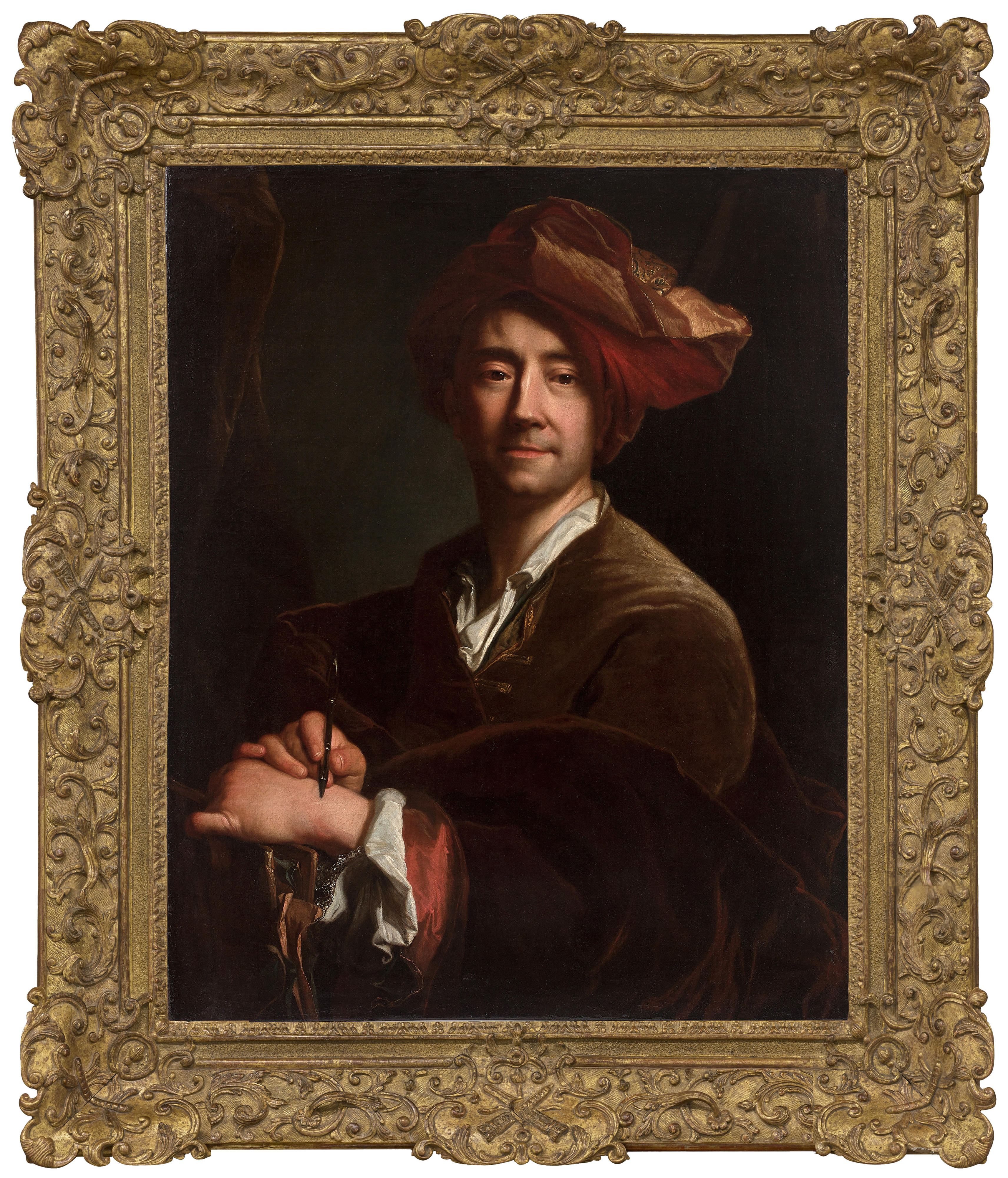
Framed: 105.5 x 91.5 x 10.2 cm (41.5 x 36 x 4 in.)
Provenance
Literature
Description
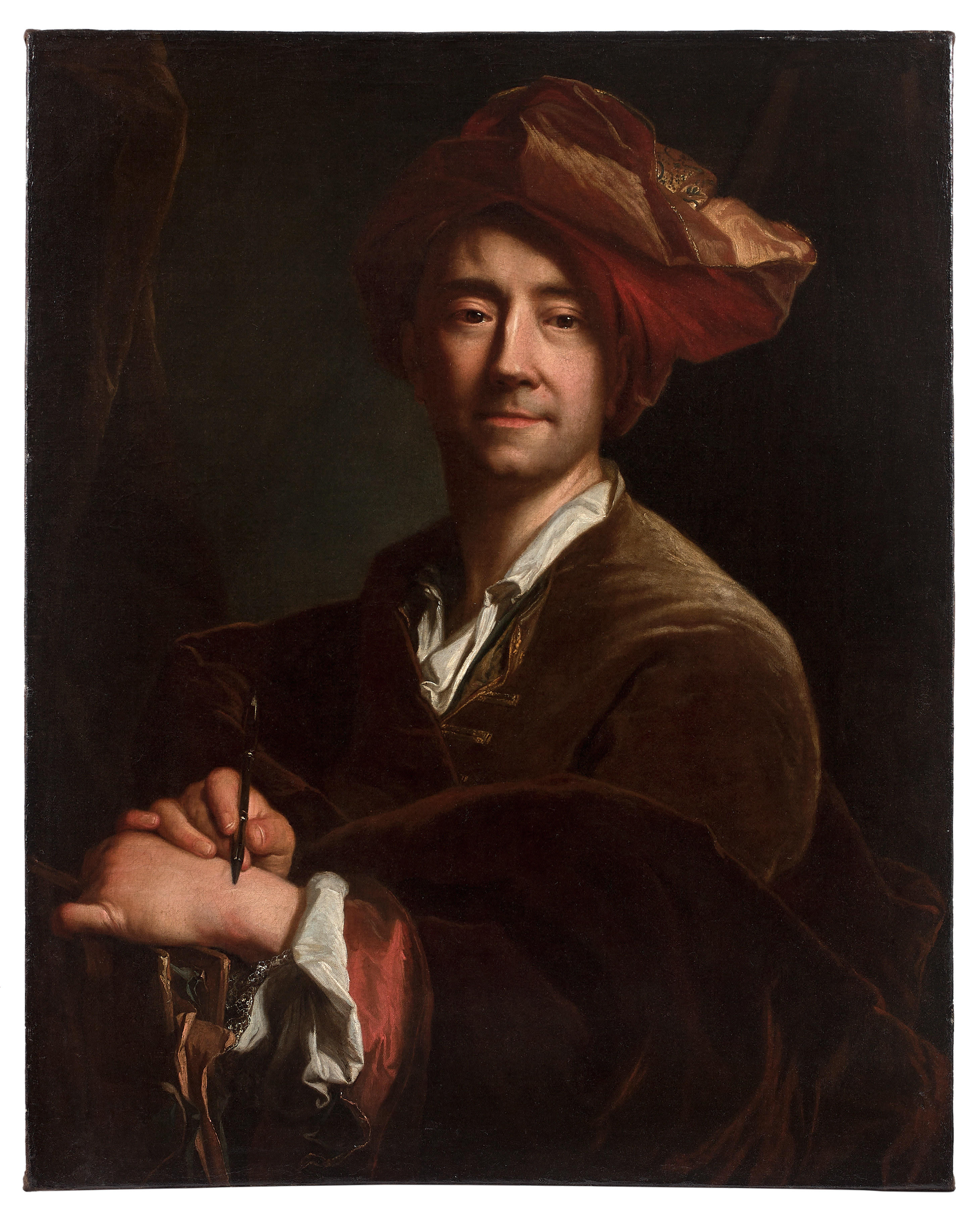
Renowned in his lifetime as the “French Van Dyck” and sought after by European courts for his extraordinary skill in capturing likeness and conveying the natural elegance of attire, Rigaud had to meet a constantly growing demand for his image throughout his career. His early self-portraits, more intimate in nature, were intended solely for his private circle, albeit his so-called Self-Portrait with a Turban, painted in 1698 and now held in Perpignan at the Musée Hyacinthe Rigaud, saw extensive replication and dissemination in print. While another self-portrait, known as the Academy Self-Portrait or Self-portrait with a Portrait of His Wife, would not achieve similar fame until the years 1727–42(1), the Self-Portrait with a Mechanical Pencil - of which this is the only known autograph copy - holds a particularly significant place in his oeuvre. Created shortly after the Self-Portrait with Black Ribbon of 1710(2), in which the artist depicted himself with his palette, torso turned to the left and adorned (thanks to a later addition) with the ribbon of the Order of Saint Michel acquired in 1727, this portrait precedes by only a few years the Self-Portrait with Palette, painted in 1716 as a gift for Duke Cosimo III de’ Medici in Florence(3). While the latter is essentially an adaptation of the 1698 Self-portrait with a turban, with revised features and changes to attire and hairstyle, the Self-Portrait with a Mechanical Pencil is an entirely original creation. Commissioned by Louis Malpenée (1656-1747), Lord of Assenay, a dedicated art collector(4), Rigaud, much like Largillierre received a similar commission, devised a new pose. Now housed in the collections of the Château de Versailles et de Trianon(5), and once owned by the famed collector Jean de Julienne, who later bequeathed it to the Royal Academy, the original canvas bears an autograph inscription on the reverse, providing both its date and provenance: “hyacinthe Rigaud. Ecuyer noble citoyen de Perpignan / Professeur de lacadémie Royalle de Peinture / Sculpture, peint par luy même / donné à son amy Mons[ieu]r Dassenet / le 10 juin 1711” (Hyacinthe Rigaud, Esquire, noble citizen of Perpignan, Professor of the Royal Academy of Painting and Sculpture, painted by himself, given to his friend Mr. Dassenet on June 10, 1711).
With his face forward and torso turned to the left, the artist depicts himself within a staged interior. On the right, an easel supports a blank canvas, and on the left there is a brown velvet curtain. Dressed in a jacket of a similar hue, lined with blue silk and trimmed in gold along the edges and buttonholes, he is enveloped by the deep red-brown velvet folds of his cloak, draped over his arms. The sweeping movement of the fabric, from left to right, mirrors the motion of the silk-lined brocade bonnet (which artists commonly wore to protect their shaved heads once their wigs were removed), imparting a dynamic sense of motion to the work.
In a natural and relaxed pose, the artist’s hands rest in the foreground on a portfolio holding various slightly crumpled sheets of brownish and blue paper. While his right hand prominently holds a silver mechanical pencil, ready for use, the fingers of his left hand holds firmly onto the portfolio. The elegance of this arrangement, which Rigaud would partially reuse two years later for his portrait of the royal preacher Antoine Anselme(6), allows the painter to dedicate particular attention to this part of the composition. Indeed, it is the only section of the painting, along with the face, that is bathed in bright light, thus drawing the viewer’s attention directly towards this passage. The choice of the pencil is not incidental, as it reflects the artist's advocacy of drawing - he who also aligned himself with the colourists during the famed quarrel that divided artists in the final years of the seventeenth century. These luminous focal points are further accentuated by the contrasting darkness of the rest of the composition, showing a chiaroscuro that Rigaud cherished and that resonate as a homage to Northern painting, particularly to Rembrandt, whose works he collected.
The creation date of our copy must have been very close to that of the Versailles version, as the work quickly left the studio to be displayed on the walls of its patron. Rigaud thus swiftly transitioned to another type of self-portrait by 1716. Although some archival records indicate that copies of this 1711 version and its “pendant” by Largillierre may have been produced(7), only one reduced-format copy has been known until now(8). With a somewhat cold execution that prevents it from being considered a work made directly under Rigaud’s direction, it nonetheless holds interest as it incorporates slight variations introduced by the master in our version compared to the original painting at Versailles. In certain areas of our the present painting, one senses the possible involvement of one of his trusted assistants - particularly in the filling of the cloak, the flat colour areas of the bonnet, or the sketching of certain parts of the facial modelling. However, Rigaud himself carefully applied the final touches. This is evident in the intricate passages of contrasting colour, whether in the arrangement of the folds of the protruding cotton sleeves or in the cracks in the leather of the right edge of the drawing board, which at Versailles remains pristine, free of wear. Malpenée greatly appreciated the Self-Portrait with a Mechanical Pencil. The collector had it engraved by Pierre Drevet in 1721, accompanied by a dedication informing the public of his friendship with Rigaud(9). In his portrait painted by Largillierre - now lost but known through a small-format replica(10) - Malpenée had himself depicted holding the engraving commissioned from Drevet prominently, with only a hint of another print by Chéreau from 1715, after Largillierre’s self-portrait, also commissioned by Malpenée in 1711, peeking out from a stack of papers arranged on the table before him.
Stéphan Perreau, January 2024 (translated from French)
Fig. 1 – Hyacinthe Rigaud, Self-Portrait, 1711, oil on canvas, 80.5 x 63.6 cm. Chateau de Versailles, MV 5825.
Notes
1 Engraving by Jean Daullé for his admission to the Academy on 20 June 1742; Perreau, 2013, cat. *P.1436, p. 302–03.
2 Perpignan, Musée Rigaud; Inv. 820-1-2, Perreau, 2013, cat. P.1345, p. 276.
3 Florence, Uffizi Gallery, Vasari Corridor; Inv. 1857 - A759, Perreau, 2013, cat. P.1249, p. 251.
4 As early as 1717, Germain Brice noted that Malpenée had assembled “several works by the most skilled modern masters, selected with discerning taste,” and that one could see at his residence “works by Rigault and Largillierre, of particular beauty, which greatly honour these great painters” in Description of the City of Paris and all that it contains of note [...] enriched with a new plan and new illustrations accurately drawn and engraved, Eighth edition, Paris, Fournier, II, 1725, p. 76.
5 Inv. MV5825, Perreau, 2013, cat. P.1123, p. 227–28.
6 Toulouse, Musée des Augustins. Perreau, 2013, cat. P.1183, p. 236–37.
7 Marriage contract of Pierre Villebois, Paris, National Archives, central registry of Parisian notaries, study IV, 565, 3 February 1750. Cited by Rambaud, 1971, p. 946.
8 Middlebury College Museum of Art (États-Unis), A. Johnson Memorial Gallery, inv. 1986.049.
9 “hyacinthus rigaud Eques in Regia Picturæ / Academia Professor. / Tabulam in qua se ipse pinxit, amico dedit ludovico. / Dassenet ; grati animi amicus cælari curavit ; sous le trait carré à gauche, Hyacint.s Rigaud pinxit ; à droite, P. Dr.evet Sculpsit”, Perreau, 2013, cat. P.1123, p. 227–28.
10 Perreau, 2004, p. 140–42