
Gianni Colombo
b. 1937, Milan, Italy
d. 1993, Melzo, Italy
Spazio Elastico–Due Cubi (Elastic Space–Two Cubes)
1967
Aluminum and an electric engine
48.5 x 50 x 15 cm (19 1/8 x 19 3/4 x 5 7/8 in.)
Provenance
Galleria dell’Annunciata, Milan;
Studio Casoli, Milan;
Private collection.
Description
Gianni Colombo, a key figure in the rise of Kinetic art in the 1950s and 1960s, worked in diverse media, including painting, sculpture, furniture design, and light installation. A founder of the art movement Gruppo T, Colombo believed art must be kinetic and participatory, and aimed to create works and interactive spaces that eliminated the static boundaries dividing painting, sculpture, and architecture. In 1968, Colombo won first prize at the Venice Biennale with his 1967 work Spazio Elastico (Elastic Space), an interactive piece in which viewers enter a darkened room and are confronted by a shifting cube of luminescent elastic strings. This would ultimately become his most famous work (it was remounted at the 2011 Venice Biennale). Throughout his career, Colombo was interested in perception, specifically the perception of a reality understood in terms of continual change. In an age of cybernetics, systems theory, and feedback, Colombo approached art in terms of the interaction between objects and viewer in an ongoing feedback loop. Deploying simple mechanisms and materials, Colombo’s objects make a crucial point: art that thinks about contemporary technology need not fully embrace that technology.
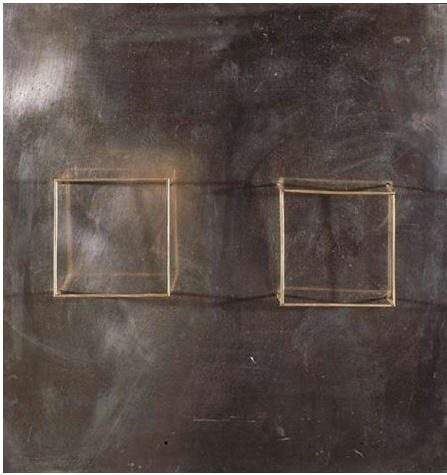
In Gianni Colombo’s 1967 work Spazio elastico—due cubi (Elastic space—two cubes), the outline of two cubes sinks into a metallic surface in slow motion. The effect of movement is further enhanced by the reflectivity of the metal panel. The work is made of a flat, metal surface, and eight holes in the metal plate allow eight metal tubes in the shape of two cubes to be pulled in and out. The back-and-forth movement of the cubes is created by two small, synchronized, single-phase motors. Inside the work, each cube is attached to a plastic plate. Each motor moves two levers, which in turn move two small wheels, raising and lowering the plastic plates, thereby moving the cubes up and down.
The works is, in a sense, made of nothing—pure invention brings unassuming materials to life. Once it is in motion, it fully engages the surrounding environment. A concatenation of geometric images, sometimes twisted, then immediately transformed into figures that are more regular, delineate the space around it studied speed, exciting anticipation of the next move; thus, Colombo sought to act on perception. Two elements are at the core of Colombo's work: construction and illusion. In the case of the latter, the observer is the definitive protagonist.
The artwork described above is subject to changes in availability and price without prior notice. Where applicable ARR will be added.
In Gianni Colombo’s 1967 work Spazio elastico—due cubi (Elastic space—two cubes), the outline of two cubes sinks into a metallic surface in slow motion. The effect of movement is further enhanced by the reflectivity of the metal panel. The work is made of a flat, metal surface, and eight holes in the metal plate allow eight metal tubes in the shape of two cubes to be pulled in and out. The back-and-forth movement of the cubes is created by two small, synchronized, single-phase motors. Inside the work, each cube is attached to a plastic plate. Each motor moves two levers, which in turn move two small wheels, raising and lowering the plastic plates, thereby moving the cubes up and down.
The works is, in a sense, made of nothing—pure invention brings unassuming materials to life. Once it is in motion, it fully engages the surrounding environment. A concatenation of geometric images, sometimes twisted, then immediately transformed into figures that are more regular, delineate the space around it studied speed, exciting anticipation of the next move; thus, Colombo sought to act on perception. Two elements are at the core of Colombo's work: construction and illusion. In the case of the latter, the observer is the definitive protagonist.
The artwork described above is subject to changes in availability and price without prior notice. Where applicable ARR will be added.
