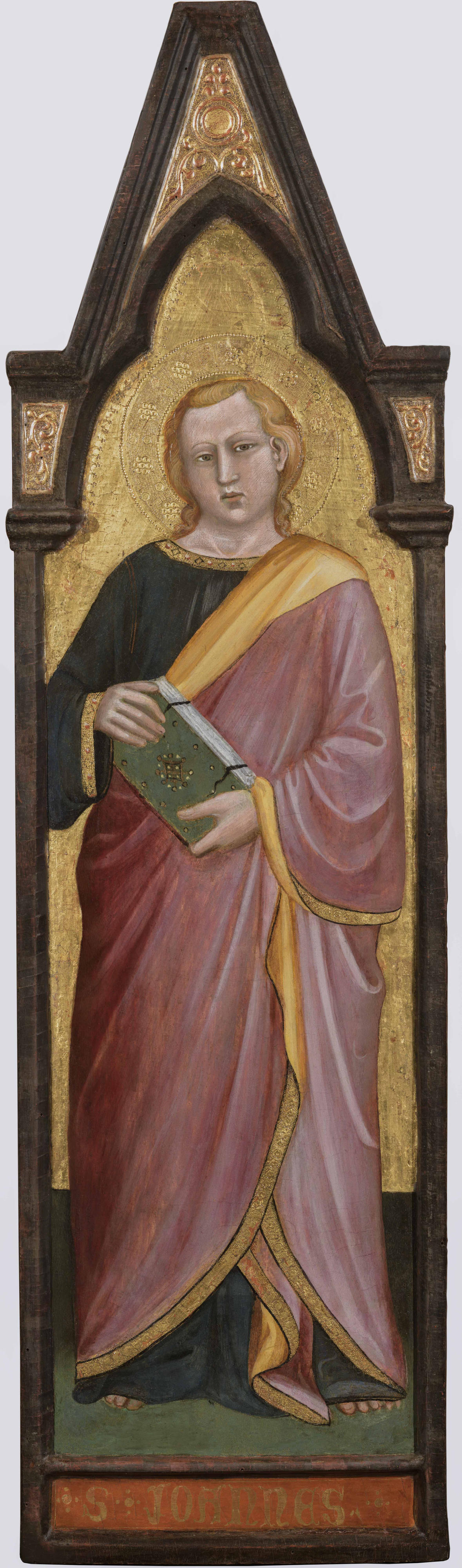

Spinello di Luca Spinelli, called Spinello Aretino
Saint John the Evangelist
c. 1385/90
Tempera and gold on panel
115 x 32 cm (45 1/4 x 12 5/8 in.)
Provenance
Sotheby’s, Monaco, 20–21 June 1987, lot 303,
with Antichi Maestri Pittori, Turin,
Private collection.
Literature
M. Ferretti, ed. G. Romano, Antichi Maestri Pittori. Quindici anni di studi e ricerche, exhibition catalogue, Turin, 1993, pp. 54-67.
E.S. Skaug, Punch Marks from Giotto to Fra Angelico, Oslo, 1994, p. 279.
A. Labriola, ‘La Decorazione Pittorica’, in M. De Vita (ed.), L’Oratorio di Santa Caterina. Osservazioni storico – critiche in occasione del Restauro, Florence, 1998, pp. 51–59.
S. Weppelmann, Spinello Aretino e la Pittura del Trecento in Toscana, Florence, 2011, pp. 178–180.
Description
Active for about forty years in his native Arezzo as well as Florence, Lucca and Pisa, Spinello Aretino was a key transitional figure in the Late Gothic style of the late fourteenth and early fifteenth centuries in Tuscany. The subject of a life included in Vasari, Spinello has been the subject of modern studies by Miklós Boskovits and Stefan Weppelmann, who have worked to reconstruct his career and oeuvre. As Everett Fahy wrote: 'In recent studies of late fourteenth-century Italian painting, the reputation of few painters have gone up more than Spinello Aretino's. No longer classified with the conservative followers of Orcagna, he is now estimated as a first-rate talent and credited in part with the reform that paved the way in Tuscany for the flourishing of the International Gothic style' (in 'A Madonna by Spinello Aretino', Cleveland Museum of Art Bulletin, 1978, pp. 261-267).
Spinello's career began in Arezzo in the mid-1670s; the earliest fixed point in our knowledge of the artist is a fresco, dated 1377, originally executed above the tomb of Clemente Pucci in the cloister of Sant'Agostino in Arezzo and now in the Museo Diocesano. From Arezzo in 1380 the artist moved to Lucca, where he became one of the most active painters in the city; for Lucca Spinello produced two important altarpieces that would leave a profound mark on the younger generation of local painters, including Angelo Puccinelli and Giuliano di Simone.
Around the end of the decade Spinello moved again, relocating to Florence, where he was enrolled in the Arte dei Medici e degli Speziali in 1387. In the Tuscan capital, the artist left his first masterpiece, the frescoes in the sacristy of San Miniato al Monte (fig. 1), datable to 1388, where the life of Saint Benedict is narrated in scenes rich in anecdotal detail, and with a verve far removed from Giotto's grave austerity. The years of Spinello’s early Florentine sojourn are also rich in works on panel, long read in the light of Vasari's writings which viewed them in terms of their debt to Giotto, but which instead, as modern critics have pointed out, look instead to the models of Bernardo Daddi, accounting for their more refined sweetness.
The present panel painting belongs to this moment. The work first appeared in modern times in 1987, in a sale at Sotheby's; the previous lot included a Madonna and Child evidently from the same complex. Our panel then passed to the antiquarian Giancarlo Gallino, who presented it at an exhibition in his gallery in Turin in 1987, entrusting its study to Massimo Ferretti. The scholar identified two further elements from the same complex, a Saint Augustine and a Saint Dominic which appeared in a sale in 1989 at Semenzato in Milan (23 November 1989, lot 10), and thus managed to provide a nearly complete hypothetical reconstruction of the polyptych (fig. 2).
In the centre is the Madonna and Child; on her left is Saint John the Evangelist; beside him is Saint Dominic; the place of honour to the right of the Virgin was occupied by a panel that has not yet been traced; while at the far left appeared Saint Augustine. The question remains whether the polyptych also had a predella, either with Marian scenes or other stories relating to the saints above. The original location of the work remains an open question, but the presence of Saint Dominic, though not in the place of honour, nevertheless suggests, as Stefan Weppelmann has noted, that the polyptych may have been executed for a convent of the Dominican order.
The Saint John, with his sweet and somewhat melancholy demeanour, with the iridescent pinks of the cloak juxtaposed to the pistachio green of his robe, exemplifies the new elegance embraced by Spinello in the late 1380s. The greater refinement that artists like Spinello and Agnolo Gaddi brought to Florentine art in the subsequent decade paved the way for a sort of 'Autumn of the Middle Ages' in the first quarter of the fifteenth century, marked as it was by the masterpieces of Gentile da Fabriano, Lorenzo Monaco and Lorenzo Ghiberti.
Fig. 1. Detail of Spinello’s frescoes in San Miniato al Monte, Firenze
Fig. 2. Hypothetical reconstruction of the polyptych with Saint John the Evangelist