
Alighiero Boetti
b. 1940, Turin, Italy
d. 1994, Rome, Italy
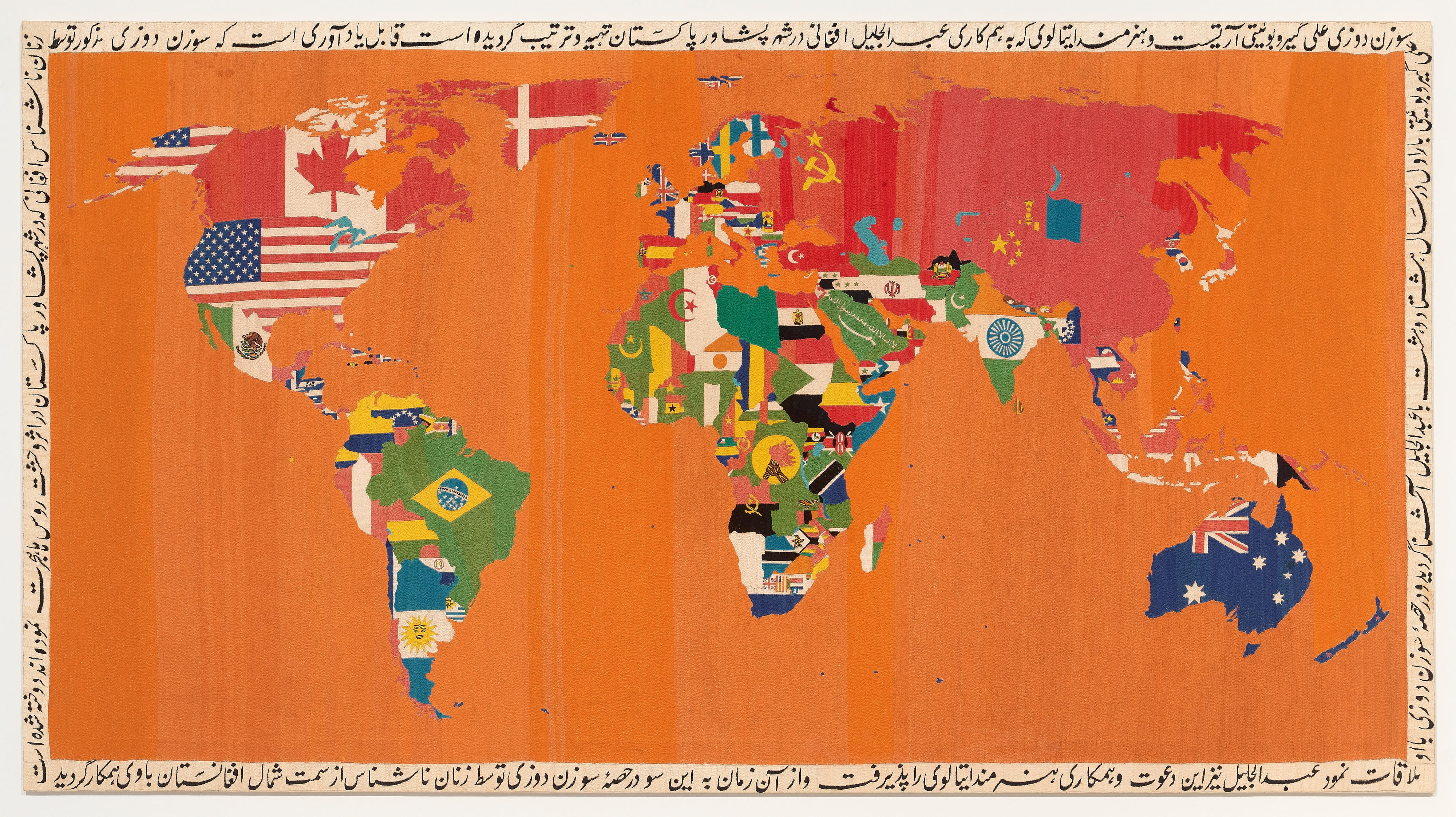
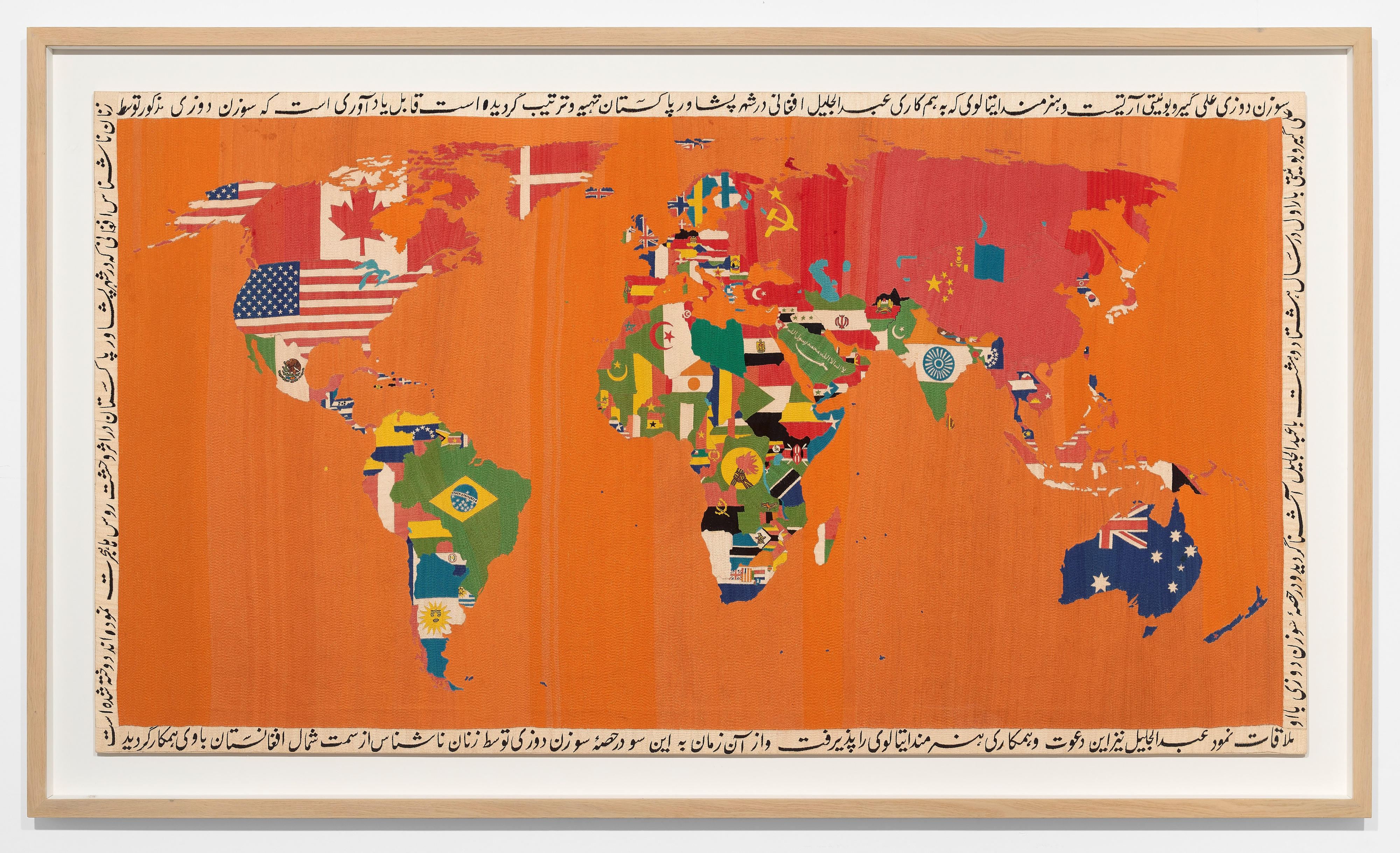
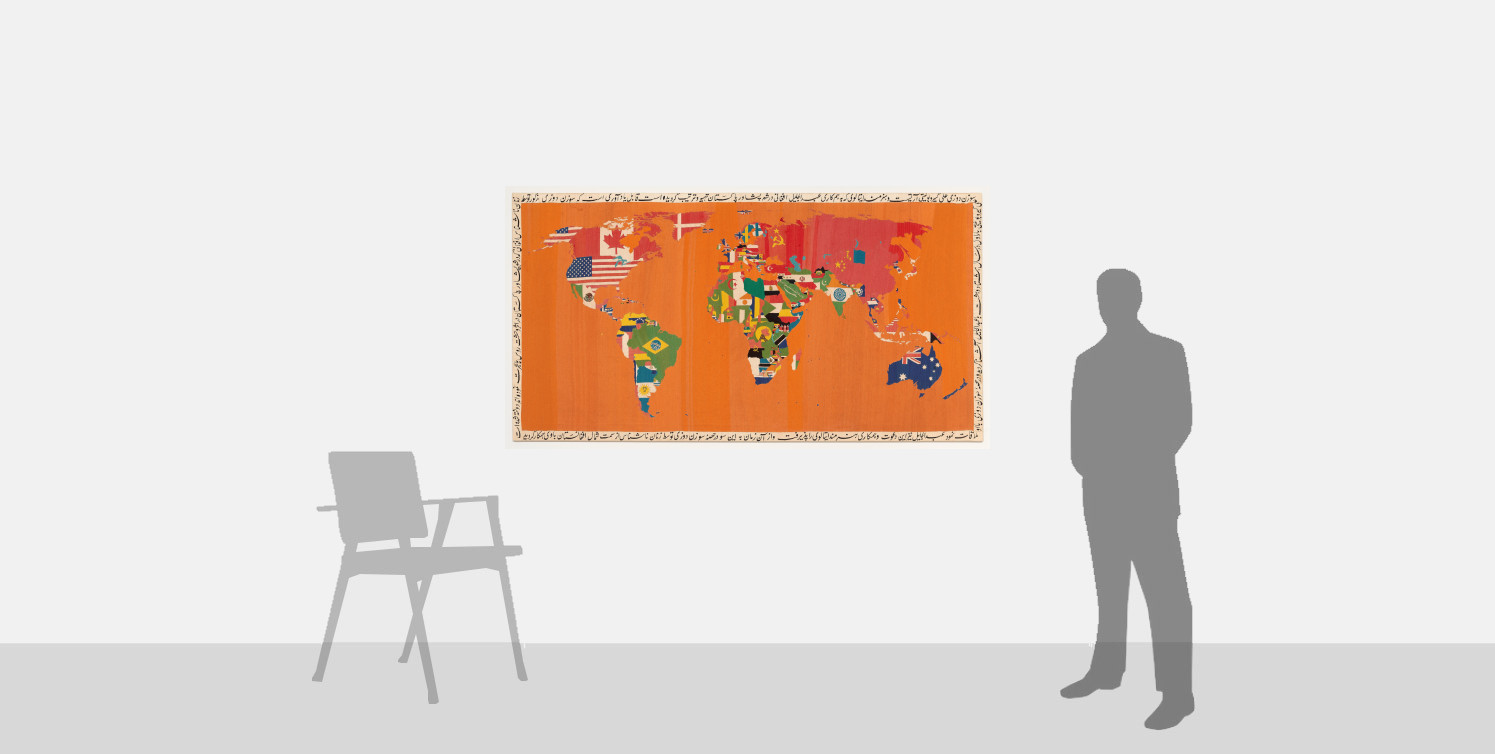
Mappa
1993
Embroidery
117 x 216 cm (46 x 85 in.)
Framed: 143 x 243.5 cm (56 1/3 x 95 7/8 in.)
Provenance
Private collection, New York
Description
As a collective entity, the mappe of Alighiero Boetti (1940–1994) encapsulate the essence of an artist whose practice was simultaneously conceptual, collaborative, playful and revealing. Famously stating that he ‘invented nothing’, Boetti used the existing framework of the world map to initiate the creation of around 150 embroidered maps, each reflecting a specific geo-political reality from its moment of production.
Boetti first engaged with the format of the world map in Planisfero Politico (1969), taking a cartographic plan of the world of the type common in Italian schools at the time, and colouring each country according to its national flag. Two years later, he used this same concept of a world map designed with individual flags, to commission his first embroidered mappa from the Royal School of Embroidery in Kabul, Afghanistan. The resulting tapestry revealed the possibilities inherent within such a work, for incorporating multiple artistic agents and the intervention of external factors, and initiated a project of creating embroidered maps that would last until Boetti’s death in 1994.
During this time, Boetti, commissioned maps from groups of female Afghan embroiderers, always operating through an extended chain of production due to the social customs and restrictions of male and female interaction in Afghan society at the time. For each map, Boetti made the initial designs, specifying the colours of the countries and certain parts of the borders. The Afghan women in turn shaped the visual outcomes of the mappe through their skilled craftsmanship, fine selection of colours, and unconscious errors – being unfamiliar with the visual codification of world geography into countries, each one designed with its national flag.
The intervention of time and unforeseen elements of chance have also shaped the appearance of the maps – uncontrollable factors that Boetti welcomed and indeed encouraged, in the mappe as in many works across his oeuvre. Indeed, for Boetti, the mappe constituted the pinnacle of his artistic achievements because they seemed to be entirely self-determined, needing only his Duchampian, light-handed guidance to expose deeply complex issues in an extraordinarily simple and beautiful form. ‘To my mind, the work of the embroidered map represents the supreme beauty’ he said, because ‘I made nothing, selected nothing in the sense that the world is made the way it is and I have not drawn it; the flags are those that exist anyway, I did not draw them; all in all, I have made absolutely nothing. Once the basic idea is there, the concept, then everything else is already chosen (Boetti, quoted in Alighiero Boetti: Mettere al mondo il mondo, exh. cat., Frankfurt, 1998, p. 69).
The present work, Mappa (1993), illustrates the impact of political shifts and the passing of time in our contemporary understanding of the maps. The tapestry shows a snapshot of the international framework of the world at this moment – with the red mass of the Soviet Union instantly imbuing the work with a historical significance. Other details also reflect the geopolitical situation when this map was created: in southern Africa, Namibia is left white due to the civil war that continued into the 1990s, and the Republic of South Africa shows the tricolour of the Union Flag that was used until 1994, now considered a controversial symbol of apartheid and colonial rule. The Soviet Union, Mongolia and China also appear to merge into each other, their borders obscured by the continuation of the red of their national flags.
What might also seem surprising is the colour of the oceans: a vibrant orange, rather than the conventional blue used in the maps and atlases with which we are familiar today. In the early maps, Boetti had specified that the oceans should be coloured blue; however, in 1979, a map was produced for which Boetti had not explicitly stated the colour for the oceans. The Afghan embroiderers, unfamiliar with the overall schema of the world map and therefore unaware of the requirement to use blue to denote water, had used a surfeit of pink thread to embroider the vast swathes of ocean. Boetti was delighted with this unexpected outcome of colour and thenceforth encouraged such variation of colour in the seas. This late Mappa from 1993 is a rare example of a map with orange oceans, giving an eye-catching result that questions our own expectations of the codification of geographies.
Around the edge of the map is another compositional element that distinguishes this mappa. The majority of Boetti’s tapestries incorporated decorative borders, with the Italian artist drawing upon the tradition of ornate borders in Afghan embroidery. For each mappa, Boetti prepared an outline for the border around the edge. He designed some sections with specific Italian words or phrases, leaving other parts blank for the Afghani women to fill – in Dari, the Afghan variant of Farsi – according to their own ideas. This particular map features a border that was left entirely blank by Boetti, instead filled with Dari sentences that give voice to the otherwise unknown people who made the tapestry.
The inscription discloses information about the background to this particular map, and can be translated thus:
The needlework of Alighiero Boetti, an Italian artist, was produced in collaboration with Abdul Jalil Afghani in the city of Peshawar, Pakistan.
It is noteworthy that the described needlework was sewn by unknown Afghan women who migrated to Peshawar, Pakistan, for fear of the Russians.
Alighiero Boetti first met Abdul Jalil in a needlework class in 1988. Abdul Jalil also accepted this invitation, saying yes to collaboration with the Italian artist, and from then on, unknown women from northern Afghanistan collaborated with him in the needlework class.
This detailed description of the people and situation behind the Mappa is one of the most revealing inscriptions to be found across all the maps, identifying by name Boetti’s Afghan contact and coordinator, Abdul Jalil, and emphasising the desperate situation of the female embroiderers, forced to flee from their home country following the Soviet invasion.
The present Mappa embodies a time and place, the vision of a world at a particular time, made in a particular place. On first appearance, it seems to be a recognisable cartographic schema, but on closer inspection the stories behind this map are revealed. Elements such as intricate details of the flags, the complexity of the weave and unknowing decisions by the embroiderers, as well as the text in the border contribute to the deeper significance of this map, giving voice to the invisible makers of the work and revealing the enduring collaboration between Boetti and his Afghan collaborators.