

North America, New Amsterdam (New York)
The Anneken Jans Chest
c. 1633
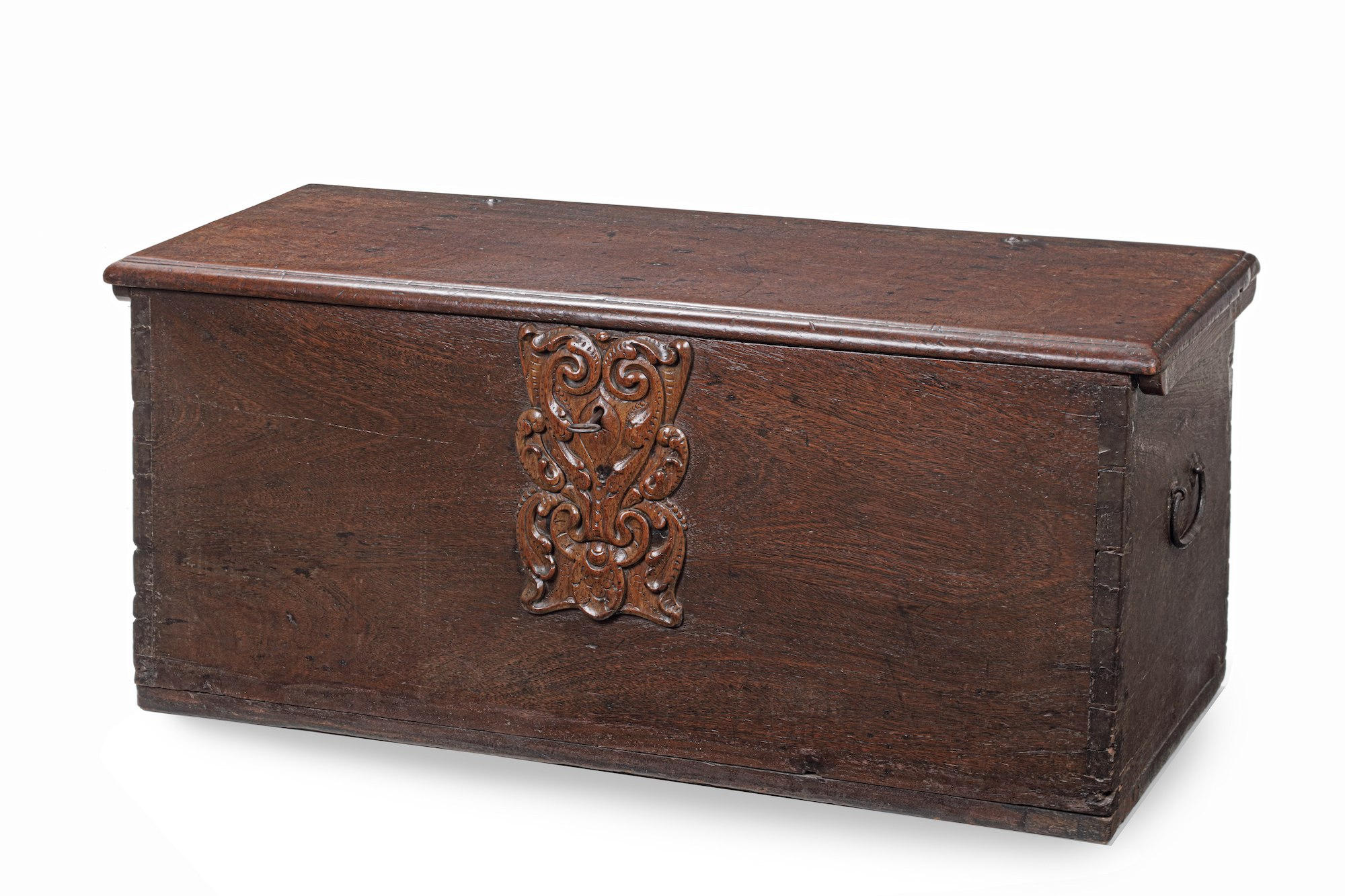
Teak (Tectona grandis) and American Walnut (Juglans nigra) coffer with iron and brass mounts
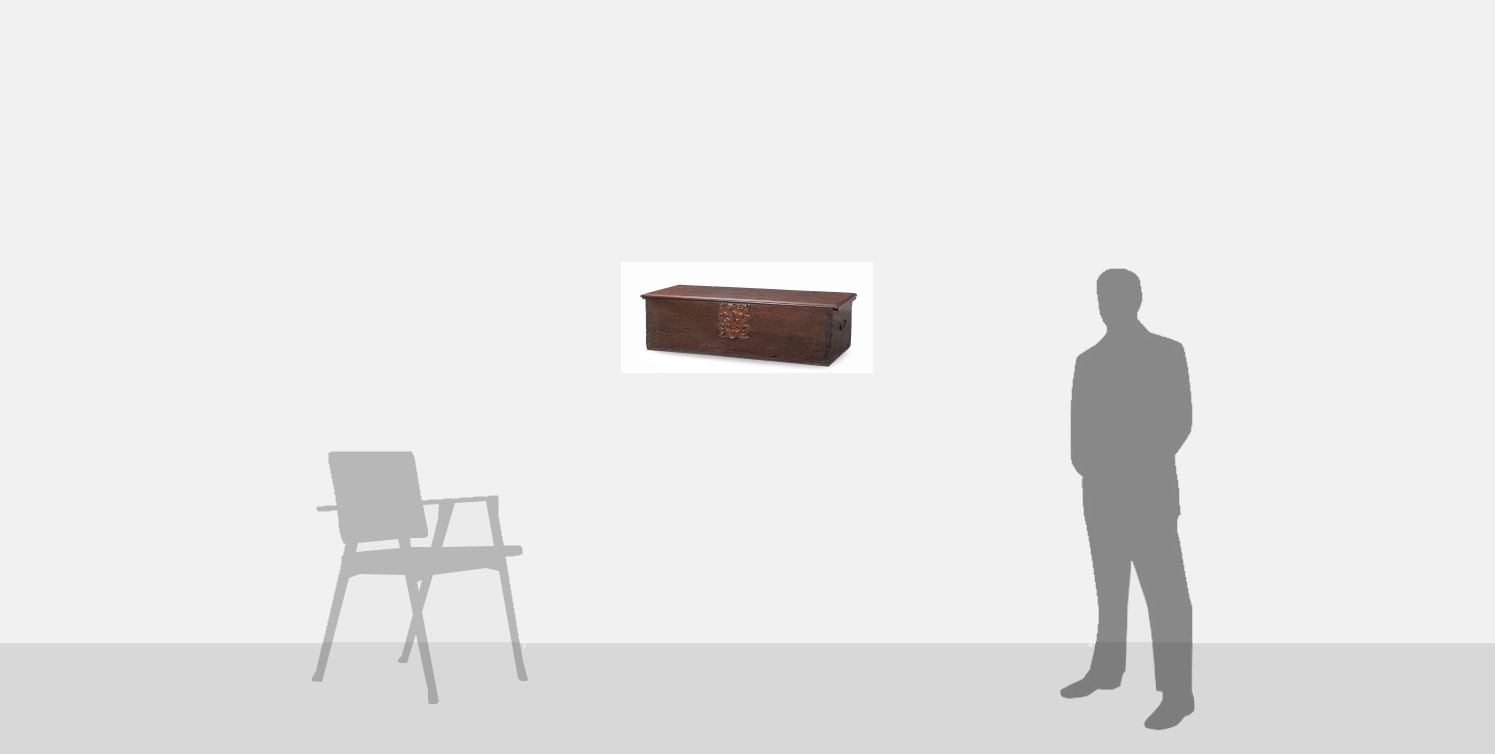
49.2 x 112 x 46.8 cm (19 3/8 x 44 1/8 x 18 3/8 in.)
Provenance
From the collection of Mr. and Ms. Van Hanxleden Houwert Van Silfhout, Netherlands.
Private collection, Netherlands.
Description
Anneken Jans, also known as Anneken Jans-Bogardus, was born in 1604/5 in Flekkerøy, an island in the country of Vest Agder in Norway. She was the daughter of Jan (Roelofsz.) and Trijn Jonas, who later was to become the first midwife for the Dutch West India Company in New Amsterdam. At a young age Anneken moved with her family to from Norway to Amsterdam. Anneken married Roeloff Jansz (1601/2–1637) on 18 April 1623, a Norwegian seaman. The couple were among the very first Dutch settlers in New Amsterdam, embarking for North America in 1630. Roeloff had a contract to work for three years for the wealthy Amsterdam jewellery merchant Kiliaen van Rensselaer, a governor of the Dutch West India Company in Amsterdam, who had been granted by the company a vast swathe of lands encompassing all of present-day Albany, Rensselaer counties, and parts of Columbia and Greene counties in present day New York state. On 24 May 1630, Anneken, Roeloff, and their three daughters, together with Anneken’s mother and sister, arrived at Fort Orange and settled in the small village of Beverwijck. Roeloff was paid seventy-two guilders a year to work as a farmer of the Laets Burg Farm along the Hudson River near Normanskill Creek, and was appointed schepen, or alderman, of Beverwijck. In the meantime, Anneken, her sister, and mother set up a retail business. Anneken gave birth to two more daughters and a son; all of the children were baptized Lutherans. The family interacted daily with local Native Americans, and their eldest daughter, Sara, later became a translator for the New Netherlands director-general, Peter Stuyvesant, in his negotiations with the local tribes.
Anneke’s farm was not a great success, and in 1634 the family moved to Manhattan and worked in the Dutch West Indian Company’s Bouwerie, or farm, in the section of Manhattan now known as The Bowery. In 1637 the industrious Roeloff was given a grant for a sixty-two- acre farm of his own near the site where later the World Trade Center would stand. There he built a small house on the farm for his mother-in-law, the colony’s midwife. That same year Roeloff died suddenly. Anneken, now with six children and no money, was acquitted of her debts by Rensselaer, and continued to work her own farm. A year later, 1638, Anneken married reverend Everhardus Bogardus (c. 1607–1647), the second ‘dominee’ to be sent by the Dutch West India Company to the New Netherlands. Bogardus was a well-read Dutch Reformed clergyman, with whom Anneke had another four sons (one of their grandsons, Everardus Bogardus (1675–c. 1725), was to become a famous Dutch New York silversmith). The couple lived on Anneken’s farm which came to be known as ‘Dominee’s Bouwerie’. Reverend Bogardus was orthodox, considering himself the guardian of public morality, even though he himself had a significant problem with alcohol. He frequently quarrelled with the magistrates of the New Netherlands, often denouncing them from the pulpit; displeased, they charged Bogardus with drunkenness, meddling with other men’s affairs, and using bad language. In September 1647, leaving behind his wife Anneken and his four sons, Bogardus sailed on the Princes for Amsterdam to defend himself from the charges brought against him. He drowned when his ship was wrecked on 29 September 1647 off the coast of Wales. Anneken, widowed for the second time at the age of forty-two, had nine children to support and still was cash-poor but land-rich, having three farms, in Beverwijck (Albany), Manhattan, and an eighty-two-acre farm on Long Island, called ‘Dominee’s Hoek’, which she inherited from her husband. She sold the Long Island farm and moved back to Beverwijck, where she had a house built on land adjacent to the property owned by her son from her first marriage. As her children married and moved away, she gave each of them a bed and a cow as a wedding present. In 1659 the widowed Anneken was forced to appear in court because she had shown her ankles in public. She was saved by a friend who declared that when Anneken had to walk through the mud, she lifted her skirts so as to keep them clean—she was acquitted.
Anneken died in 1663 after living another sixteen years in Beverwijck. Her will stipulated that the estate be divided equally among her seven surviving children. The children sold her Albany house to Dirk Wessels ten Broeck for the substantial sum of 1.000 guilders. After Colonel Richard Nicolls had taken possession of New Amsterdam in 1664 for the British, all property-holders were required to obtain new titles for their lands. Anneken’s heirs secured a new patent for the farm of sixty-two acres on Manhattan from Governor Nicolls on 27 March 1667. In March 1671, the farm was sold to Governor Lovelace for a ‘valuable consideration’. All of Anneken’s heirs signed the deed of transfer, save the widow and child of Cornelius Bogardus, one of Anneken’s sons who had died in 1666. That omission was to cause a number of subsequent legal problems. In 1674 the Duke of York (the later King James I) confiscated ‘Dominee’s Bowery’ and it was turned over to the British crown; subsequently, in 1705, Queen Anne granted the farm to the Trinity Church. Descendants of Cornelius Bogardus (whose wife and son had not signed the deed) later claimed parts of the Trinity Church farm, as their ancestors had not agreed to the sale. This resulted in a famous and protracted lawsuit over Manhattan landownership that lasted into the twentieth century. In the end all, the matter was decided in the Church’s favour.
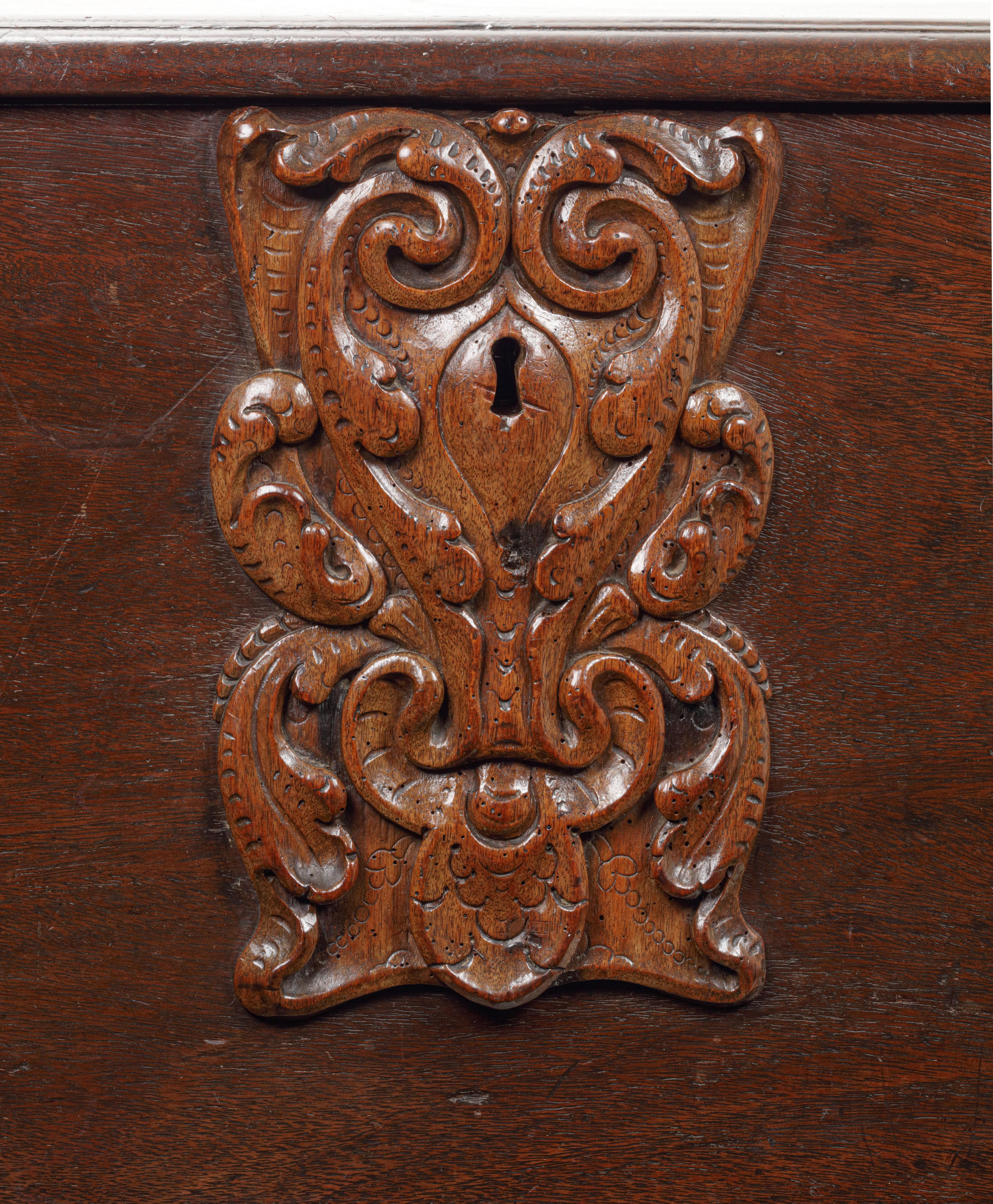
Vessels belonging to the Dutch West India Company arriving in New Amsterdam were laden with goods from Holland, from building materials such as bricks and tiles to all kinds of household goods including furniture, textiles from East India, carpets from Turkey, oriental ceramics, Dutch Delftware, silver, tin, and copper objects. It is possible to hypothesise that the present coffer arrived with a Dutch ship in 1633 and was bought at the time by Anneken Jans. She had her name inscribed on the lock, presumably because she intended to keep the chest to store her own belongings.
Anneken Jans-Bogardus remains today an almost mythical ancestress of the Dutch community in the United States. Six of her children had numerous offspring, who formed a ‘Nederlandse’, anti-British, anti-royalist, Dutch Reformed community. Anneken herself became the subject of many, and many erroneous, legends, one of which stipulated that she was a daughter of William of Orange. Both the reality of her life and the legends that grew up around her continue to form a strong bond for the multitude of her descendants still living in the United States.
Owing to its style and the wood used in its creation, the present chest was likely produced on the Indian Malabar Coast or in Persia, sometime before 1633. Originally the chest probably had an additional central hinge (traces of this hardware can be found inside the lid), ending in a hasp hanging over a metal backplate with a protruding ring (evidence of which is present inside the chest), and would have been secured by a padlock. Chests from the Malabar Coast were typically secured in this manner, though the Dutch typically replaced the padlock with an internal chest lock, a mechanism of Dutch origin. The chest’s wooden lockplate, is carved in American walnut (Juglans nigra) in the New Netherlands in the auricular or ‘kwab’ style, popular at the time. All parts of the brass lock, analysed by the conservation laboratories of the Rijksmuseum with stereomicroscope and XRF-analysis, proved to have originated from the Falun mine in Sweden, which dominated the European copper market during the mid-seventeenth century. Brass based on Swedish copper also made its way to the New World and was found among the scrap discovered during an excavation of an early seventeenth-century site in Jamestown. The engraving of the text shows signs of wear predating some repairs to the lock, but according to conservators at the Rijksmuseum is authentic to the original object.
Consequently, the present chest offers superlative evidence of the global reach of the Dutch in the seventeenth century, while at the same time offering a glimpse into the extraordinary life of one of the first, pioneering women to venture forth into the new world that was to become America.
In the late nineteenth century, the present chest was in the collection of Van Hanxleden Houwert, a wealthy dealer in colonial goods based in the Netherlands.