
Jean-Baptiste Oudry
b. 1686, Paris
d. 1755, Beauvais
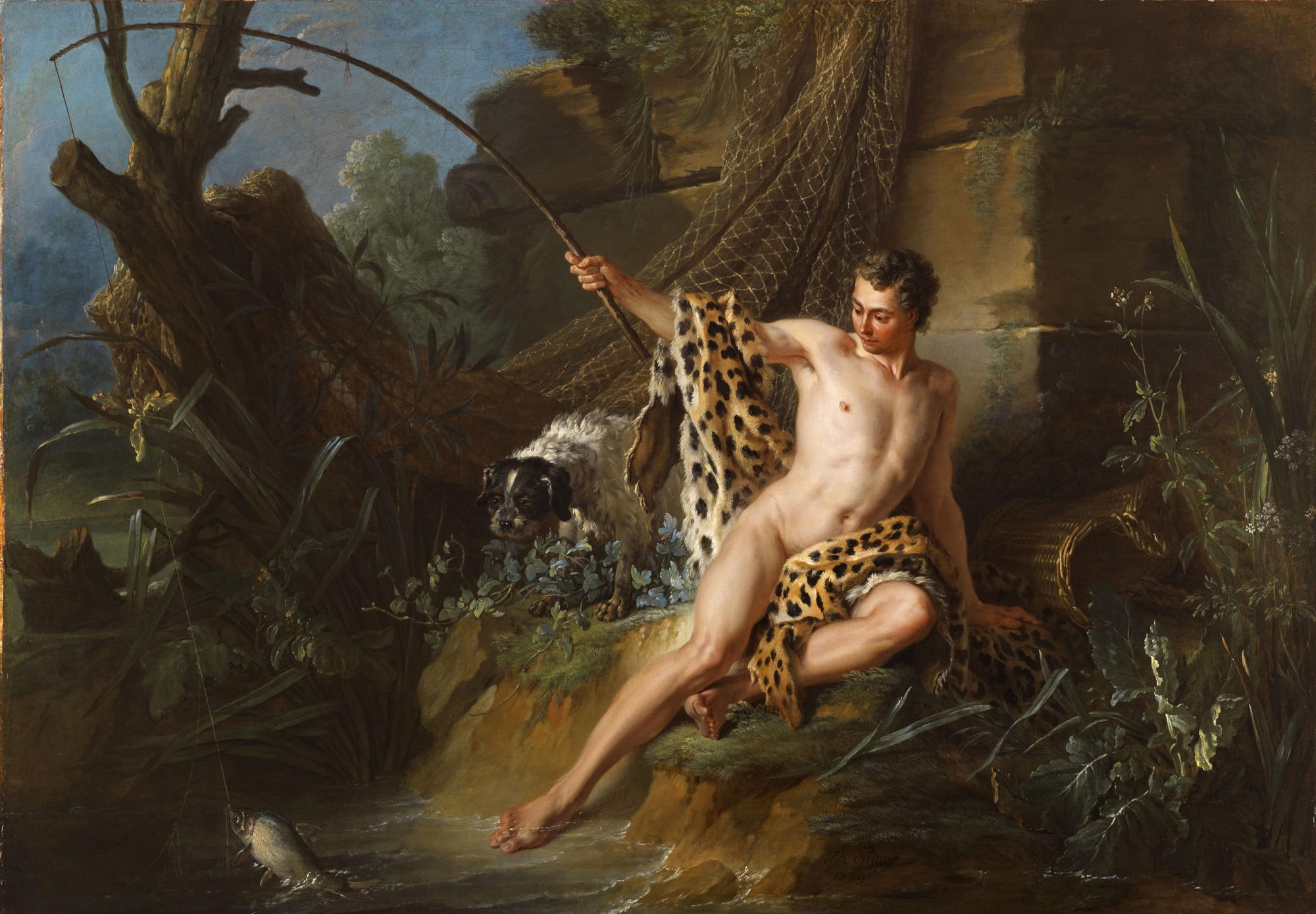
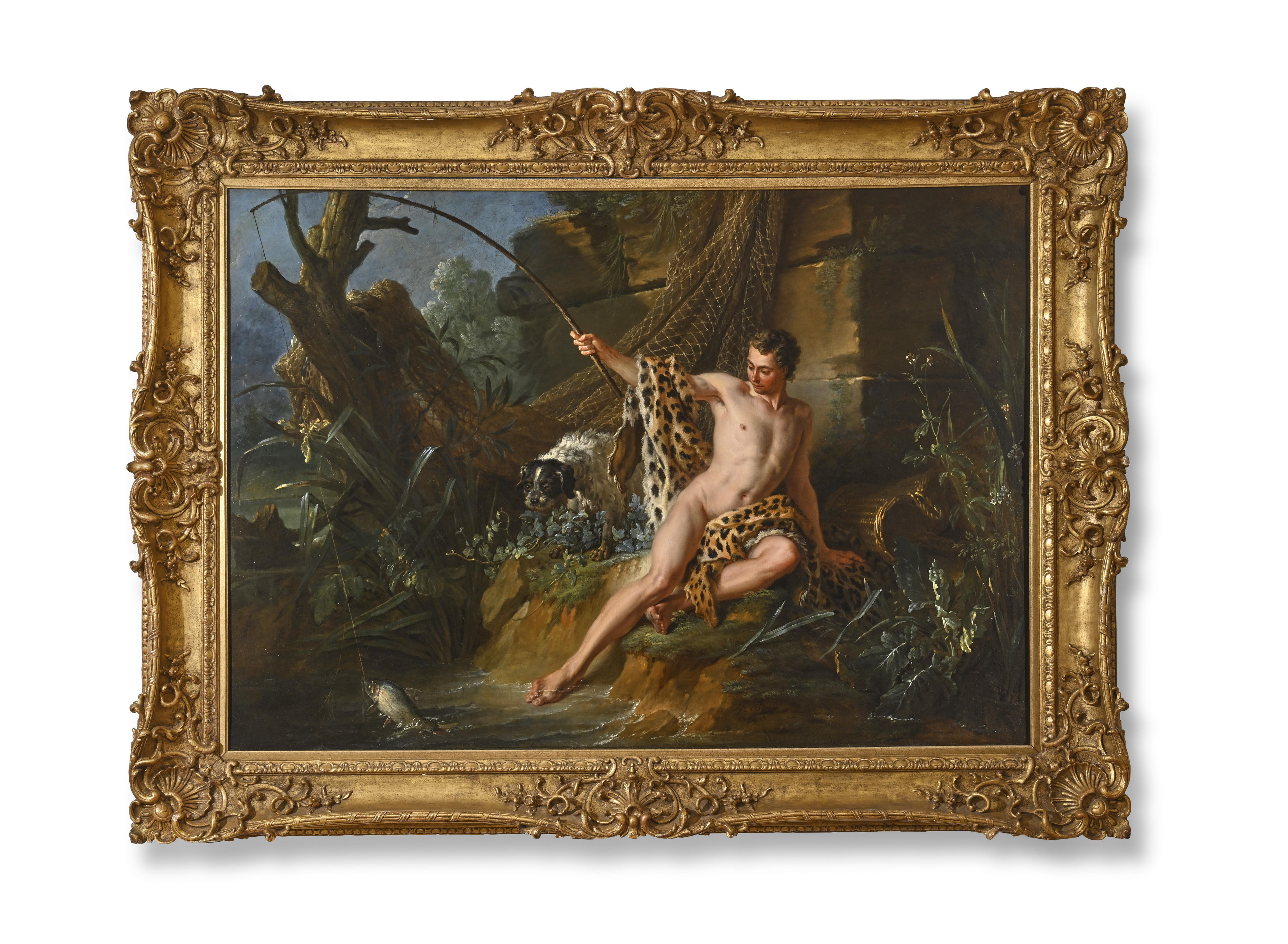
The Fisherman and the Little Fish from Fontaine’s Fables
1739
Oil on canvas
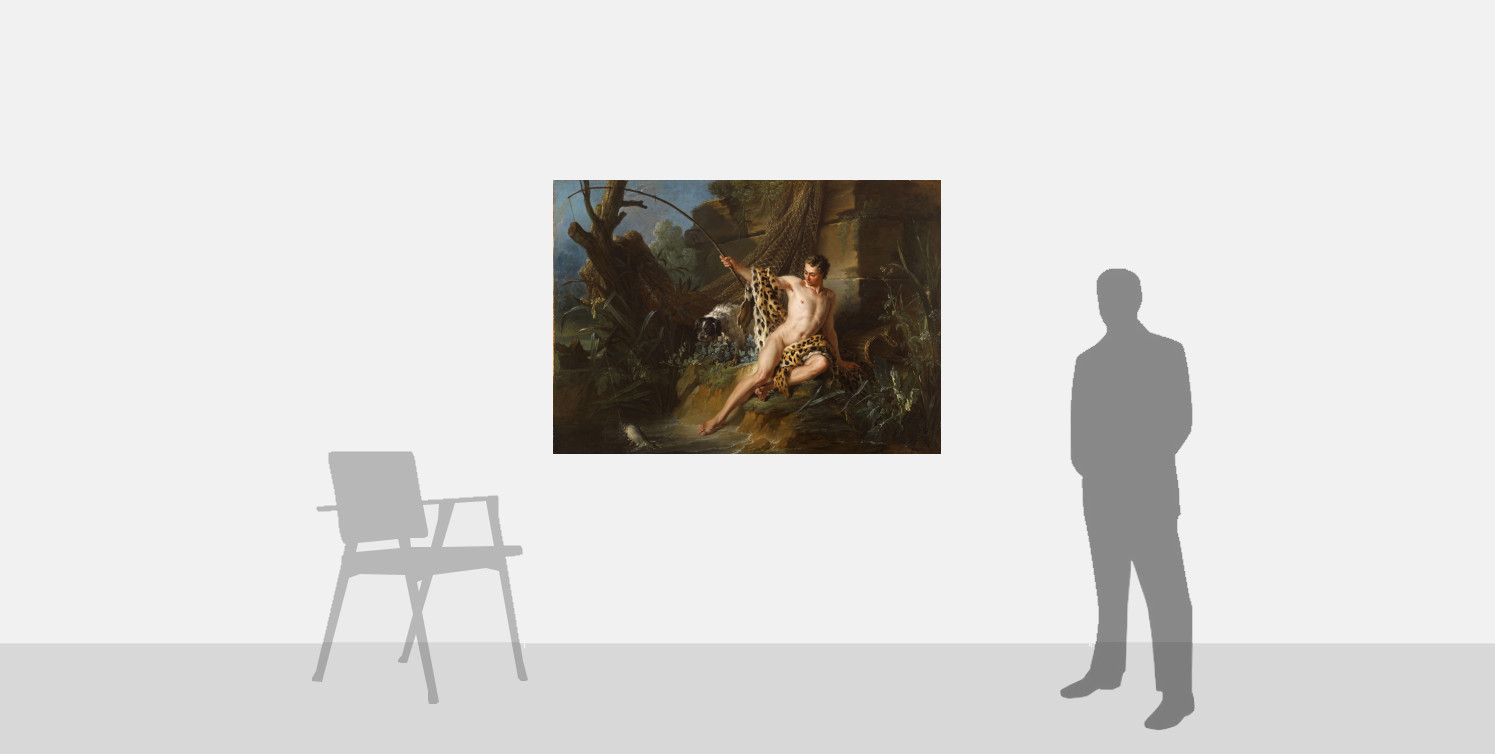
122 x 172.8 cm (68 1/8 x 48 1/8 in.)
With frame: 150 x 202 x 9 cm (79 1/2 x 59 1/8 x 3 1/2 in.)
Provenance
Collection of the artist;
Louis-François Mettra, listed in his post-mortem inventory of 1763 as “un tableau peint sur toile par Oudry représentant un Pêcheur...prisé 60 livres”[1];
Mme Steinberg, Paris, from the 1950s, and by descent to her nephew;
M. Garnier;
Galerie Aveline and Galerie Maurice Segoura, Paris, shown at Grosvenor House in 1995, where acquired by;
Sir Elton John, United Kingdom.
[1] Mettra was the agent for Frederick the Great in Paris, and the picture may have been intended for his collection at Sanssouci. See François Marandet, “La famille Mettra et ses achats pour la cour de Prusse” in Patrick Michel, ed., Art français et art allemand au XVIIIe siècle (Paris, 2008), pp. 265–81, for the inventory.
Literature
H.N. Opperman, Jean-Baptiste Oudry, Chicago, 1972, vol. 2, p. 355, as 'Le Petit Poisson et le Pêcheur, present whereabouts unknown. 1.3 x 1.62 m. Ex. Salon of 1739. Bibl.: Locquin, no. 383'.
H.N. Opperman, Jean-Baptiste Oudry, New York, 1977, vol. 2, supplement, p. 1199, as 'Le Petit Poisson et le Pêcheur, Paris, Private Collection. Dated 1739'.
Description
Jean-Baptiste Oudry was the foremost animal painter of the French eighteenth century, celebrated for his still lifes, game pieces, hunting scenes, and depictions of exotic animals. Oudry first trained as a portraitist with Nicolas de Largillière, and he was admitted to the Académie Royale de Peinture et de Sculpture as a history painter in 1719. Yet over the course of the 1720s it was his still lifes of game, hunt scenes, and animal portraits that attracted an enthusiastic following, challenging and ultimately eclipsing the primacy of the leading exponent of the genre, Alexandre-François Desportes. Royal commissions followed, and Oudry soon reigned supreme as Europe’s foremost animalier, boasting an international reputation and clientele—in addition to the king of France, Oudry counted among his patrons the Margrave of Ansbach, Grand Duke Friedrich of Mecklenburg-Schwerin, and Sweden’s ambassador to the court of France, Count Carl Gustaf Tessin.
Between 1729 and 1734, Oudry undertook his most ambitious project as a draughtsman, producing 276 highly finished drawings to illustrate tales from the famous seventeenth-century work by Jean de La Fontaine, the Fables choisies mises en vers (Selected Fables Rendered in Verse).[1] Oudry revisited La Fontaine’s Fables in a set of four tapestry designs, woven after 1736 at the royal manufactory at Beauvais, of which Oudry had been appointed director in 1734. And finally, he reprised the a theme from the Fables once again in the present canvas depicting The Fisherman and the Little Fish, which was presented at the Salon in 1739 and remains the artist’s sole surviving history painting.
The story of the fisherman and the little fish was first recounted by Aesop, though La Fontaine’s later retelling would have served as Oudry’s primary source.[2] The fable tells of a small fish is caught by a fisherman. The fish begs for its life on account of its diminutive size, suggesting that the fisherman should wait until it is larger, when the fish will make for a more filling meal. The fisherman refuses, noting that every little bit helps, and that it is stupid to give up a present advantage for an uncertain future gain—as the expression goes, a bird in the hand is worth two in the bush. Yet there is no such proverb in French, and so La Fontaine concludes with the reflection that one possession is better than two promises: “un ‘tiens’ vaut mieux que deux ‘tu l’auras.’”
Oudry took a markedly different approach to the fable in the present canvas than he had in his earlier rendition on paper, in which he showed the fisherman as a peasant, clutching the caught fish, ready to put it in his satchel, against a backdrop of two trees and some buildings (fig. 1). Instead, here, the artist was clearly keen to showcase his skills as painter of naturalia, rendering the dog, its intense stare immutably fixed on the fish, the hunter’s luscious leopard pelt, the rich foliage, net, basket, and slippery fish with textural richness and exacting verisimilitude.
At the same time, Oudry sought to claim his place as an academic painter with this work. Throughout the eighteenth century at the prestigious Académie Royale in Paris, the defining mark of ability amongst students and academicians alike was the anatomically correct depiction of the beautiful male body. For this painting, Oudry’s submission to the 1739 Salon, it would have critical for the artist to synthesize his specialist skills with such a vision of ideal masculinity. Indeed, the sinewy figure of the fisherman is very much in line with the taste of the day, which had moved on from the previous generation’s more Herculean male body types. An accomplished portraitist and master of the human form, Oudry often portrayed noblemen, hunters, and peasants alike as participants in his hunts and pastorals, which set him apart from his fellow—and rival—animal painter, Desportes. Nevertheless, the fisherman here, calibrated to meet academic standards for the male nude, is a rare standout in the artist’s oeuvre.
Poised in a dramatic manner, the figure is as full of tension as the bowed pole on which the titular fish is caught. The decorative exuberance in the foreground of the painting, especially in the exquisitely delineated fauna and foliage, recedes into cooler, darker, and more subdued greens and earth colors in its background. The Rococo charm and wit of subject is balanced by an unexpected drama of scale, a depth of palette, and an attention to naturalistic detail lacking in the artist’s drawn representations of the Fables, rendering it a wholly singular achievement.
[1] Around 1751 Oudry sold the complete set of drawings to the amateur and collector Jean-Louis Regnard de Montenault, who decided to have them reproduced as prints and published as an illustrated book. The drawings dispersed were dispersed, and many of these are now in public collections, including the Rijksmuseum, the Art Institute of Chicago, the Cleveland Museum of Art, the J. Paul Getty Museum, the Metropolitan Museum of Art, the Morgan Library, the Musée du Louvre, and the National Gallery of Art in Washington.
[2] Volume 3, book 5, fable 85.
Fig. 1. Fig. 1. Pierre-Alexandre Aveline, after Jean-Baptiste Oudry, Le Pêcheur et le petit poisson (from Les Fables by La Fontaine), 1755–59, engraving, published by Desaint & Saillant, rue saint Jean de Beauvais, Paris, Bibliothèque nationale de France, Paris.