
Sebastiano Ricci
b. 1659, Belluno
d. 1734, Venice
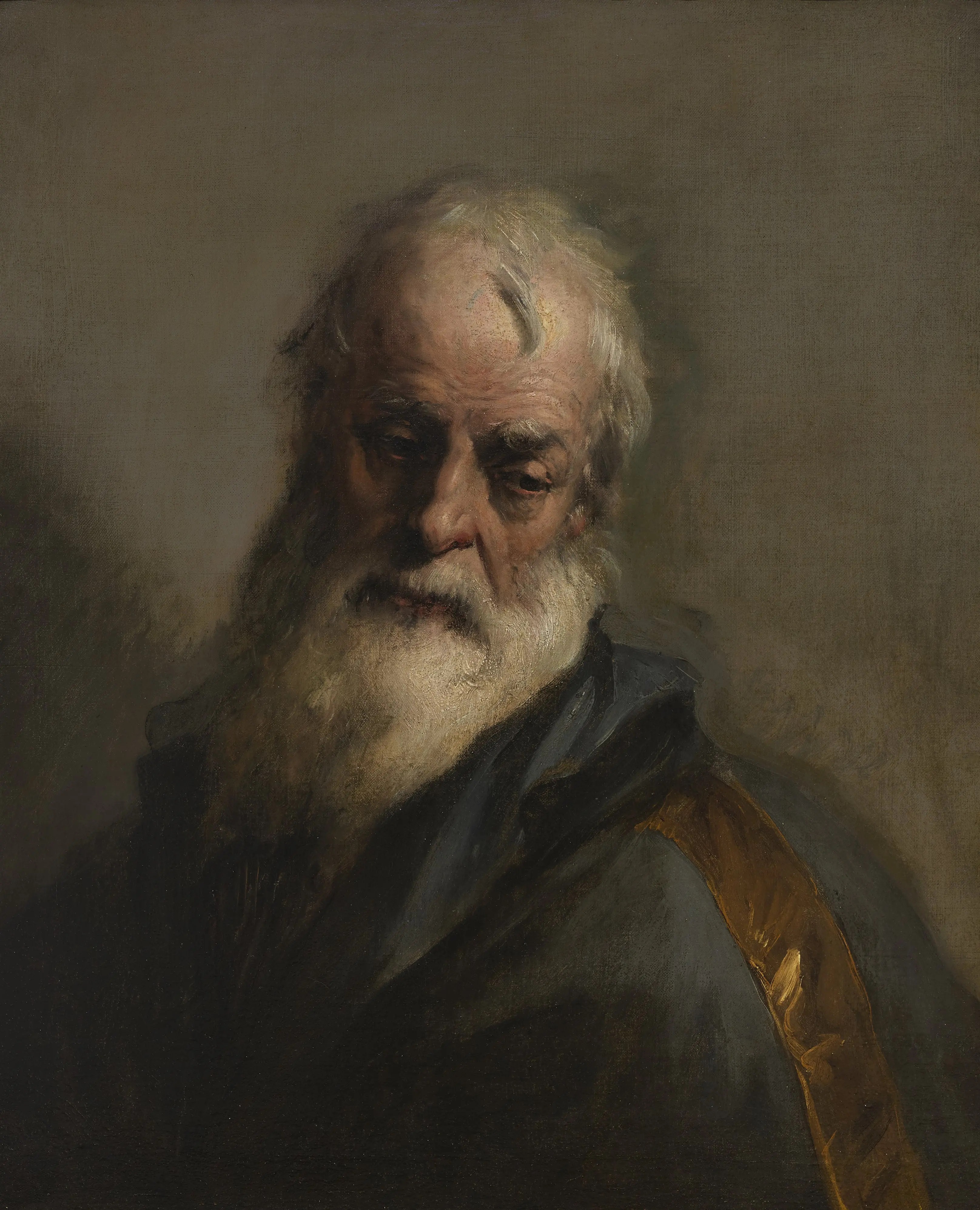
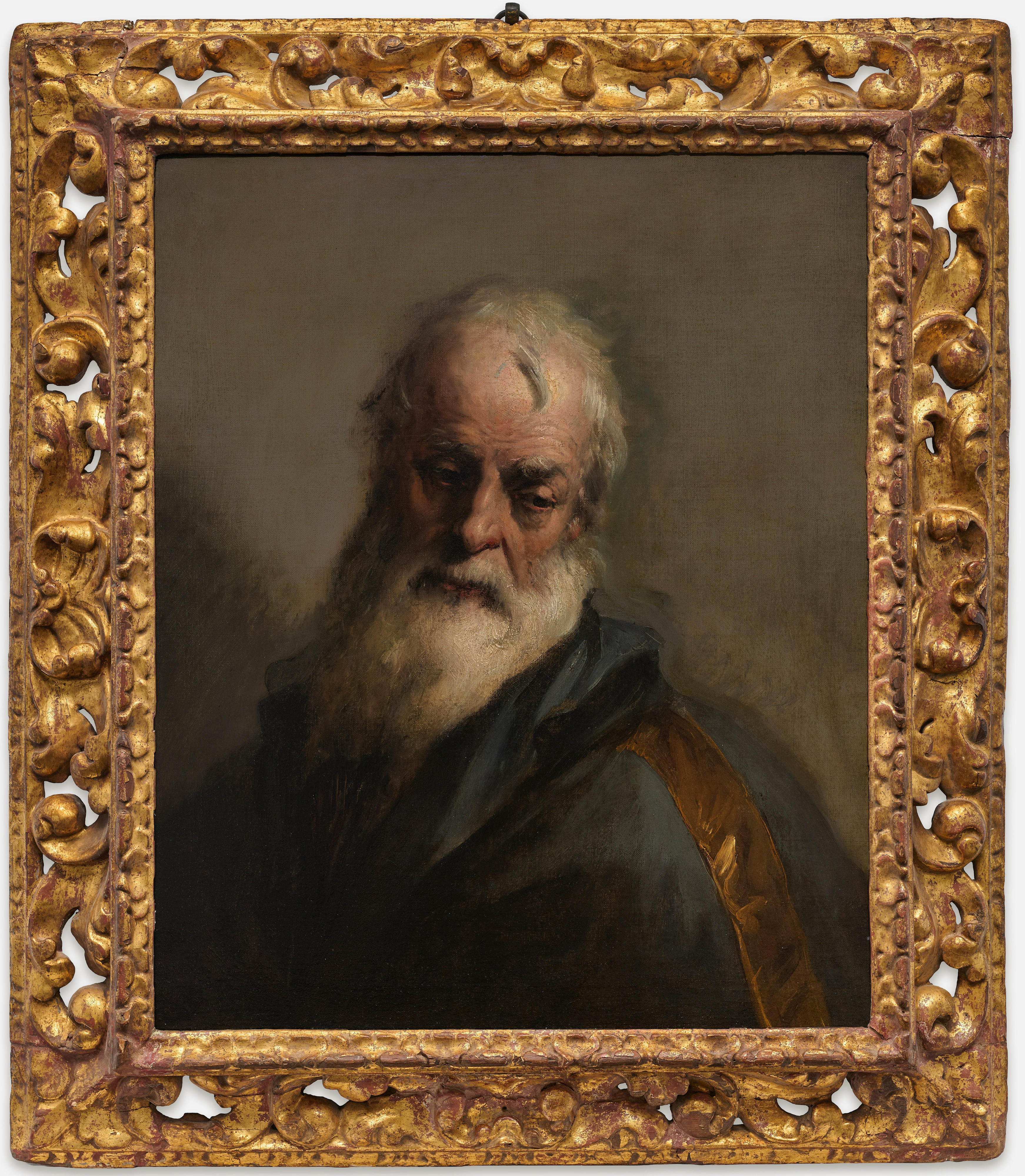
The head of a bearded man looking down
1690s
Oil on canvas
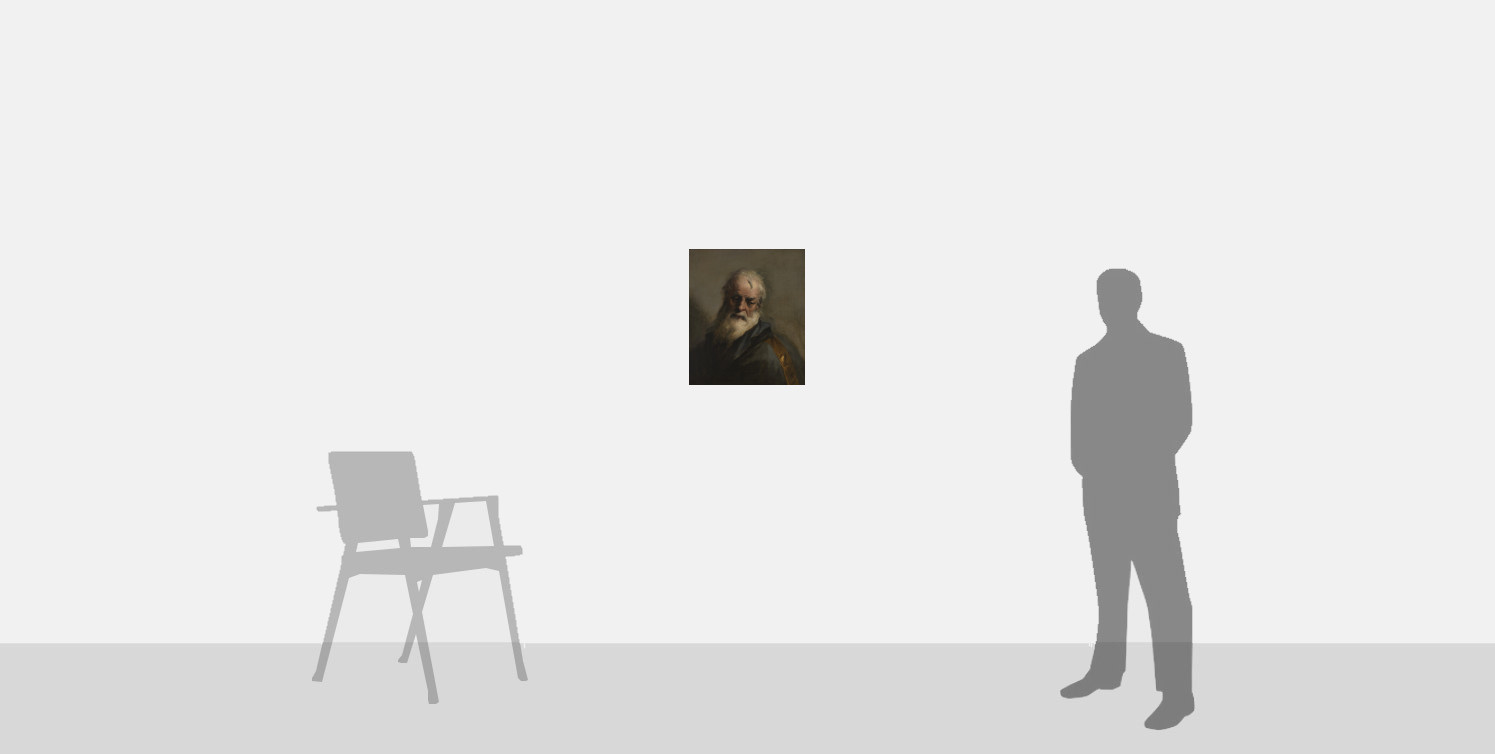
60.5 x 51.4 cm (23 3/4 x 20 1/4 in.)
Provenance
Jean-Luc Baroni, Ltd., London, 2014, cat. no. 8,
Private Collection.
Description
Annalisa Scarpa Sonino has confirmed the attribution of this work to Sebastiano Ricci.
Sebastiano Ricci was born in Belluno in 1659. At the age of either twelve or fourteen, he left his hometown for Venice, where he entered the studio of Federico Cervelli (c. 1625–before 1700), a Milanese painter who had worked in the city since the mid-1650s. While contemporary biographers sometimes discounted Sebastiano's debt to Cervelli, modern scholars generally agree that the Milanese master gave him solid practical instruction, encouraging a free manner of painting, and introduced him to the Venetian painters of the seventeenth century.
Sebastiano's departure for Bologna in the summer of 1681 initiated a fifteen-year period of intense study and work in Emilia, Lombardy, and Rome. In Bologna he gravitated toward the studio of Carlo Cignani (1628–1719), then the leading exponent of the Carracci tradition. In Parma he studied the sensuous colour of Correggio (1495–1534) and Parmigianino (1503–1540), as well as their graceful, refined figure repertory. A commission in December 1685 by Federico II Rossi, Marchese of San Secondo to decorate the oratory of the Madonna del Serraglio in San Secondo Parmense, included the artist’s earliest known fresco scheme and paved the way for future decorative commissions.
Supported by one of his most important Emilian patrons, Ranuccio II Farnese, Duke of Parma and Piacenza, Sebastiano went to Rome in 1691. This enabled him to study works of the great 16th- and 17th-century painters, the Carracci, Pietro da Cortona (1596–1669), Giovanni Lanfranco (1582–1647), Andrea Pozzo (1642–1709), and Luca Giordano (1634–1705), refining his own skills as a decorator, colourist, and manipulator of light effects.
By 1696, Ricci had returned to Venice, where he married Dutchwoman Maddalena van der Meer, after a number of amatory mishaps in his youth, which on more than one occasion resulted in a stint in prison. During his time in the city, he undertook a number of his most masterful decorations, which revealed careful exploration of Veronese's pure colour and tonal highlights, expressive use of light, illusionistic composition, and richness of costume; all of which the younger artist assimilated into an already mature personal style formed during earlier years of travel.
After 1700, Ricci’s fame was such that he was summoned to execute commissions in Vienna and in Florence. In 1712 he accompanied his nephew Marco (1676–1729) to England, where for the next five years he executed a number of major commissions, some in close collaboration with Marco, for a number of important and influential patrons, such as Lord Burlington and the Duke of Portland.
On the return trip to Venice in 1716, Ricci stopped in Paris, where he was accepted into the Académie Royale de Peinture. Once back in Venice, the collaboration between Sebastiano as figure painter and Marco as architectural and landscape specialist continued and intensified during the 1720s. Until his death in 1734 Sebastiano continued to work on commissions from rich Venetians or important foreign patrons such as the Duke of Savoy and the Emperor Charles VI.
Through his prolific and international career, creating dynamic and luminous decorative schemes, Ricci was a highly influential painter who not only contributed to the growing taste for Venetian painting but also bridged the gap between the drama of the Baroque with the exuberance of the Rococo.
This refined and touching unpublished head study shows the sensitivity of Ricci’s approach, while still conveying a majesty upon his subjects. The realism of the facial features, the subtle tenebrism and free brushwork are characteristic of the artist’s style of the 1690s, the moment at which Annalisa Scarpa Sonino has placed the work. The rich blue robe detailed with a gold stripe is reminiscent of the costumes worn by Veronese’s figures, to whom Ricci paid close attention during this period. This sensitive head study brings to mind the famous series of heads – including those of philosophers and Oriental figures – painted in the following century by Giovanni Battista and Giandomenico Tiepolo.
Ricci was a prolific draughtsman and was known to undertake significant preparations for finished compositions, including oil sketches, many of which he himself prized highly. Although several other head and figure studies by the artist are known, this is an unusual example in Ricci’s oeuvre, given that it likely depicts a real person, rather than a character or type. A famous group of head studies (see figs. 1–2), today in the Royal Collection, were acquired by George III from Consul Smith, each one recording figures from Veronese’s painting The Feast in the House of Levi (Gallerie dell’Accademia, Venice). Aside from these studies, there are only a handful of single-figure portrait works by the artist painted in a comparable bust format, notably a self-portrait painted for the Medici (n. 1754, fig. 3), and a study of a woman in profile, also in the Royal Collection (although the condition of the painting has led to some doubts regarding its attribution, fig. 4). Thus the present work is an important addition to Ricci’s oeuvre, its intimate nature and the unguarded expression of the sitter suggesting it could be a friend or relation of the artist.
Fig. 1 – Sebastiano Ricci, Head of a Man in Profile (a Steward?), 1725–30?, oil on canvas, 58 x 46.9 cm. London, Royal Collection Trust, RCIN 403978
Fig. 2 - Sebastiano Ricci, Head of an Old Man (a Publican?), 1725–30?, oil on canvas, 57 x 46.5 cm. London, Royal Collection Trust, RCIN 403970
Fig. 3 – Sebastiano Ricci, Self-Portrait, 1704, oil on canvas, 98.5 x 78.2 cm. Florence, Uffizi Galleries, inv. 1846 / 1890.
Fig. 4 – Attributed to Sebastiano Ricci, Head of woman in profile, c. 1700–34, oil on paper, 42 x 33.4 cm. London, Royal Collection Trust, RCIN 406726