
Workshop of the Master of the Pala Sforzesca
b. Active in Milan, c. 1490-c. 1500
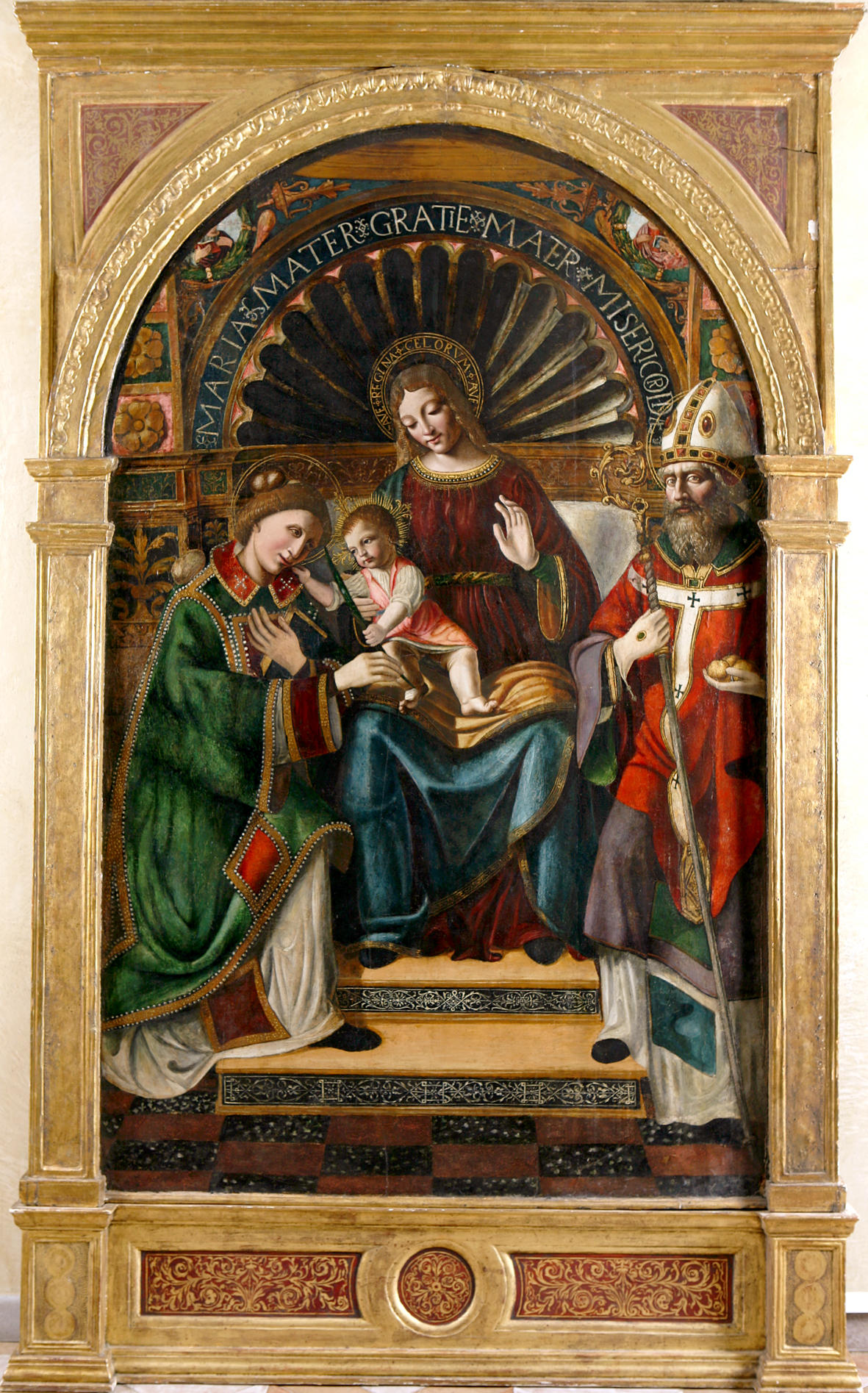
The Madonna and Child with Saints Stephen and Nicholas of Bari
1590s
Oil on panel
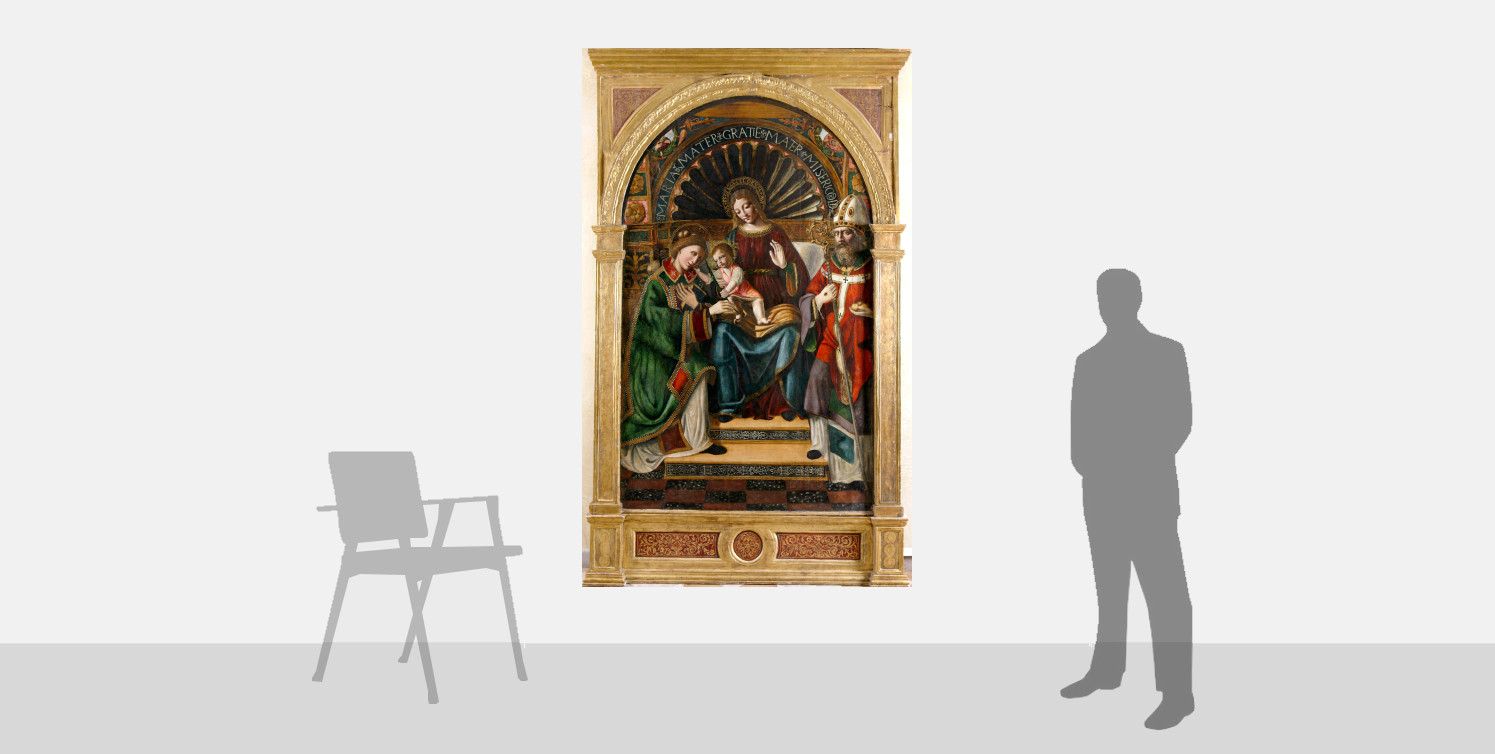
240 x 147 cm (94 1/2 x 57 7/8 in.)
Provenance
Acquarone collection, Turin
Marco Datrino, Torre Canavese
Literature
G. Romano, ed. G. Romano, M.T. Binaghi, Olivari and D. Collura, ‘La Pala Sforzesca’, in Il Maestro della Pala Sforseca, Florence, 1978, p. 18.
Description
The present altarpiece was first published in 1978 by Giovanni Romano, who noted its affinities with both the works of Giovanni Ambrogio De Predis and the Master of the Pala Sforzesca, slightly favouring the former. Perhaps owing to the work’s location in a private collection, the many studies on the works of Leonardo and his followers have substantially neglected this fine example, and thus its attribution must be guided by Romano’s observations.
There are obvious similarities with the Master of the Pala Sforzesca: the sumptuous garments of Saint Nicholas, Saint Stephen and the Virgin echo the obsession with brocades, pearls and golds that characterize the works of that master. At the same time, the physiognomy of the Virgin descends from the celebrated and much-copied Leonardesque model of the Virgin of the Rocks: analogous replicas are found both in the corpus of the Master of the Pala Sforzesca (for example the Madonnas of Baltimore and Berlin) and in other artists active in those years, from Marco d'Oggiono (the Crespi polyptych preserved in the museum in Blois Museum) to the various Madonnas with Child of the Pseudo-Francesco Napoletano to those of Bernardino de' Conti. Meanwhile, the imposing architecture that encloses the sacred scene in the present work, namely the shell-shaped apse, is a motif that can be found in the works of the Master of the Pala Sforzesca (for example in the Sant'Ambrogio in the Accademia Carrara in Bergamo). Yet, the greater monumentality and the presence of the graduated clypeus seems to indicate knowledge of models such as the polyptych of Treviglio by Butinone and Zenale, and perhaps even of the Milanese works of Bramante. We are therefore faced with an artist who in the last decade of the fifteenth century, to which date the present work should be assigned, was receptive to all of the innovations that were taking place in the Milanese scene, with very strong similarities to the Master of the Pala Sforzesca but also to other artists such as Bernardino de'Conti or Bernardo Zenale. Given our currently imperfect understanding of the career of De Predis, above and beyond his role as a transmitter of Leonardesque models, and exponent of court portraiture, it is not impossible to discount the possibility that the present work might be assigned to his hand.