
Sperindio Cagnoli
b. Piedmont, active c. 1505-1530
d. Padua
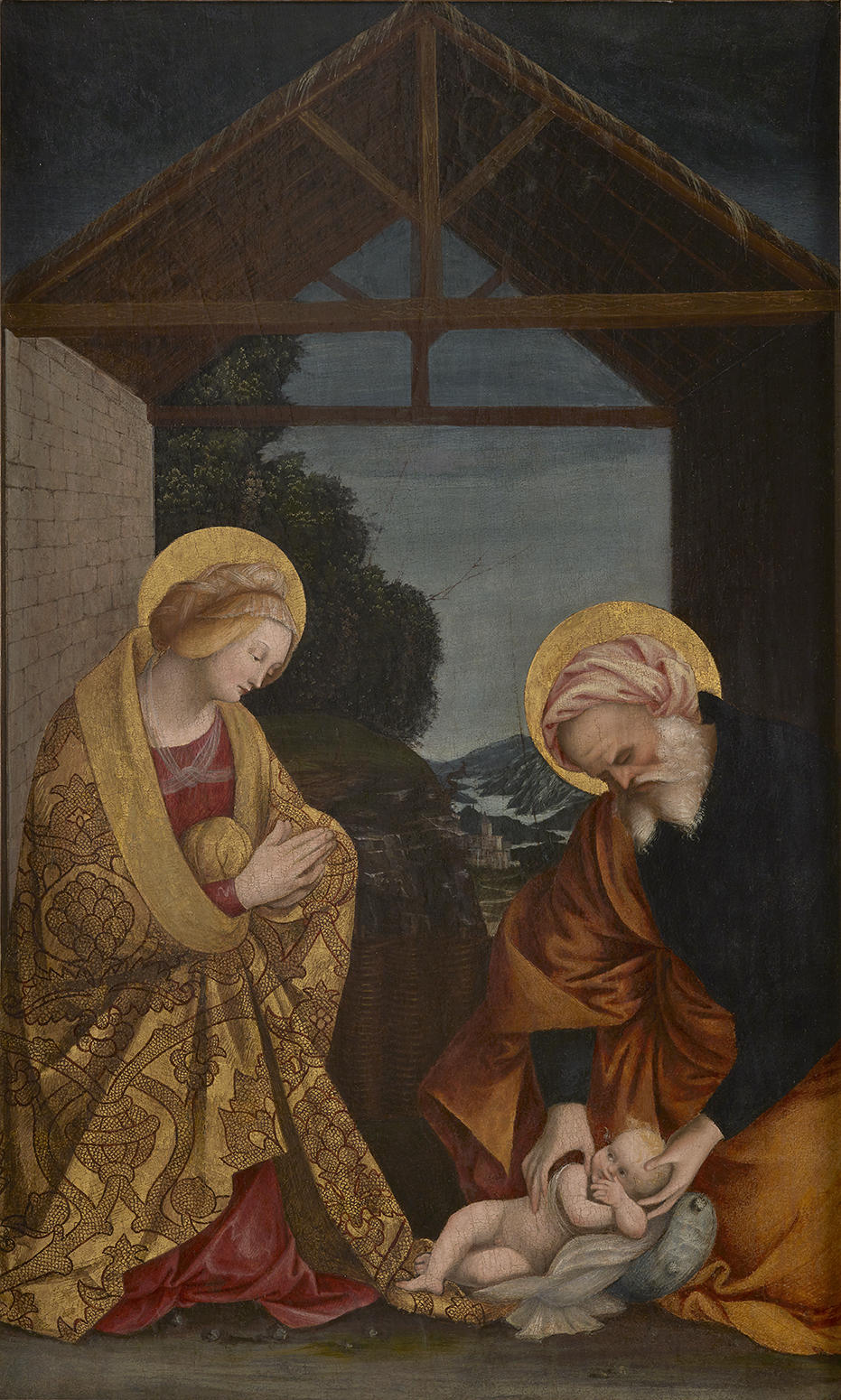
The Nativity
Oil on panel
90 x 56 cm (35 3/8 x 22 1/8 in.)
Literature
P. Manchinu in Fermo Stella e Sperindio Cagnoli seguaci di Gaudenzio Ferrari. Una bottega d'arte nel Cinquecento padano, exh. cat., G. Romano ed., Milan, 2006, p. 100 (as Cagnoli).
Description
This tender depiction of the Nativity has been in a private collection in Turin for almost half a century, acquired at the suggestion of the art historian Luigi Mallé, who included the work in his book on Spanzotti, Defendente and Giovenone, published in Turin in 1971. Mallé selected the painting for the dust jacket, demonstrating his high regard for the work. In his essay Gerolamo Giovenone: traccia per una monografia, Mallé links the Nativity to another panel, the Noli me tangere which entered the collection of the Museo Civico di Torino in the same period. According to Mallé, the two paintings should be dated around 1520 and mark a new maturity in the artist's career, moving away from the more Gothic style of his works from the first decade of the sixteenth century.
In 1973, Giovanni Romano (s.v. Cagnola (Cagnoli, De Cagnolis)) proposed an attribution to Sperindio Cagnoli for the altarpiece from Palazzo Madama. The proposal was taken up more recently by Paola Manchinu, who reiterated the close connection between the Noli me tangere and the Nativity, which was confirmed by Simone Baiocco, whom we thank for his recommendation and advice.
Sperindio Cagnoli was born at the end of the fifteenth century into a well-known family of painters from Novara who, under the guidance of their father Tommaso, enjoyed considerable success. Tommaso and his sons were among the painters called upon in 1490 to decorate the Sala della Balla in the Castello Sforzesco in Milan on the occasion of the wedding of Ludovico il Moro and Isabella d'Este. Cagnoli’s first independent work was the polyptych in the church of the Nativity of the Virgin Mary in Cerano, completed by November 1510. Here, Cagnoli’s work shows the influence of the previous
generation of Lombard painters, first and foremost Bergognone, as well as the impact of the work of Guadenzio Ferrari, an artist with whom Cagnoli had a long and fruitful collaboration.
Both the Nativity and the Noli me tangere are rich in references to Guadenzio, but also refer to the paintings of Giovenone and Martino Spanzotti, works that Manchinu suggests date to the middle of the second decade of the sixteenth century.