
Jacopo da Ponte, called Jacopo Bassano
b. 1510, Bassano del Grappa, Italy
d. 1592, Bassano del Grappa, Italy
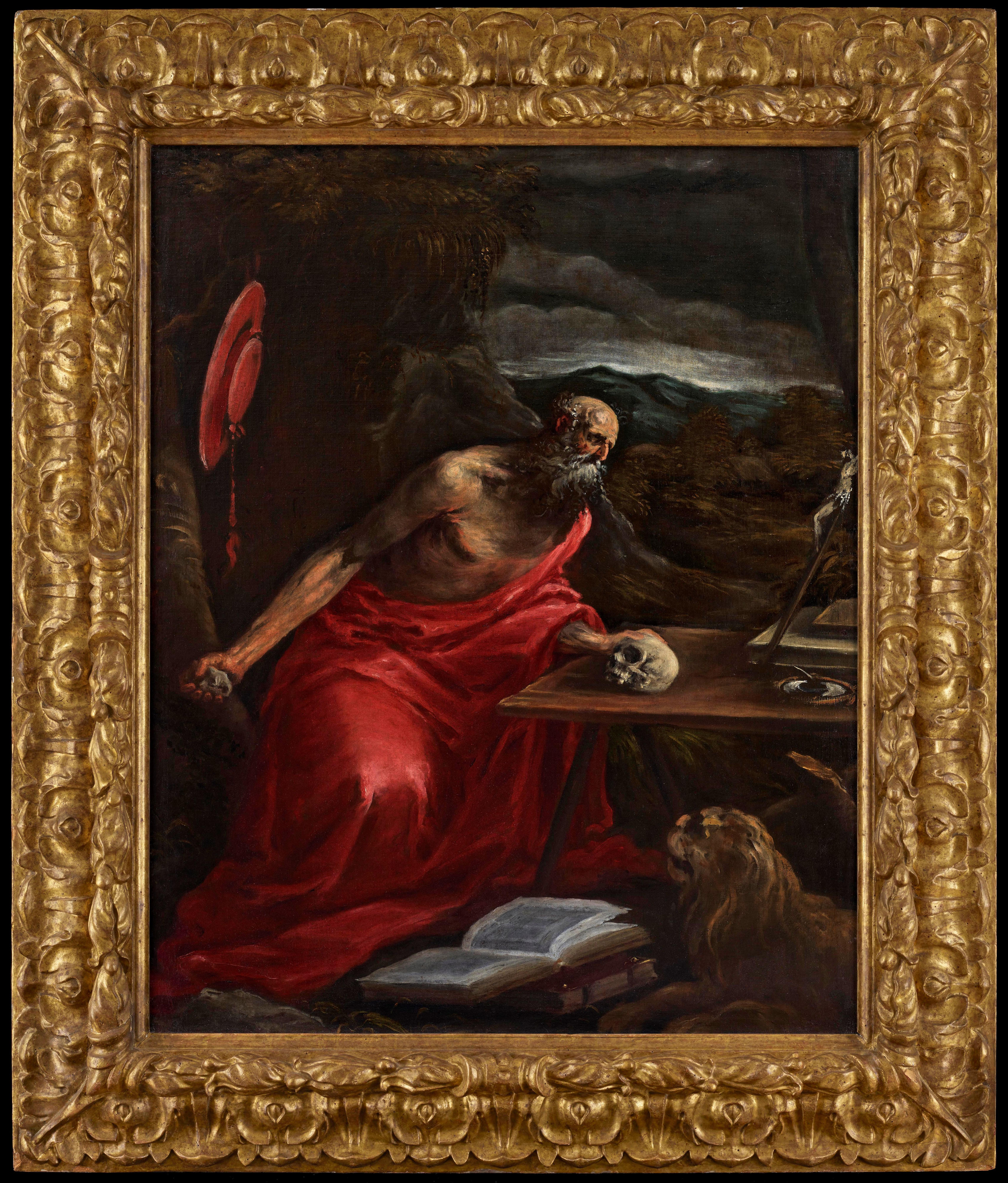
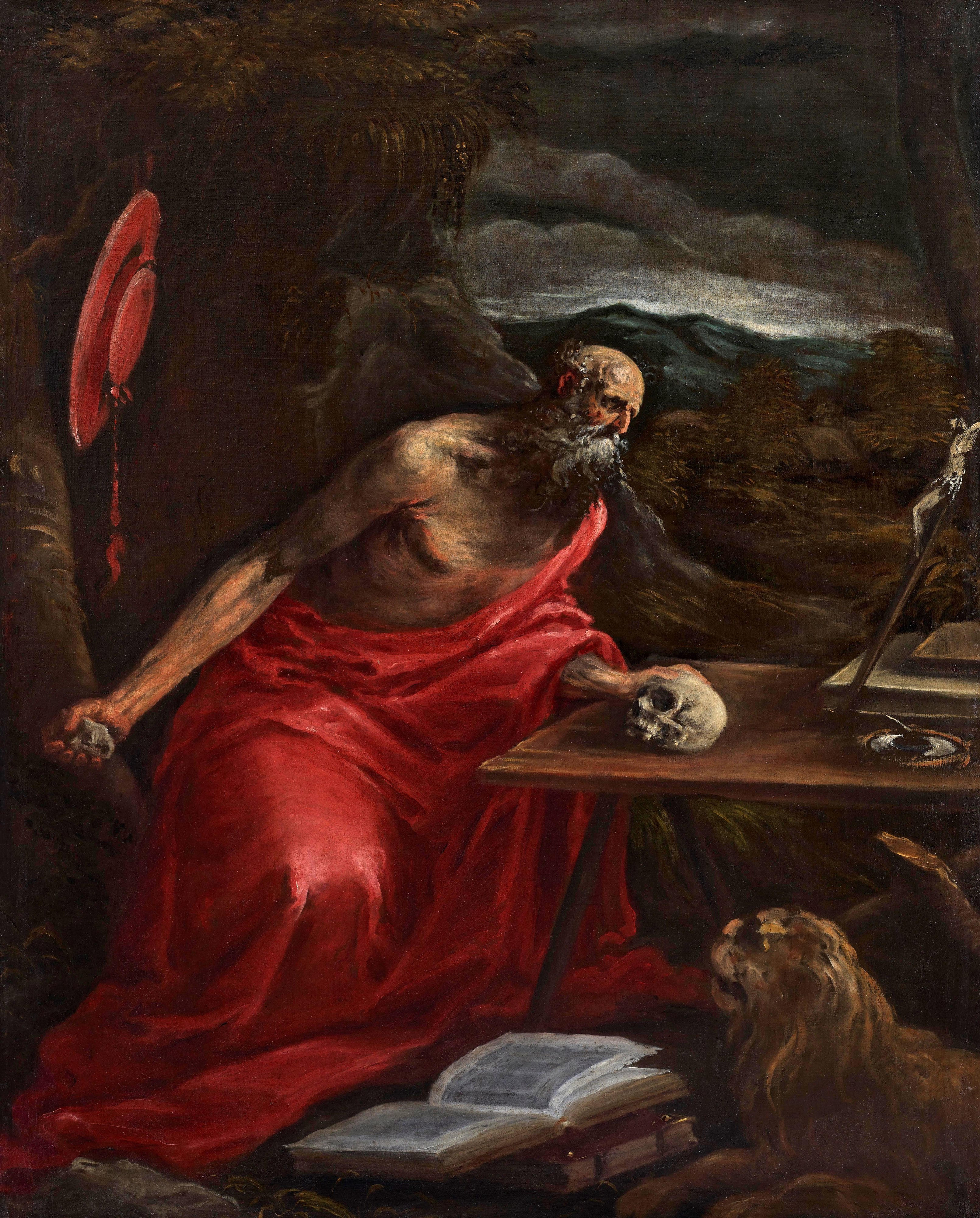
The Penitent Saint Jerome
c. 1585–91
Oil on canvas
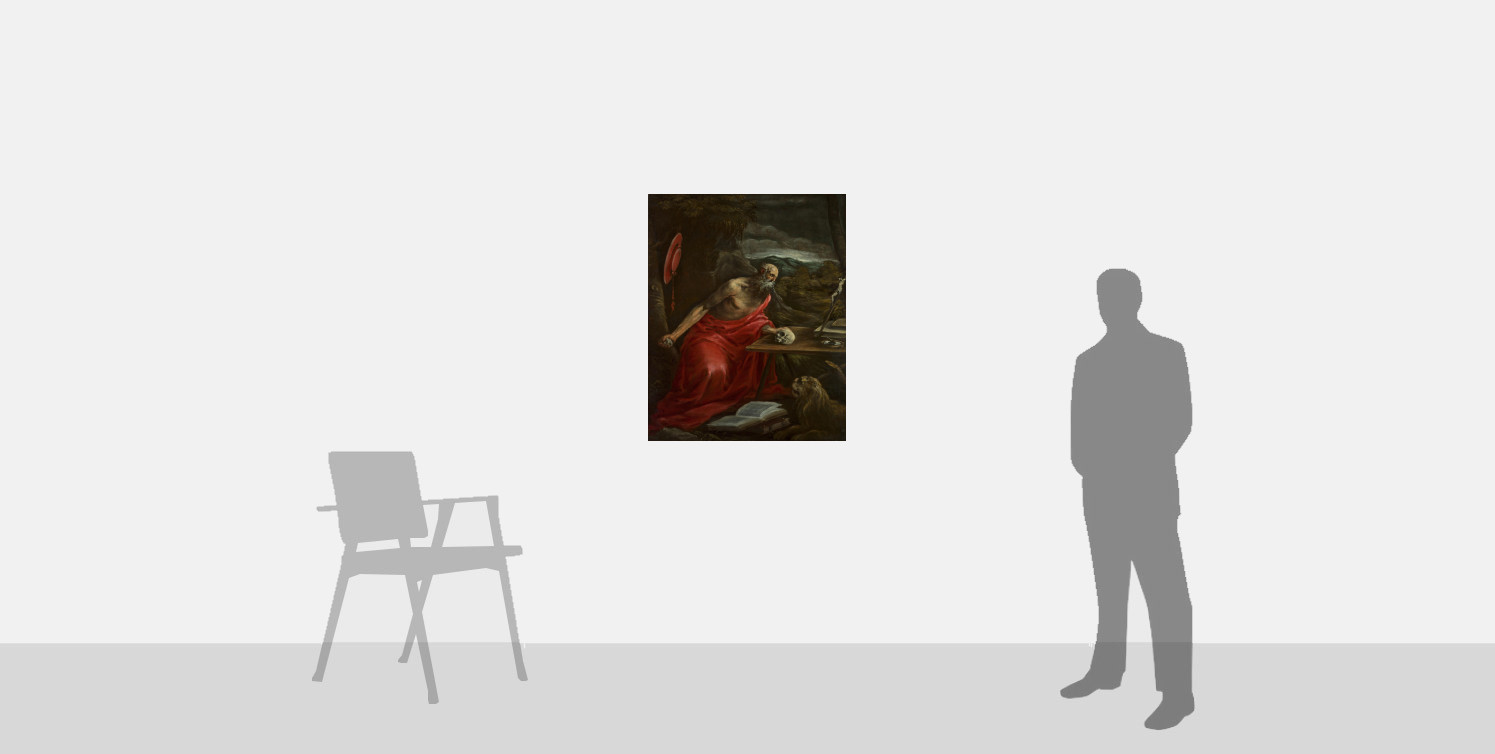
110 x 88 cm (43 1/4 x 34 5/8 in.)
Provenance
Literature
Description
Jacopo Bassano’s biography and career has been much studied and commented upon in the centuries since his death, and among his earliest biographers, Giambattista Verci is perhaps the most significant to our contemporary understanding of the artist. Verci also provided an astute analysis of Bassano’s artistic development, identifying four distinct maniere (styles) across his career and categorising his artworks accordingly. In the twentieth century, Alessandro Ballarin added a fifth maniera to those classified by Verci, corresponding to Bassano’s later works (1585–92), and represented by a series of key works exhibiting similar stylistic elements.
The starting point for Ballarin’s reconstruction was the discovery of the date 1585 for Bassano's Susanna and the Elders, now in the collection of the Musée des Beaux-Arts of Nîmes (fig. 1), a painting usually dated ten years before. Alongside the Nîmes painting, Ballarin was able to create a group of paintings that marked a new development, in comparison with the works of the 1570s. During this last period, Bassano appears to have adopted a new approach to colour; the surface of his paintings has a free and energetic texture with bold passages of colour and heightened use of light and shadow. The scale of these late paintings was smaller and they often depicted religious subjects in nocturnal settings with exquisite and contrasting effects of lighting. Critics now concur that Bassano’s works of this period demonstrate a personal interpretation of Tintoretto's and Titian’s late paintings, sharing the same dramatic atmosphere and taste for thick painterly brushstrokes.
The present painting, until recently unknown in Bassano’s oeuvre, evidently belongs to the same period. With a relatively small size, it was likely intended for personal devotion. In this work, Bassano deftly combines the iconography of the scholar-saint with that of the penitent. The saint is depicted at the opening of a large cave, with a crucifix, two books and another object – perhaps an inkwell or downturned mirror – atop a table in front of him. Another large book lies open at his feet, near to the tamed lion whom he befriended after removing a thorn from its paw. In his right hand, the saint holds a stone – symbolising his penitence – his arm extended and tense, grasping tightly, as if about to hurl the rock forward. His left hand rests upon a skull, with his gaze fixed on the slanting crucifix, his desperate concentration echoed by the full momentum of his body leaning towards this object of devotion. His flowing red robe is draped over one shoulder, revealing a bare chest with streaks of pink and orange in the flesh tones. The visible shock of red is accentuated by the cardinal’s hat that hangs from a nearby branch. The landscape on the disappearing horizon reveals hills punctuated by farms, rising into the mass of Monte Grappa.
The general composition of the Penitent Saint Jerome derives from a picture of the same subject by Bassano, dating to around 1563 and housed in the Gallerie dell'Accademia, Venice (inv. no. 761). Although representing the same subject and compositionally similar, the two paintings of Saint Jerome (painted approximately two decades years apart) vary considerably. The earlier work is marked by a powerful naturalism, placing the emphasis of the painting on the contemplative life of the saint, and exhibiting a restrained style and muted palette. This later version, by contrast, differs significantly in terms of its melancholy mood and apparition-like portrayal of the saint. The painting technique is, however, the key differentiator between the two works, and the defining feature that places this work into Bassano’s fifth and final maniera.
The artist’s mastery of colour is on full display in this painting, using layers of various hues to build the saint’s flesh, applied with vigorous and uninhibited brushstrokes. The landscape forming the background is constructed with bold, swirling applications of paint; the extreme contrast between light and dark further dramatises the composition, creating a denser, more sombre impression and foreshadowing the paintings of Caravaggio or even Goya.
The present work is an exciting and important addition to the artist’s last phase of painting. Not only does it reflect the culmination of the career of one of the greatest sixteenth-century Venetian painters, but it is also an exemplary illustration of a painterly maturity that the artist himself knew was significant; as recounted by Carlo Ridolfi, Bassano, approaching his final years, expressed regret at his looming demise just as he had started to appreciate what ‘good’ art was and was ready to learn afresh how to master the art of painting (see C. Ridolfi, Le Maraviglie dell’arte (1648), ed. D. von Hadeln, I, Berlin, 1914, p. 402).
We are grateful to Professor Alessandro Ballarin for confirming that the present work belongs to Jacopo Bassano’s fifth maniera, that he himself identified. This text is accompanied by an expertise from Professor Ballarin (originally in Italian and also with a translation into English).