
Giovanni Baglione
b. 1566, Rome
d. 1643, Rome
The Penitent Saint Jerome
c. 1610–15
Oil on canvas
117 x 158 cm (46 1/8 x 62 1/4 in.)
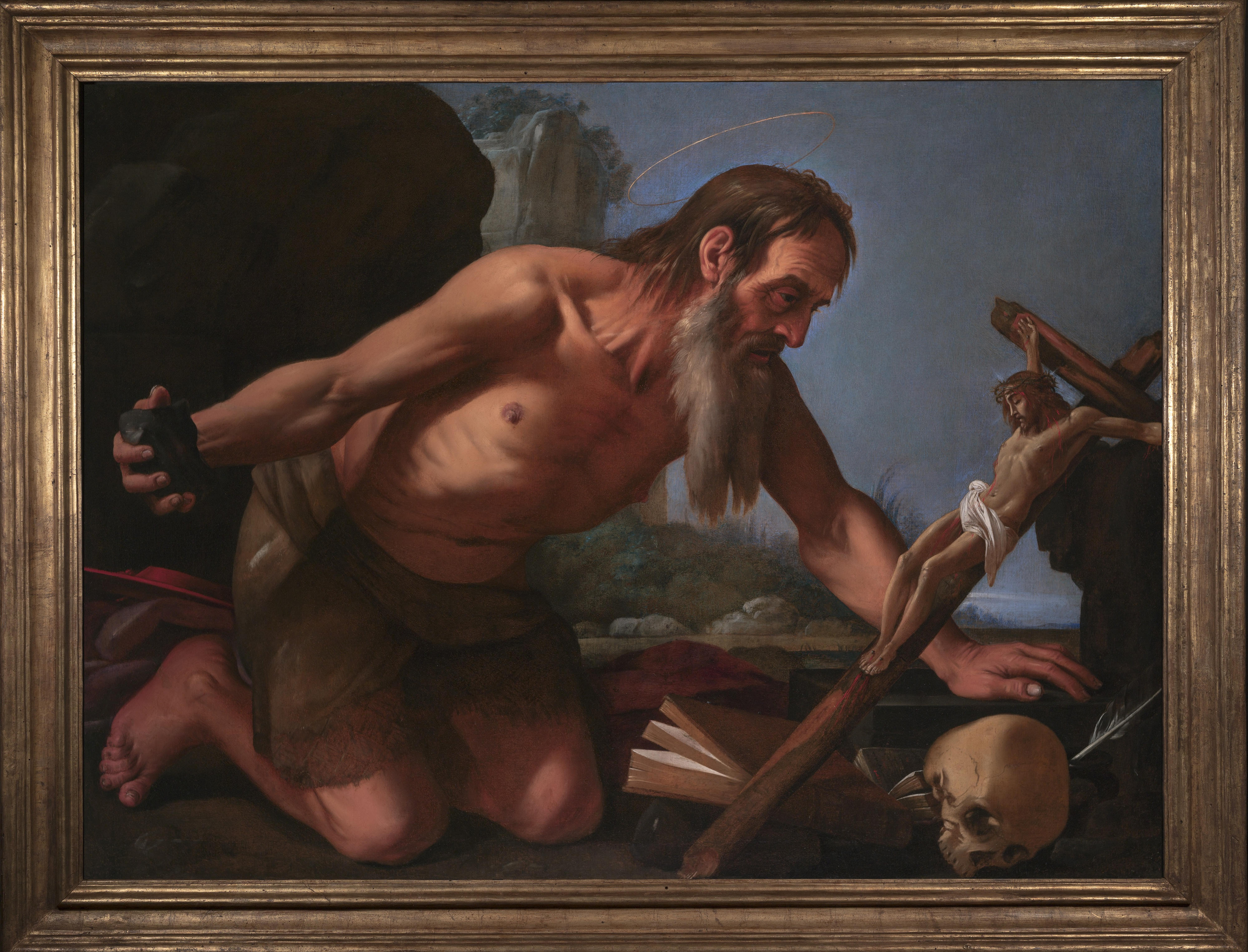
With frame: 140 x 181 x 8 cm (55 1/8 x 71 1/4 x 3 1/8 in.)
Provenance
Literature
A. Cosma and Y. Primarosa (eds.), Barocco in Chiaroscuro: persistenze e rielaborazioni del caravaggismo nell'arte del Seicento : Roma, Napoli, Venezia 1630- 1680 (proceedings of the conference held at the Gallerie nazionali di arte antica, Palazzo Barberini, Rome), Rome, 2020, p. 339.
G. Freuler, 'Una Sacra Famiglia della fase giovanile di Giovanni Baglione. Genesi di un'idea per un'opera perduta', Filo d'Arianna. Raccolta di Studi dell'Arte, II, March 2025, p. 60.
Description
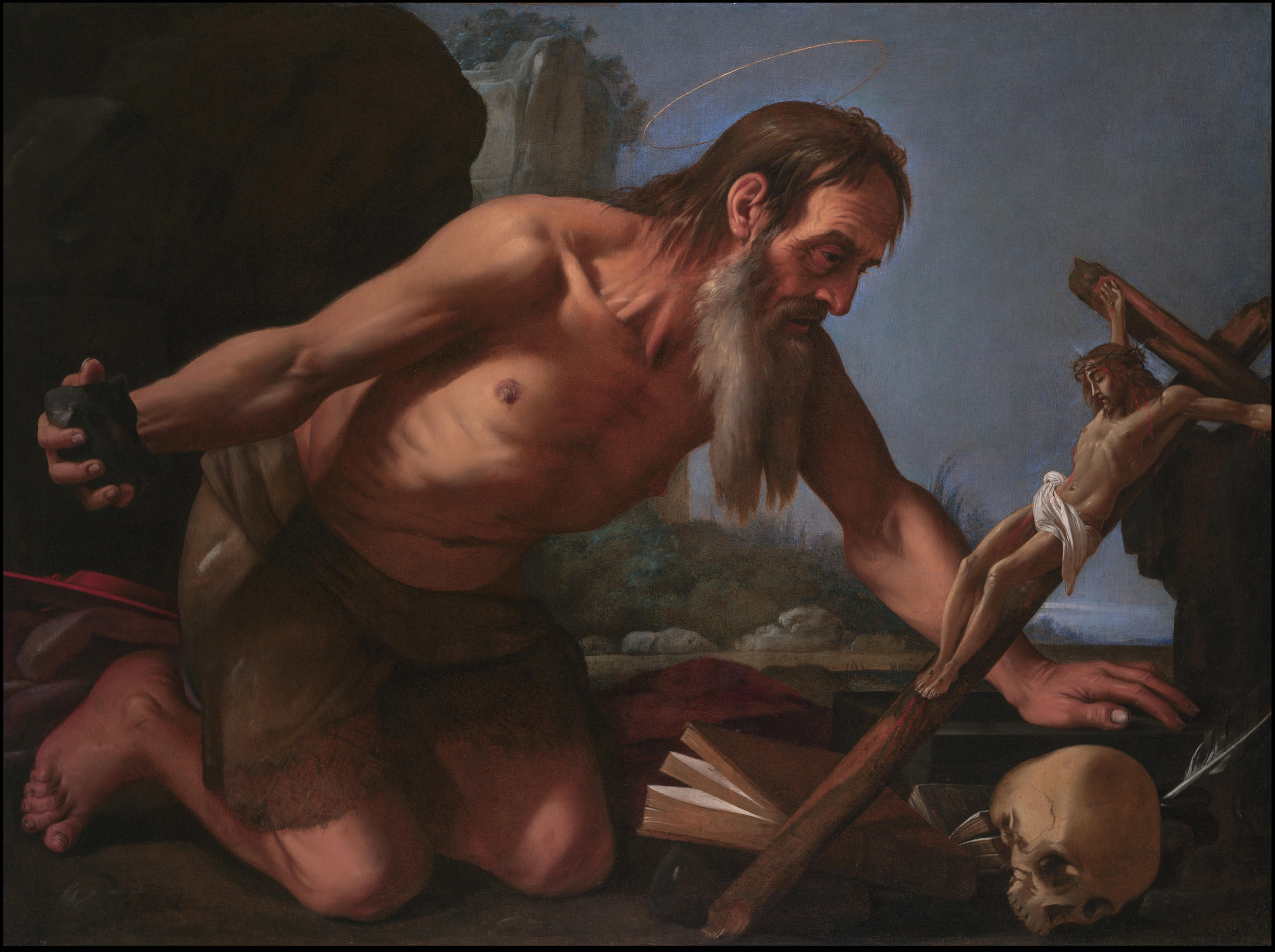
The scene takes place near a cave, dominated by the monumental figure of Saint Jerome, depicted life-size and prostrate on the ground in a moment of intense ascetic tension. In the background, a clear sky unfolds, its diffused light softening the contours of the landscape behind and harmonising the rocks and vegetation within a composition oriented towards a peaceful contemplation of nature.
The hermit saint clutches a stone in one hand and, extending his arm in preparation to strike his chest; with this gesture, his body fills the space of the composition, involving the viewer in the drama of the representation. His other hand rests on a ledge, providing support and helping to balance the weight of his vigorous, muscular body. Jerome is covered only by a brown loincloth tied at the waist, having already laid his red cloak and cardinal's hat on the ground, attributes that allude to his ecclesiastical dignity.
In front of him is a still life consisting of a skull, some worn books with partially open pages, an inkwell with a pen and a crucifix on which the figure of Christ appears almost miraculously made of flesh and blood.
However, the observer's attention is inevitably drawn to the saint's face, which is extraordinarily expressive. Although marked by old age – evident in the deep wrinkles furrowing his brow – it retains a remarkable vitality. The pathos that permeates his tense expression is visible in his fixed, absorbed gaze, indicative of his deep contemplation, and in his slightly parted mouth, almost suspended in the act of articulating a silent vowel.
The entire canvas is also distinguished by a marked attention to naturalism, particularly evident in the rendering of the saint's body. The abdomen, contracted at the diaphragm by an intake of breath, reveals the folds of the skin, while the clearly visible vein on the temple reveals an extraordinary sensitivity to reality.
As highlighted by the most recent criticism (TERZAGHI 2018; NICOLACI 2020, pp. 339-340), the discovery of this painting is one of the most significant additions to Giovanni Baglione's catalogue in recent years. Similarly, other recent attributions of works of remarkable quality have drawn attention to the painter, including The Apparition of the Angel to St Joseph (1599), now in the Pushkin Museum in Moscow (MORANDOTTI, TERZAGHI 2009); St John the Baptist, formerly in the Naumann collection, signed and dated 1610 (NAUMANN, SIMON 2014); and Judith with the Head of Holofernes, held in a private collection (PAPI 2014).
Giovanni Baglione was a central figure in the Roman art scene of the first half of the 17th century, known not only as a painter but also as a chronicler and biographer. His work Le Vite de’ pittori, scultori e architetti (Rome, 1642) is one of the fundamental texts for understanding the artistic, cultural and social dynamics of the period.
After an initial Mannerist period, marked by the influence of Giuseppe Cesari (Cavalier d'Arpino), Baglione underwent a profound transformation under the influence of the Caravaggesque revolution, starting in 1600, showing a renewed interest in the representation of nature, a more incisive modelling of light and an intensification of shadows. However, following his famous dispute with Caravaggio relating to marchese Giustiniani, which culminated in 1603 in a defamation lawsuit stemming from Caravaggio’s public mockery of Baglione, critics hesitated for a long time to interpret his work in a naturalistic key, reducing it to a limited “Caravaggesque interlude”.
In this context, Gianni Papi (2014, pp. 19-41; 2018, pp. 20-41) has repeatedly emphasised that this episode should not be considered as the end of Baglione’s Caravaggism, which continued after 1603. Baglione's naturalism, although often overlooked, reappears continuously in his painting practice, complicating the chronology of the works in his catalogue, which has recently undergone a more philological reorganisation (NICOLACI 2016a). The Judith with the Head of Holofernes, preserved in a private collection, has also made it possible to highlight how these more Caravaggesque works exerted a significant influence on other important contemporary artists, in particular Artemisia Gentileschi, considered the most eminent painter of those years in terms of fame and skill (PAPI 2014, pp. 8-18; PAPI 2018, pp. 20-41).
The attribution of this Saint Jerome to Giovanni Baglione can be corroborated through a series of comparisons with works dating from the end of the first decade of the 17th century and no later than the middle of the following decade. In particular, there are striking similarities with the Disputation of St Peter and St Paul (1606–7) in the Galleria Spada in Rome (fig. 1), and, even more specifically, with the face of St Paul in the other Disputation of St Peter and St Paul (1607) (fig. 2), formerly in the Koelliker collection (cf. PAPI 2006, pp. 74-75). The severe and almost menacing character of the physiognomy, distinguished by the aquiline nose, beard and white hair, together with the refined detail of the tense and pulsating temporal vein, even lead us to hypothesise the use of the same model from life.
Another significant point of comparison is provided by St John the Baptist (fig. 3), formerly in the Naumann collection, signed and dated 1610. This work displays the same careful attention to anatomical detail in the rendering of the body, evident in the contracted abdomen, slightly bent at the diaphragm, where the skin surface ripples in natural folds rendered with great attention to physiological detail. Additionally, the landscape in the background reveals remarkable similarities: it is structured as an evocative natural vista, orchestrated by the presence of imposing rocks rising above sparse vegetation which, gradually moving from the left to the right of the composition, tend to thin out until they open up into a large portion of clear, crystalline blue sky.
Gaudenz Freuler (FREULER 2025, p. 60) recently traced a sheet preserved at the Albertina Museum in Vienna (inv. 17753v, fig. 4) to the painting examined here, on which Giovanni Baglione executed a series of pen studies that relate to the compositional development phase of his Saint Jerome. At the centre of the various sketches, it is possible to recognise the composition of our painting, now clearly defined in the artist's mind and close to its pictorial translation. The identification of this sheet in relation to the canvas is therefore particularly significant, as it allows us to document a design phase in Baglione's creative process.
On the other side of the same sheet (inv. 17753r, fig. 5), among the various motifs, there is also a study after Correggio's Madonna del Latte, now in the Museum of Fine Arts in Budapest (inv. 55) (GOULD 1976, plate 95). At the beginning of the 17th century, the painting by Correggio was in the possession of the Aldobrandini family, as attested by the 1626 inventory; this circumstance makes it plausible to hypothesise that this sheet of sketches, and subsequently our painting, were also executed in Rome (cf. GOULD 1976, pp. 196-197).
However, in the Saint Jerome under examination, there is a marked influence of Venetian painting, an element that is almost entirely new in the artist's career. This is particularly evident in the unusual importance given to the landscape component within the composition. In this sense, it has been suggested that there may be a possible reference to the Venetian tradition and, specifically, to Giovanni Gerolamo Savoldo's Saint Jerome, now in the National Gallery in London (fig. 6) (TERZAGHI 2018; NICOLACI 2020, pp. 339-340), which may once have been in Venice, in the home of “Madama d'Ardier, Ambasciatrice Francese” (cf. FRANGI 1992, pp. 80-81).
Although paintings from the Venetian school were present in various Roman collections and could therefore have served as a means of learning about these models, Nicolaci's research has also documented Baglione's presence in the Venetian lagoon in the autumn of 1614 (NICOLACI 2016b, pp. 65-66). In light of this information, it cannot be ruled out – as hypothesised by the scholar himself in relation to the painting in question – that the work may have been created in Venice (NICOLACI 2020, pp. 339-340), also considering that it is not currently possible to establish whether the preparatory drawings predate or postdate this stay.
The present painting, which appears to be an extraordinary example of contact between Roman and Venetian figurative culture, could plausibly have been commissioned by a particularly important individual of the time, whose identity remains, however, unidentifiable with the current state of research. Although there is no direct documentation that attests with certainty to its provenance or patronage, it seems appropriate to refer to some mentions in ancient inventories that could refer to the work.
In the ‘inventory of paintings in Rome in the palace of the most illustrious Scipione Lancellotti’ (Inventario delli quadri che sono in Roma nel Palazzo dell’Ill.mo Scipione Lancellotti), dated 15 October 1640, no. 133 is recorded as “un quadro di San Girolamo originale del Baglione con cornice indorata”[1] (Lancellotti Archive, Palazzo, file 26, letter E; CAVAZZINI 1998, pp. 160, 196). The painting is still recorded in the family collections until 1769, as documented in the inventory of Ottavio Maria II Lancellotti (f. 258), after which all traces of it are lost (TERZAGHI 2018).
Even more significant could be a reference contained in the guide to Villa Borghese written by Domenico Montelatici (1700, p. 221), which mentions a “San Gerolamo che genuflesso avanti al Crocefisso in sembianza di penitente si percuote il petto con un sasso”[2] attributed to Baglione. However, there is no previous record of this work in the Borghese collections, which makes its identification uncertain (TERZAGHI 2018).
It should also be noted that Baglione tackled this subject several times during his career. The inventory drawn up after the painter's death records three paintings depicting Saint Jerome; however, the dimensions indicated do not seem to correspond to those of the work discussed here. These paintings could perhaps be identified with those that remained in the possession of the heirs at least until 1652, as attested by the documentation relating to the artist's bequest (see NICOLACI 2016b).
Giovanni Morciano, 9 March 2026, Florence
(translated from Italian)
Fig. 1 – Giovanni Baglione, The Disputation of Saint Peter and Saint Paul, 1606–7. Galleria Spada, Rome, no. 259.
Fig. 2 – Giovanni Baglione, The Disputation of Saint Peter and Saint Paul, 1607. Koelliker Collection, Milan.
Fig. 3 – Giovanni Baglione, Saint John the Baptist, 1610. Formerly Otto Naumann collection.
Fig. 4 – Giovanni Baglione, sheet of sketches (including Saint Jerome). Albertina Museum, Vienna, 17753v.
Fig. 5 – Giovanni Baglione, sheet of sketches (including Madonna and Child). Albertina Museum, Vienna, 17753r.
Fig. 6 – Giovanni Gerolamo Savoldo, Saint Jerome, c. 1525–30. National Gallery, London, NG3092.
Bibliography:
CAVAZZINI 1998
P. Cavazzini, Palazzo Lancellotti ai Coronari, Rome 1998.
FRANGI 1992
F. Frangi, Savoldo: catalogo completo dei dipinti, Florence 1992.
FREULER 2025
G. Freuler, ‘Una Sacra Famiglia della fase giovanile di Giovanni Baglione. Genesi di un’idea per un’opera perduta’, Filo d’Arianna. Raccolta di Studi dell’Arte, March 2025, pp. 58-66.
GOULD 1976
C. Gould, The Paintings of Correggio, London 1976.
MORANDOTTI, TERZAGHI 2009
A. Morandotti, M. C. Terzaghi, Giovanni Baglione: un dipinto ritrovato, Milan 2009.
NAUMANN, SIMON 2014
O. Naumann, R. Simon, Looking South. Three Centuries of Italian Paintings, exhibition
catalogue, New York 2014.
NICOLACI 2016a
M. Nicolaci, Giovanni Baglione (1566/1568-1643). Catalogo ragionato dell’opera pittorica, PhD dissertation, Sapienza Università di Roma, 2 vol., 2016.
NICOLACI 2016b
M. Nicolaci, ‘Giovanni Baglione e i “Virtuosi al Pantheon”. Precisazioni sulla Natività di Gesù con san Giuseppe e sull’eredità del pittore’, in V. Tiberia, A. Capriotti and P. Castellani (eds.), La collezione della pontificia Insigne Accademia di Belle Arti e Lettere dei Virtuosi al Pantheon, Reggio Emilia 2016, pp. 60-74.
NICOLACI 2020
M. Nicolaci, ‘Venezia (anti)caravaggesca. Itinerario critico in chiaroscuro (1620-1660)’, in A. Cosma and Y. Primarosa (eds.), Barocco in chiaroscuro. Persistenze e rielaborazioni del caravaggismo nell’arte del Seicento. Roma, Napoli, Venezia 1630-1680, Milan 2020, pp. 331-355.
PAPI 2006
G. Papi, La “schola” del Caravaggio: dipinti della Collezione Koelliker, Milan 2006.
PAPI 2014
G. Papi, Giovanni Baglione. Judith and her Maidservant, Florence 2014.
PAPI 2018
G. Papi, ‘Sull’Intermezzo caravaggesco di Giovanni Baglione’, in Senza più attendere a studio e insegnamenti. Scritti su Caravaggio e l’ambiente caravaggesco, Naples 2018, pp. 20-41.
TERZAGHI 2018
M. C. Terzaghi, expertise on the painting The Penitent Saint Jerome, written for Robilant+Voena gallery, October 2018.
[1] ‘an original painting of Saint Jerome by Baglione with a gilded frame’
[2] ‘Saint Jerome kneeling before the Crucifix in the guise of a penitent, beating his breast with a stone’