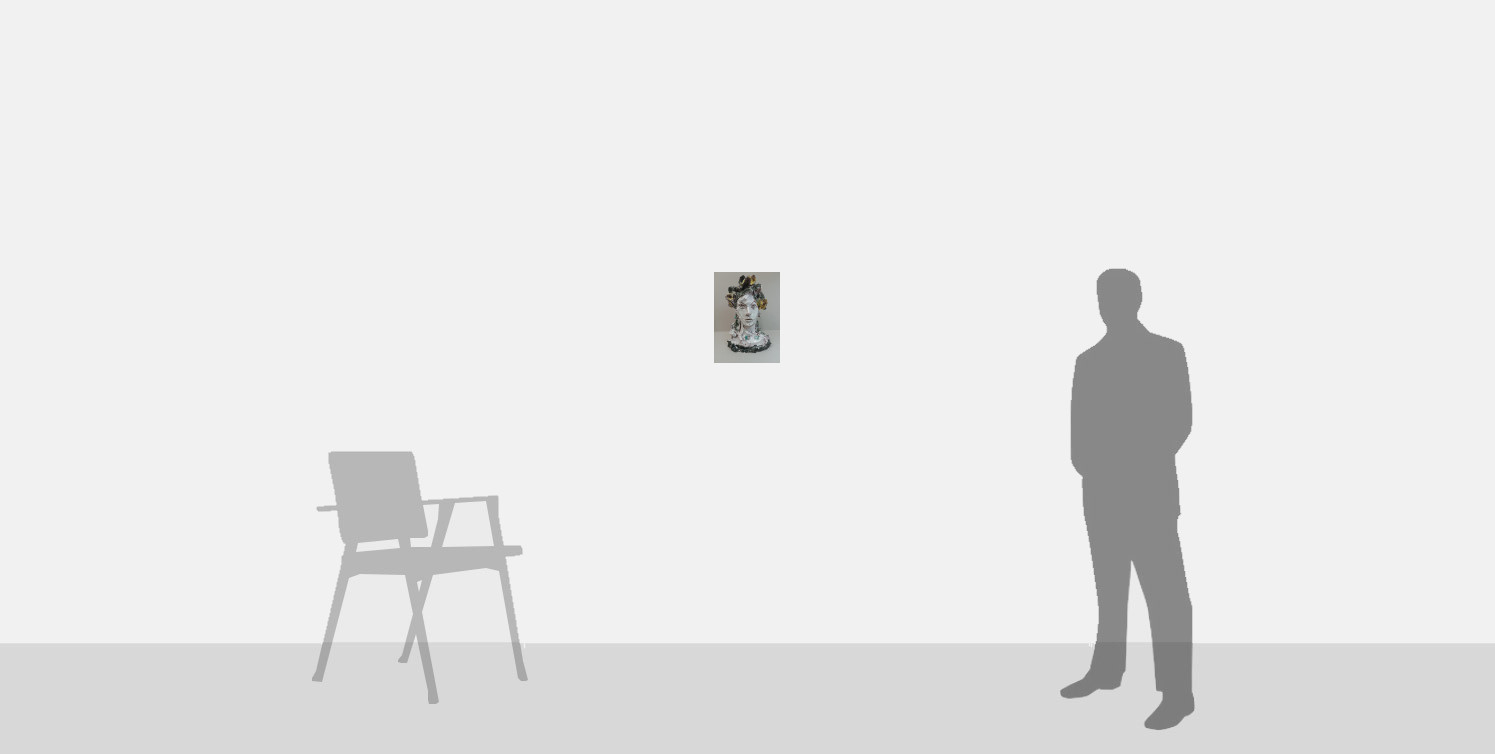

Lucio Fontana
b. 1899, Rosario de Santa Fé, Argentina
d. 1968, Comabbio, Italy
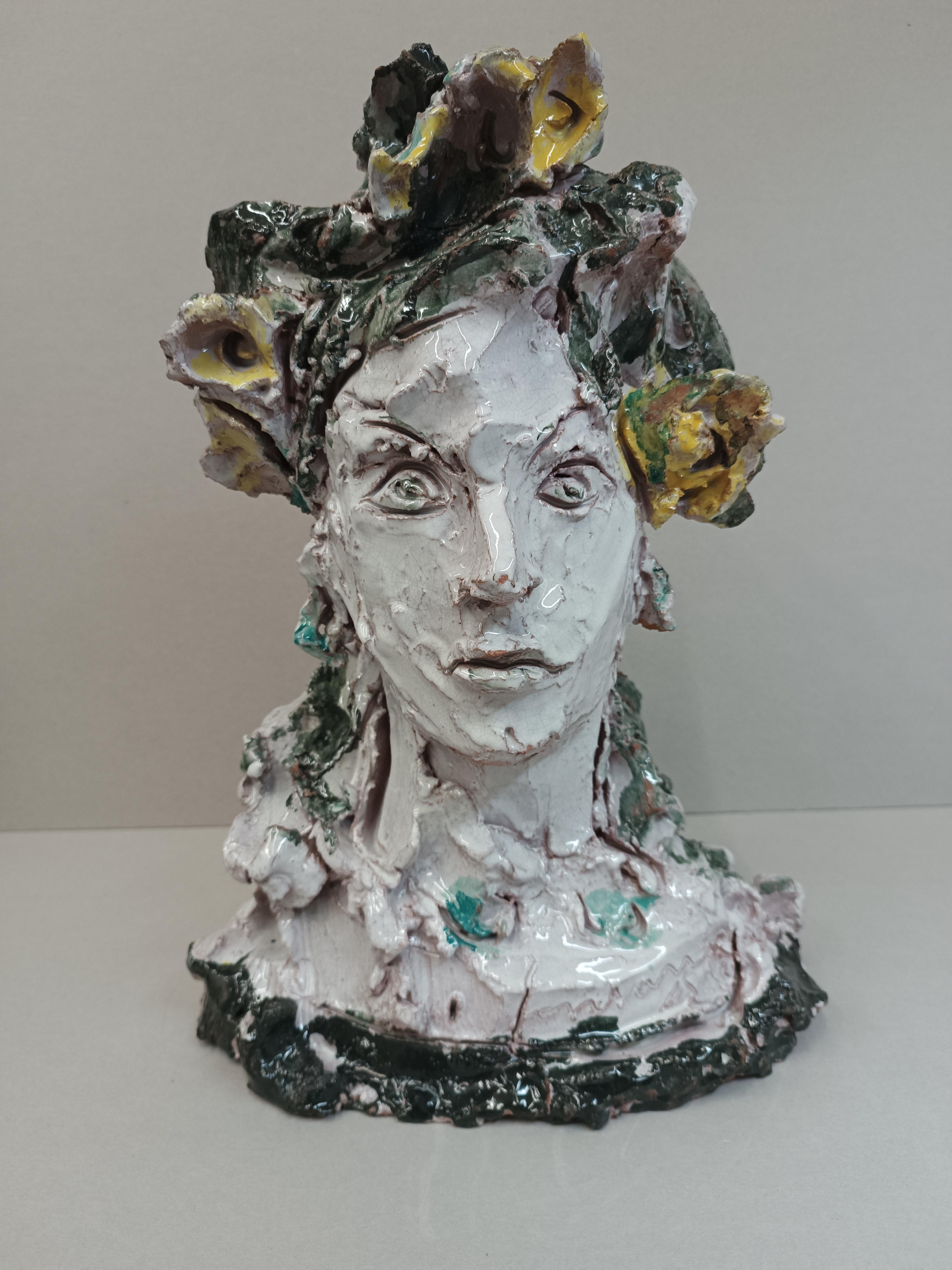
La reina de las rosas (o Cabeza de Mujer) (The Queen of the Roses (or, Head of a Woman)
1948
Painted and glazed terracotta
40.5 x 29.2 x 21 cm (16 x 11 1/2 x 8 1/4 in.)
Provenance
Alfredo Lisdero collection, Buenos Aires,
Private collection, Buenos Aires,
Thence by descent to a private collection.
Literature
Enrico Crispolti, Lucio Fontana, Catalogo ragionato di sculture, dipinti, ambientazioni, I, Milan 2006, p. 213, 48 SC 19, illustrated (with incorrect size).
Luca Massimo Barbero, Lucio Fontana, Catalogo ragionato delle sculture ceramiche, I, Milan 2022, p. 369, 48 SC 19, illustrated (with incorrect size).
Description
“We do not intend to abolish art or stop life: we want paintings to come out of their frames, and sculptures from under their glass cases. An aerial, artistic portrayal of a minute will last for thousands of years in eternity.”— Second Spatialist Manifesto, 1948
Lucio Fontana’s beautiful Reina de las rosas (Cabeza de Mujer) was created in 1948, the year he returned to Italy from Argentina. This sculpted bust is both raw and refined, an exposé of the artist’s tactile manipulation of the clay and interrogation of form and the limits of space. Such questions were clearly on his mind at the time; the work was created the year after Fontana published the first Spatialist Manifesto (1947), with the second version published in 1948. The artist created other sculpted heads and busts around this time, reflecting his continued interest in traditional subjects while he grappled with his ideas for a new language for the modern era. The female form provided constant source of inspiration for the artist, and other comparable works from the time include portraits of his wife Teresita (fig. 1), the writer Milena Milani and Esa Mazzotti, niece of the Albissola ceramicist Tullio Mazzoti (fig. 2), all of which have recently been exhibited in the landmark exhibition of Fontana’s ceramics at the Peggy Guggenheim Collection, Venice, Manu-facture: The Ceramics of Lucio Fontana (2025–26). Fontana made another work of the same subject as the present in 1948–49, this time titled in the Italian, La regina delle rose (fig. 3). The later work depicts more of the torso and is painted more boldly, contrasting with the delicate polychromy of our ceramic. La reina de las rosas shows Fontana’s interests in the female figure beyond portraiture, extending also to the group of works representing Medusa that he made around this time.
The rippling surface and undelineated boundaries between the subject's skin, hair, clothing and the flowers in her hair constitute in La Reina de las rosas the fundamental tenets of Fontana’s Spatialism, defined by the artist as “neither painting nor sculpture, nor lines delimited in space, but continuity of space in matter.” Moreover, the miniature peaks and troughs of the clay witness and evoke the artist’s own highly dynamic, gestural approach to his medium.
La Reina de las rosas dates from a pivotal period in which Fontana was involved in both figurative and abstract projects. The sculpture was executed in the same year that Fontana participated in the 24th Venice Biennale, exhibiting his first plaster Scultura spaziale (Spatial sculpture), 1947. While experimenting with purely Spatialist sculpture, Fontana continued to work figuratively across the 1940s and early 1950s. Many such works, including his famous series of crucifixes, explore religious subject matter, and his reliefs for the fifth door of the Duomo in Milan, completed in 1956, mark the culmination of this project. In the same period, Fontana concurrently began to create his first series of paintings in which he punctured the canvas with buchi (holes), as well as his first spatial environments, which originally combined shapeless sculptures, fluorescent paintings, and black lights viewed in a dark room, soon integrating neon tubing into their ceiling decoration.
In the Manifiesto Blanco, published by Fontana and a group of his students in Buenos Aires in 1946, the nascent Spatialists declared that “We live in the mechanical age. Painted canvas and upright plaster no longer have a reason to exist.” Yet in Fontana’s La Reina de las rosas and other figurative works of the 1940s and '50s, Fontana insisted that “upright plaster” did indeed merit existence, pushing his sculptural materials to their limits in order to capture an inexorable and wholly modern sense of form and interaction with space.
Fig. 1 – Lucio Fontana, Ritratto di Teresita, 1949, glazed and polished terracotta and topaz, 70 x 45 x 31 cm. Fondazione Lucio Fontana, Milan.
Fig. 2 – Lucio Fontana, Ritratto di Esa, 1953, glazed and painted terracotta with stones, 57 x 43 x 27 cm. Private collection, Albissola Marina.
Fig. 3 – Lucio Fontana, La regina delle rose, 1948–49, glazed, painted and polished terracotta with stones, 63 x 42 cm. Private collection, Rome.