
Neri di Bicci
b. 1419, Florence
d. 1491, Florence
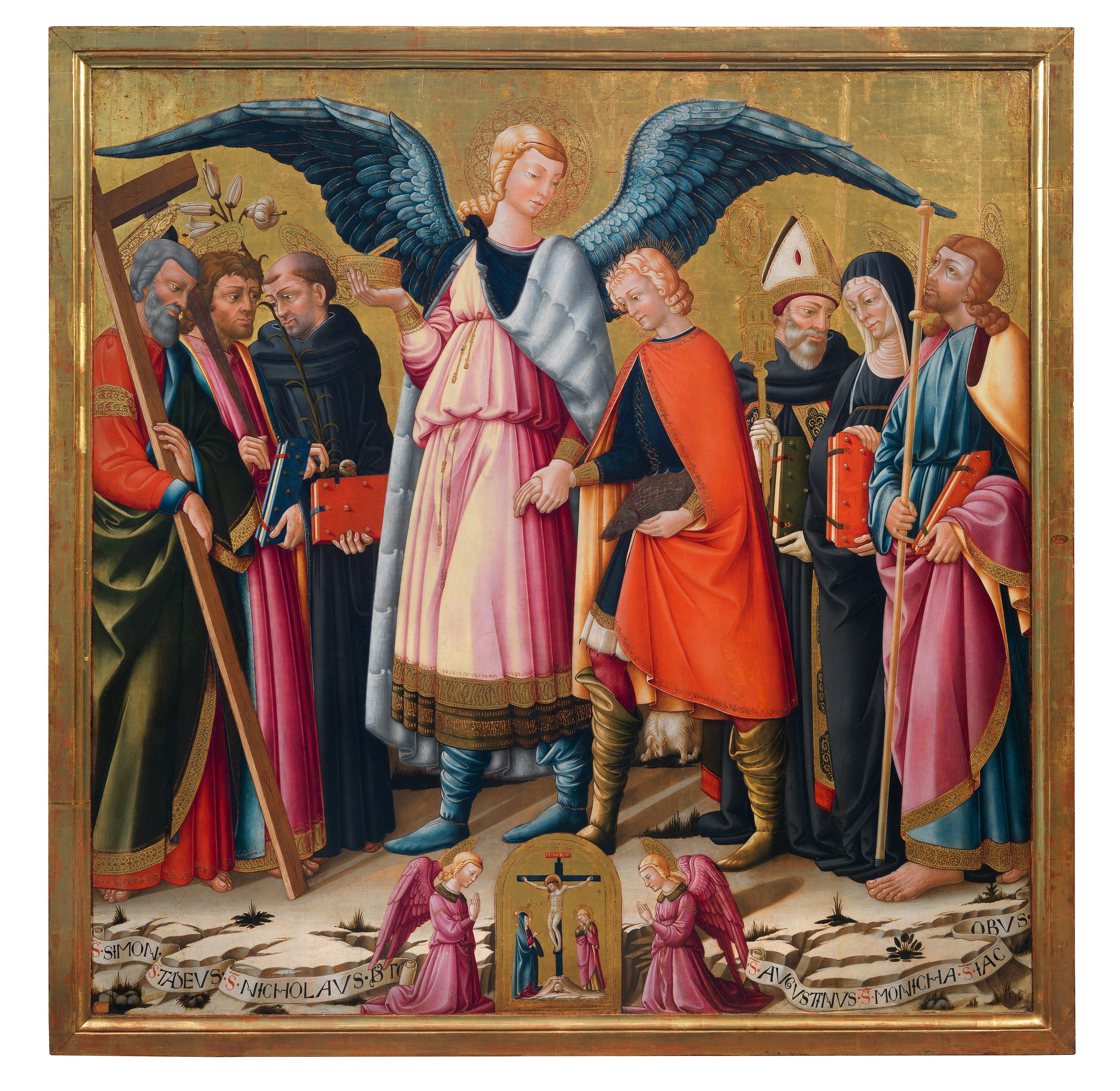
Tobias and Archangel Raphael, Saint Simon, Saint Thaddeus, Saint Nicholas of Tolentino, Saint Augustine, Saint Monica and Saint James the Greater
c. 1475
Tempera with gold and silver foil on panel
170.8 x 179.9 cm (67 1/4 x 70 7/8 in.)
Provenance
Venice, Giuseppe Piccolo,
Palermo, Chiaramonte Bordonaro Collection (purchased from the above, on 13 October 1900, for 4500 lire),
Turin, Galleria Antichi Maestri Pittori (documented in 1989 and 1993),
Sale, Wannenes, Genoa, La collezione Gallino. Dipinti antichi e del XX secolo, 1 June 2016, lot 701,
Private collection, Europe.
Literature
Salomon Reinach, Répertoire de peintures du Moyen Âge et de la Renaissance (1280 – 1580). Tome troisième, Paris 1910, p. 27, fig. 1.
Bernard Berenson, Italian Pictures of the Renaissance, Oxford 1932, p. 388.
Bernard Berenson, Pitture italiane del Rinascimento, Milan 1936, pp. 333–334.
Bernard Berenson, Italian Pictures of the Renaissance. Florentine School, London 1963, I, p. 156.
Bruno Santi in Giovanni Romano (ed.), Da Biduino ad Algardi. Pittura e scultura a confronto, exhibition catalogue, Turin 1990, cat. 6, pp. 54–61.
Arte Antica ‘93. Biennale di Antiquariato, Turin 1993, p. 5.
Annamaria Bernacchioni in San Nicola da Tolentino nell’arte. Corpus iconografico, I, Milan 2005, cat. 146, pp. 304–305.
Claudio Gulli, La collezione Chiaramonte Bordonaro nella Palermo di fine Ottocento, Milan 2021, p. 197, tav. XCV.
E. Zappasodi in Rediscoveries. Five Centuries of European Painting, London, 2025, pp. 8–15.
Description
In the centre, dressed in a pink robe, wrapped in an elegant vair cloak, the Archangel Raphael holds the hand of the young Tobias, blond and curly-haired, in three-quarter profile with a lowered gaze, depicted with a thoughtful expression as he listens to the angel's words. Between Tobias’s legs, sheathed in long boots drawn up to the knee, we can glimpse a dog, as mentioned in the biblical account in the Book of Tobit (5-11). These chapters narrate the adventures of Tobias during his journey to Media, where he marries his cousin Sarah, recovers a debt from his father and catches the great fish on the banks of the Tigris, here partially concealed under his cloak. From this fish, according to the tale, Tobias extracts the gall, heart and liver required for medicines, which are to be placed in the golden pyx held by the archangel. Tobias uses these medicines to exorcise his wife, who had been possessed by the devil, and to cure his father Tobit of his blindness. Beneath the large open wings of the angel, with their blue feathers and gilded spines, are two trios of saints, whose names are inscribed on the winding scrolls that unfurl along the rocky earth in the lower foreground. From the left, the apostles Simon and Thaddeus, holding the great cross and the palm of martyrdom respectively, are positioned alongside Saint Nicholas of Tolentino, who wears the Augustinian habit. Facing them, to the right of Tobias, stand James the Greater with a pilgrim's staff (at the extreme right edge), Saint Monica, dressed as an Augustinian nun, and her son Saint Augustine, with mitre, crosier and richly detailed cope over the black habit of his order.
At the beginning of the twentieth century, the panel was in Venice, with the antique dealer Giuseppe Piccoli where, on 14 October 1900, it was bought for the considerable sum of 4500 lire by Baron Gabriele Chiaramonte Bordonaro, senatore of the Kingdom.[1] The inventory numbers – 410 and 1510 – on the modern frame retain traces of this change of ownership. While in the Palermo collection, the work was mentioned by Salomon Reinach in the third volume of his Répertoire de peintures du Moyen Âge et de la Renaissance (1280 – 1580), published in 1910, reproduced in an engraving based on a drawing by Paride Weber (fig. 1). Reinach correctly assigned the panel to the Florentine painter Neri di Bicci, to whom it was later ascribed on several occasions by Bernard Berenson.[2]
Our panel is a vivid example of Neri’s fully mature style. The master was a prolific member of a successful dynasty of painters – that begun with his grandfather Lorenzo di Bicci in the late fourteenth century – active in Florence for over a century. He inherited a flourishing workshop, which he managed with considerable success from 1452, following the death of his father, Bicci di Lorenzo. What ensured Neri di Bicci’s favoured position was his straightforward and immediate visual language, based on figurative compositions and well-established models, rendered in a traditional manner, in which one can glimpse the influence of the main protagonists of Florentine painting in the mid-fifteenth century, in particular Fra Angelico, Benozzo Gozzoli and Filippo Lippi, but also elements which become evident in the younger generation, including the Pollaiolo brothers and Andrea del Verrocchio.[3]
The journey of Tobias represented in the centre of the painting was a much-loved subject in late-fifteenth-century Florence due to its association with Archangel Raphael's patronage of young scions sent away from their homeland for mercantile apprenticeships.[4] Neri tackled it several times both in altarpieces for public settings, such as ours, and in works destined for private devotion (figs. 2 and 3), such as a panel formerly with Kisters in Kreuzlingen, and in the Raphael and Tobias of the Lehman collection in New York.[5] These examples bear similarities to the present panel, namely in the fall of the archangel's cloak, knotted on the left shoulder and turned up on the right, and in the radiant face of Tobias.
In our painting, the figures stand out definitively against the golden background thanks to the sharp and assured draughtsmanship – in debt to Andrea del Castagno – which was typical of Neri, just as the bright and profound colouring. The frowning faces of the figures, their brows furrowed by wrinkles and their temples, necks and hands delineated by pulsating veins, are also recurrent traits in the full maturity of our painter.
The dryness of the stroke is redeemed by an irreproachable technical mastery, evident in the compact and enamelled areas of colour, in an excellent state of conservation, and in the skilful handling of the metal foils. Thaddeus’s palm frond and Tobias’s fish are executed directly on the silver leaf, while the embroidery of the latter’s giornea is embellished with gold leaf, as are the silks along the neckline and hem of the red robe worn by Saint Simon, and on the burgundy robe of Thaddeus. Small, six-petalled flowers adorn the haloes, giving rhythm to the central compass, against an engraved background; such detailing is also found in the edges of the saints' robes, on which pseudo-Arabic inscriptions and plant motifs appear at intervals, and on the stole of Augustine. Indeed, the crosier of the saint is entirely engraved on the gold leaf, achieved through the finest of incisions and with the delicate application of a translucent varnish which describes the areas of shadow.
Although the exact provenance of this altarpiece is almost impossible to ascertain, a logical assumption is that it was executed for an Augustinian community, as suggested by the inclusion of Nicholas of Tolentino, Augustine and his mother Monica, all cloaked in the black habit of the order.[6] The central subject of the panel, favoured by merchants and tradesmen as mentioned above, points to its original placement in the chapel of a noble family, perhaps dedicated to the apostles Simon and Thaddeus, who are depicted in a prominent position on either side of the archangel. Moreover, Neri di Bicci had a privileged relationship with the Augustinians, for whom he worked on several occasions and for various confraternities,[7] not only in Florence, aided by the strong contacts he had established with the convent of Santo Spirito, near which he lived.[8] It is noteworthy that both panels executed for this Florentine convent depicted the Three Archangels and Tobias – a subject akin to the present painting. This we know thanks to the Ricordanze, an exceptional personal diary in which, over the course of about twenty years, Neri jotted down facts and happenings from his professional, private and public life.[9] The first panel painted for the Santo Spirito convent, commissioned by the theologian Fra Francesco Zoppo and made between 1462 and 1463, is lost; the second, an altarpiece commissioned for the chapel of the apothecary Mariotto della Palla a decade later, in 1471, is now in the Detroit Institute of Art (fig. 4).[10] To this altarpiece, scholars have also added – with many distinctions and afterthoughts – four panels for a predella, each depicting stories of the archangel; these are today dispersed among private collections and the Philadelphia Museum of Art.[11]
The Detroit painting has similarities with our panel that are immediately obvious; they share the same format and have similar dimensions, and propose a comparable idea of the central grouping. In both panels, Raphael steps along a diagonal, with a familiar contraposto, turning towards Tobias whose hand he holds; the dog peeps out from between the young man's legs in a similar fashion; and so too are identical the two angels in adoration on either side of the small icon depicting the Crucifixion in the centre foreground. This passage, with its illusionistic appearance, is a motif that Neri returned to several times, and which looks back to the illustrious model of Fra Angelico's San Marco altarpiece.
There is no trace of our altarpiece in the Ricordanze, suggesting that it was commissioned after 4 April 1475, when the painter stopped compiling these memoirs.[12] Such a chronology, moreover, seems consistent with the style of the panel, which shows similitudes to works executed by Neri di Bicci during the 1470s, such as the Virgin and Child with Saints Nicholas, Raphael, Tobias, Domninus, Julian and Anthony Abbot in the Museum of Sacred Art in Tavarnelle Val di Pesa, commissioned by Niccolò Sernigi and painted in 1473 for Santa Maria al Morrocco (fig. 5).[13] Here the martyred knights are seen with the same apprehensive expressions as those of Nicholas of Tolentino and James the Greater in our panel (figs. 6–7), with similar decoration in the haloes. The adolescent Tobias in our panel, with his sharp eyebrows, fleshy mouth, pursed lips, and slightly protruding chin, is closely related to the Saint Sebastian with Saints Bartholomew and Nicholas in the Pinacoteca Civica in Volterra, undertaken by Neri in 1478 (figs. 8–10). This Saint Sebastian echoes Antonio del Pollaiolo’s representation of the same subject, painted for the Pucci chapel in the Santissima Annunziata in Florence, now in the National Gallery in London.[14] The date of the Volterra painting provides a probable latest date for our panel, which was likely executed around the mid 1470s. This supposition is also supported by the profound similarities between Saint Nicholas and Saint Augustine, notably in the aged appearance of the face and wrinkled forehead, in the pleats of the robe and in the crosier that they both hold in their right hands. The latter is also identical to the martyred Pope Fabian of the poorly conserved Assumption of the Virgin with angels and saints in Santa Maria Assunta in Faeto in Pratomagno, likewise painted in the period (figs. 11–12).[15]
Emanuele Zappasodi
January 2025, translated from Italian
Fig. 1 Paride Weber, after Neri di Bicci, in S. Reinach, Répertoire de peintures du Moyen Âge et de la Renaissance (1280–1580). Tome Troisième, Paris 1910, p. 27, fig. 1.
Fig. 2 Neri di Bicci, The Archangel Raphael and Tobias, early to mid-1460s, 26.4 x 19.1 cm, The Metropolitan Museum of Art, New York, inv. 1975.1.71.
Fig. 3 Neri di Bicci, Tobias and the Angel, the Penitence of Saint Jerome and the Stigmatisation of Saint Francis, 23.2 x 33 cm, formerly Kisters collection, Kreuzlingen.
Fig. 4 Neri di Bicci, Tobias and Three Archangels, 1471, 180.3 × 174.6 cm, Detroit Institute of Arts, inv. 26.114.
Fig. 5 Neri di Bicci, Madonna and Child Enthroned with the Archangel Raphael and Tobias, with saints Nicolas, Anthony Abbot, Domnius and Julian, 1473, Museo d’Arte Sacra, Tavernelle Val di Pesa.
Fig. 6 Detail of Neri di Bicci, Madonna and Child… 1473, Museo d’Arte Sacra, Tavernelle Val di Pesa.
Fig. 7: Detail of Neri di Bicci, Tobias and Archangel Rafael…c. 1475.
Fig. 8 Neri di Bicci, Saints Bartholomew, Sebastian and Nicholas with two angels, 1478, Pinacoteca Civica di Volterra.
Fig 9: Detail of Neri di Bicci, Saints Bartholomew, Sebastian and Nicholas with two angels, 1478, Pinacoteca e Museo Civico, Volterra.
Fig 10: Detail of Neri di Bicci, Tobias and Archangel Rafael…c. 1475.
Fig 11: Detail of Neri di Bicci, The Assumption of the Virgin with saints and angels, c. 1475-85, Santa Maria Assunta, Faeto di Pratomagno.
Fig 12: Detail of Neri di Bicci, Tobias and Archangel Rafael…c. 1475.
[1] C. Gulli, La collezione Chiaramonte Bordonaro nella Palermo di fine Ottocento, Milan 2021, p. 197.
[2] S. Reinach, Répertoire de peintures du Moyen Âge et de la Renaissance (1280 – 1580). Tome troisième, Paris 1910, p. 27, fig. 1; B. Berenson, Italian Pictures of the Renaissance, Oxford 1932, p. 388; Idem, Pitture italiane del Rinascimento, Milan 1936, pp. 333-334; Idem, Italian Pictures of the Renaissance. Florentine School, London 1963, I, p. 156. On the painting, see also B. Santi in G. Romano (ed.) Da Biduino ad Algardi. Pittura e scultura a confronto, exhibition catalogue (Turin, 12 May – 23 June 1990), Turin 1990, cat. 6, pp. 54-61; A. Bernacchioni in San Nicola da Tolentino nell’arte. Corpus iconografico, I, Milan 2005, cat. 146, pp. 304-305.
[3] For a profile of the painter, see D. Rivoletti, Neri di Bicci (ad vocem), in Dizionario Biografico degli Italiani, vol. 78, Roma 2013, pp. 242-245, with bibliography above.
[4] G.M. Achenbach, ‘The Iconography of Tobias and the Angel in Florence Painting of the Renaissance’, Marsyas, III, 1943-1945 (1946), pp. 71-86; G. Mara, ‘Raffaele Arcangelo’ (ad vocem), Bibliotheca Sanctorum, vol. X, Rome 1968, col 1362.
[5] The Kisters panel was sold in New York at Christie's on 6 April 2006, lot 204, after becoming part of the collection of Edwin L. Weisl.
[6] B. Santi in Da Biduino ad Algardi... cit., p. 59; A. Bernacchioni, in San Nicola da Tolentino nell’arte... cit., p. 305.
[7] There are documented works by Neri di Bicci for the Augustinian convent of Santa Monica, for the monastery of San Gaggio, for the church of Sant'Agostino in Certaldo and for the Augustinian churches of Scarperia in Mugello and Poggibonsi. On these paintings, see B. Santi in Da Biduino ad Algardi... cit., pp. 59-60.
[8] A. Thomas, ‘Neri di Bicci, Francesco Botticini and the Augustinians’, Arte Cristiana, LXXXI, 1993, 1-2, pp. 23-34, speciatim p. 26.
[9] Neri di Bicci, Le Ricordanze (10 marzo 1453–24 aprile 1475), B. Santi (ed.), Pisa 1976.
[10] Ivi, pp. 372-3783.
[11] On the Detroit painting and the predella, see the article by E. Fahy, ‘A Predella Panel by Neri di Bicci’, The Burlington Magazine, CXXVII, 1985, 992, pp. 766-768; for the addition of a fourth section, see C. Strehlke, Italian Paintings 1250 – 1450 in the John G. Johnson Collection and the Philadelphia Museum of Art, Philadelphia 2004, pp. 323-326, and L.B. Kanter in L.B. Kanter, J. Marciari, Italian Paintings from the Richard L. Feigen Collection, New Haven and London 2010, pp. 94-87
[12] B. Santi in Da Biduino ad Algardi... cit., p. 60.
[13] Neri di Bicci, Le Ricordanze... cit., pp. 428-430, n. 797; B. Santi in M. Gregori, A. Paolucci and C. Acidini Luchinat (ed.), Maestri e botteghe. Pittura a Firenze alla fine del Quattrocento, exhibition catalogue, Cinisello Balsamo 1992, pp. 194-195, cat. n. 7.4.
[14] The reference to Pollaiolo was first highlighted by E. Carli, Volterra nel Medioevo e nel Rinascimento, Pisa 1978, pp. 92-93. On the painting, from the church of San Giusto, see also A. Paolucci in A. Paolucci (ed.), La Pinacoteca di Volterra, Florence 1989, pp. 131-132, cat. 25.
[15] P. Refice and I. Droandi (ed.), L’Annunciazione di Neri di Bicci di Faeto in Pratomagno, Florence 2011.