
Damien Hirst
b. 1965, Bristol
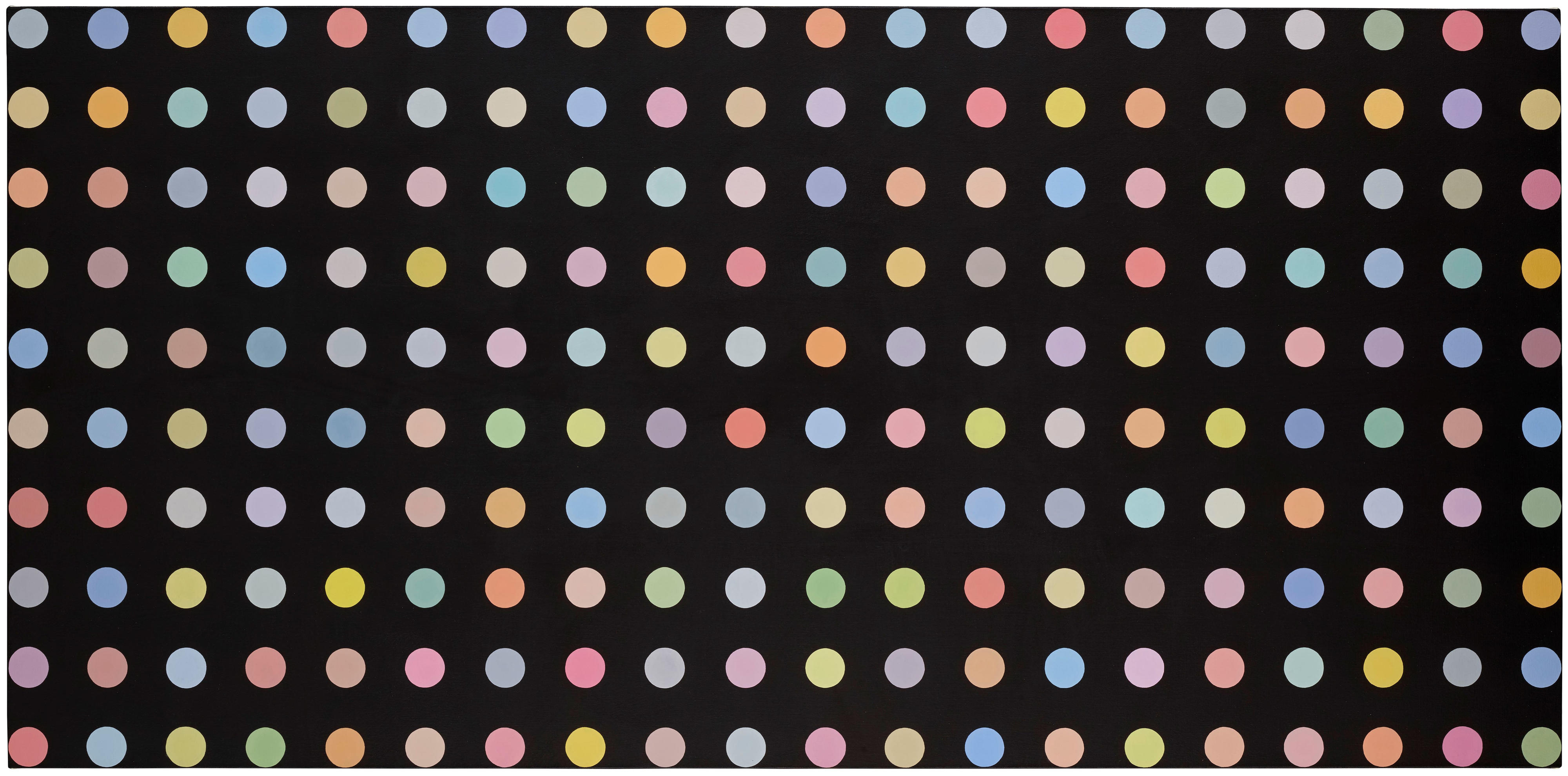
Trans-2-Hexenyl Acetate
1999–2008
Household gloss on canvas
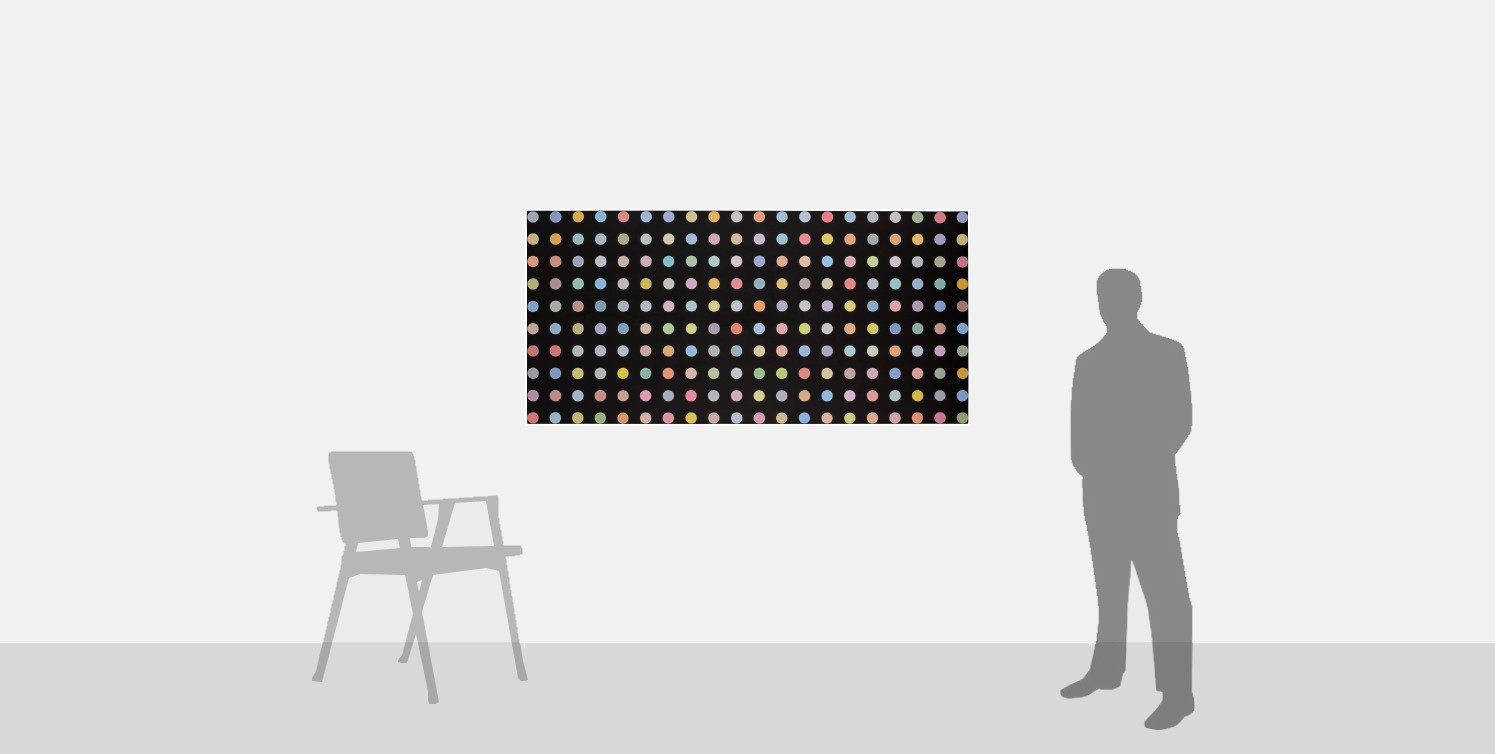
96.5 x 198.1 cm (38 x 78 in.)
Provenance
Private Collection, United Kingdom.
Description
'To create that structure, to do those colours, and do nothing. I suddenly got what I wanted. It was just a way of pinning down the joy of colour.'—Damien Hirst
The spot paintings are among Hirst’s most widely recognised works. Of the thirteen subseries within the spots category, the ‘Pharmaceutical’ paintings are the first and most prolific. There are over 1000 in existence, dating from 1986 to 2011. In 1988, during the third and final stage of ‘Freeze’, Hirst painted two near-identical arrangements of coloured spots onto the wall of the warehouse. He called the works ‘Edge’ (1988) and ‘Row’ (1988). These paintings followed some loose hand-painted spots on board, dating from 1986, and the first spot work on canvas ‘Untitled (with Black Dot)’ (1988) the only ‘Pharmaceutical’ painting ever to have incorporated a black dot. Following ‘Freeze’, Hirst started to refine his creative process. Slowly, he began to employ assistants to create the spot paintings. Any physical evidence of human intervention – such as the compass point left at the centre of each spot – was removed, until the works appeared to have been constructed mechanically, or 'by a person trying to paint like a machine'. For Hirst, it was a departure from years of experimenting with paint and collage, and the first result of his search for a contemporary art form that could succeed without a reliance on 'already organised elements.'
In 2012 Gagosian Gallery exhibited over 300 spot paintings across eleven gallery spaces worldwide. Conceived of as a single exhibition, ‘The Complete Spot Paintings 1986- 2011’ fulfilled Hirst’s longstanding ambition to show the works together. He explained in 2000 of the idea of an installation of multiple spot paintings: 'it’s an assault on your senses. They grab hold of you and give you a good shaking. As adults, we’re not used to it. It’s an amazing fact that all objects leap beyond their own dimension.'
The present work is closely related to the early spot paintings, a continuation of Hirst's ambitious series. This work is an extremely rare spot painting with a black background, rather than Hirst's customary white. It features ten rows of 20 spots, each dot a unique shade but rendered with precision of size and spacing that gives the work an almost Op Art appearance. The enduring allure of the spot paintings attests to the expansive possibilities of variation in form, composition, and colour that the humble shape of a filled circle can offer.