

Pablo Picasso
b. 1881, Málaga, Spain
d. 1973, Mougins, France
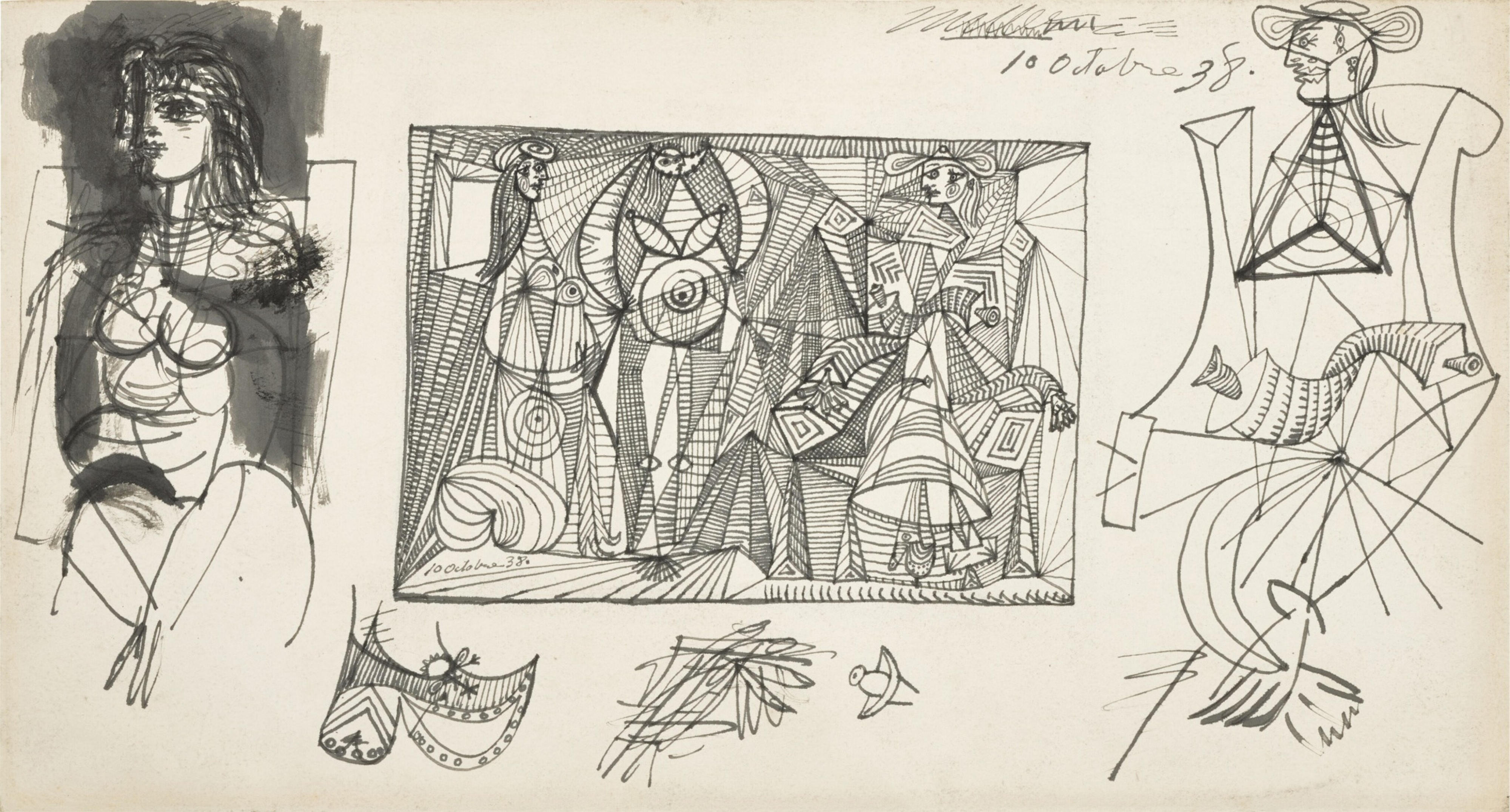
Trois femmes (étude)
1938
Pen, brush and ink on paper
24 x 45 cm (9 1/2 x 17 3/4 in.)
With frame: 52 x 72.5cm (20 1/2 x 28 1/2 in.)
Provenance
Estate of the artist,
Marina Picasso, France (acquired by descent from the above),
Jan Krugier, Switzerland (acquired from the above),
Christie's, New York, A Dialogue through Art: Works from the Jan Krugier Collection, 5 November 2013, lot 114,
Private collection, UK (acquired at the above sale).
Description
This sheet of drawings by Pablo Picasso comes from a period of intense creative energy for the artist, during the late 1930s. The pen, brush and ink studies reveal the artist’s meticulous approach, even in preparatory works, and allow us to consider the transformation of the human figure into his instantly recognisable geometric style, formed of distinct shapes, patterns and volumetric forms. The sheet contains a highly finished central study for a composition, flanked on either side by a seated female figure, at contrasting states of abstraction. Other sketches for parts of the composition (including a shoe and a hand) are situated below the central design.
The sheet is dated twice ’10 Octobre 38.’, indicating its creation during an important time for Picasso’s creativity and development, specifically relating to his lover, artistic partner, muse and informal personal photographer Dora Maar (fig. 1). Picasso met Maar in late 1935 – when he was around 55 and she 28 – and started up a relationship shortly afterwards. Picasso also developed a keen artistic fascination with Maar, and over the nine years of their relationship, she was one of the primary inspirations for his works. Indeed, Maar was the subject of some of Picasso’s most celebrated works, including Portrait of Dora Maar (1937, Musée Picasso, Paris, fig. 2) and Weeping Woman (1937, Tate, fig. 3). It was Maar who inspired Picasso’s striking motif of the tearful woman.
Beyond providing Picasso with artistic inspiration through her appearance, Maar was also integral to the genesis of other iconic works by the painter, not least Guernica, which Maar photographed in progress in the studio in May and June 1937, documenting Picasso’s process. Indeed, it has been suggested that Maar’s political activism – she was a staunch antifascist campaigner – was an important factor for Picasso undertaking this monumental and politically-engaged painting.
The present drawing was created following a summer spent by Picasso and Maar together at the Hotel Vaste Horizon in Mougins, in 1937. In this idyllic countryside setting, canopies of cane arbours created striking light effects. Captivated by the interplay of light and shadow, Maar took numerous photographs of Picasso and friends, under the shade of the foliage, as well as on the beach (fig. 4). In the months and years that followed, once developed, these photographs, with mesmerising striations of shadows falling across the subjects, had a profound effect on Picasso. The impact of this particular phenomenon can be seen clearly in the central rectangular composition; three abstracted female figures are enveloped in a complex patchwork of cross-hatched forms, a puzzle-like scene that bristles with energy.
The female figures across the sheet can be identified as Dora Maar; not only was she Picasso’s primary muse at the time, but her striking features are visible: almond-shaped, non-symmetrical eyes, straight nose and straight black, shoulder-length hair. The sketch on the left side reveals a more naturalistic approach to the subject, albeit with indications of the geometric transformation that ensues across the page. This drawing might be likened to the painting on paper by Picasso from May 1938 today in the Tate, which similarly depicts Maar seated, looking left with her hands folded (fig. 5). The drawing on the right side, by contrast, shows a much more deconstructed representation of the female figure, her hair flicking upwards and a curious tube-like form depicting either her crossed arms or clothing accessory. Even in this light sketch, we can make out a teardrop below one of Maar’s three eyes, underpinning Picasso’s obsession with her as a weeping subject.
This drawing can be seen repeated, in a more finished state, on the right side of the central composition. In this form, it is reminiscent of Picasso’s large pastel drawing Dora Maar in a Wicker Chair, 1938 (today in the Metropolitan Museum of Art, fig. 6). The completeness of the central rectangular drawing and Picasso’s conspicuous dating suggests this might be a sketch for a painting, although no corresponding work is known. It has been suggested, however, that the present work bears similarities to Picasso's famed series of paintings, Les Femmes d'Alger after Delacroix, namely 'Version O',[1] which in 2015 became the most expensive painting ever sold at auction, for $179,365,000 at Christie's New York, now in the collection of Hamad bin Jassim bin Jaber Al Thani (fig. 7). The 1981 catalogue of the exhibition of Marina Picasso's collection notes the comparable nature between our drawing and 'Version O', of certain graphic elements as well as the relationship between the main figure and the pictorial space. In any case, the sheet of drawings makes visible the artist’s obsessive fasciation with Dora Maar, offering an intriguing insight into his distillation of her physical appearance into one of the most iconic visual motifs of his career.This work also has an esteemed history; following the artist’s death it passed to his granddaughter Marina Picasso, from whom it was acquired by the legendary art dealer Jan Krugier, who was also a friend and representative of Marina during the late 1970s. Krugier, a survivor of the Holocaust, dedicated himself to dealing at the highest level of 20th-century art, and was a visionary who staged the first exhibition of Picasso’s work following the artist’s death in 1973. He worked tirelessly to promote the artist’s work, and the collection of Marina Picasso, including organising the exhibition that travelled between Munich, Cologne, Frankfurt and Zurich, in which Trois Femmes (étude) was exhibited (1981–82). He established himself as one of the leading dealers of Picasso’s works, not only paintings, but drawings, sketchbooks, sculptures and prints.
Krugier’s personal collection, amassed with his wife Marie-Anne Krugier-Poniatowski, was equally impressive. With a particular focus on works on paper representing five centuries of Western art, the collection also included paintings, sculptures and tribal art. The present drawing remained in Krugier’s collection until his death in 2008.
Fig. 1 – Dora Maar, Self-Portrait, 1935. Photo: Dora Maar Estate.
Fig. 2 – Pablo Picasso, Portrait of Dora Maar, 1937. Musée Picasso, Paris, MP158.
Fig. 3 – Pablo Picasso, Weeping Woman, 1937. Tate Modern, London, TG05010.
Fig. 4 – Dora Maar, Picasso under the trees, Hotel Vaste Horizon, Mougins, c. 1936. Photo: Dora Maar Estate
Fig. 5 – Pablo Picasso, Dora Maar Seated, 1938, ink gouache and oil paint on paper, laid on canvas. Tate, London, TG00341.
Fig. 6 – Pablo Picasso, Dora Maar in a Wicker Chair, 1938, black ink and pastel over charcoal on paper. Metropolitan Museum of Art, New York, 1999.363.70.Fig. 7 - Pablo Picasso, Les Femmes d'Alger (Version O), 1955, oil on canvas, 114 cm × 146.4 cm. Sold Christie's New York, 11 May 2015 for $179,365,000. Collection of Hamad bin Jassim bin Jabar Al Thani.
[1] Pablo Picasso: Eine Ausstellung zum hundertsten Geburtstag, Werke aus der Sammlung Marina Picasso, exh. cat., Munich, 1981, p. 357, no. 203.