

Jean Louis Ernest Meissonier
b. 1815, Lyon, France
d. 1891, Paris, France
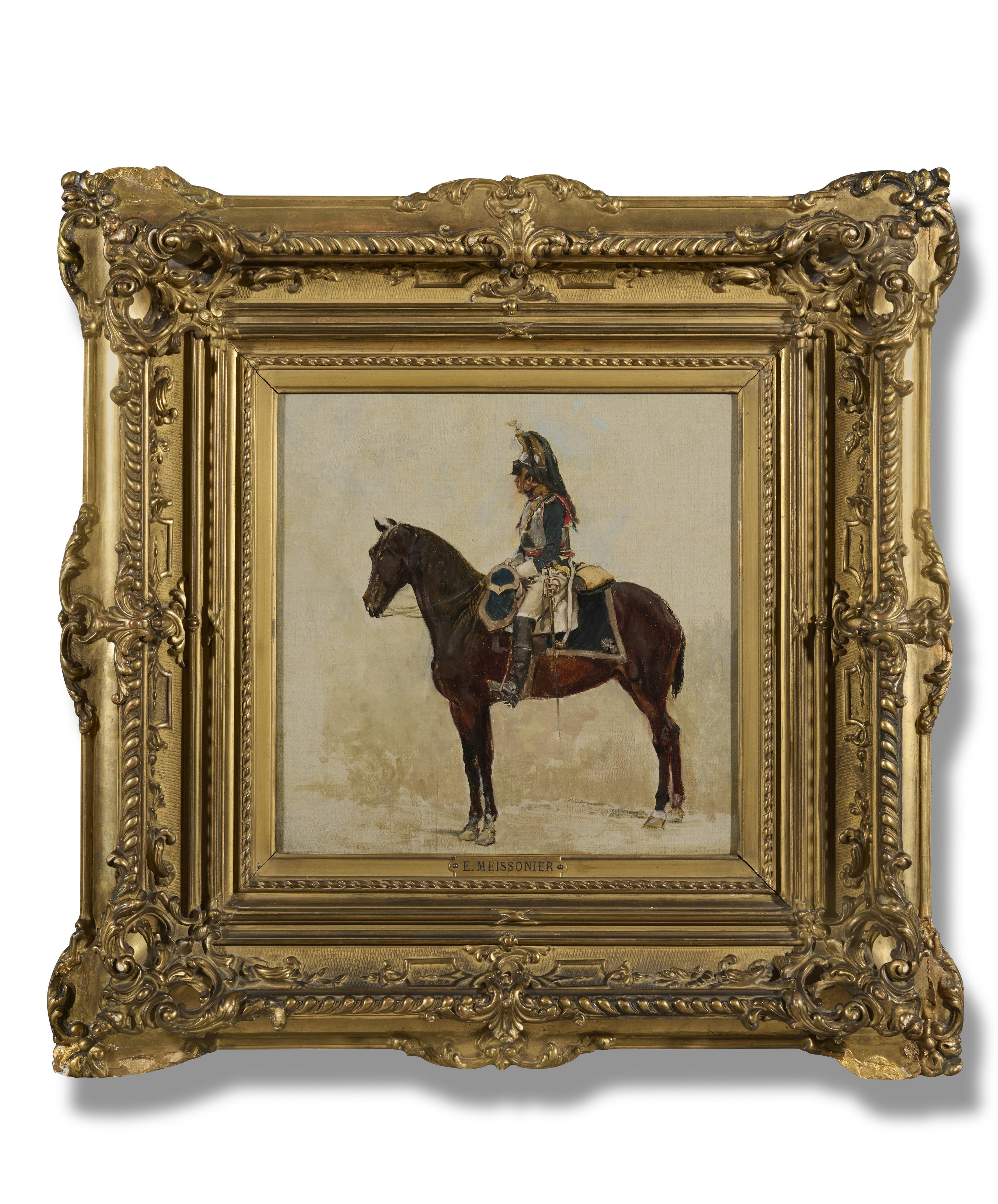
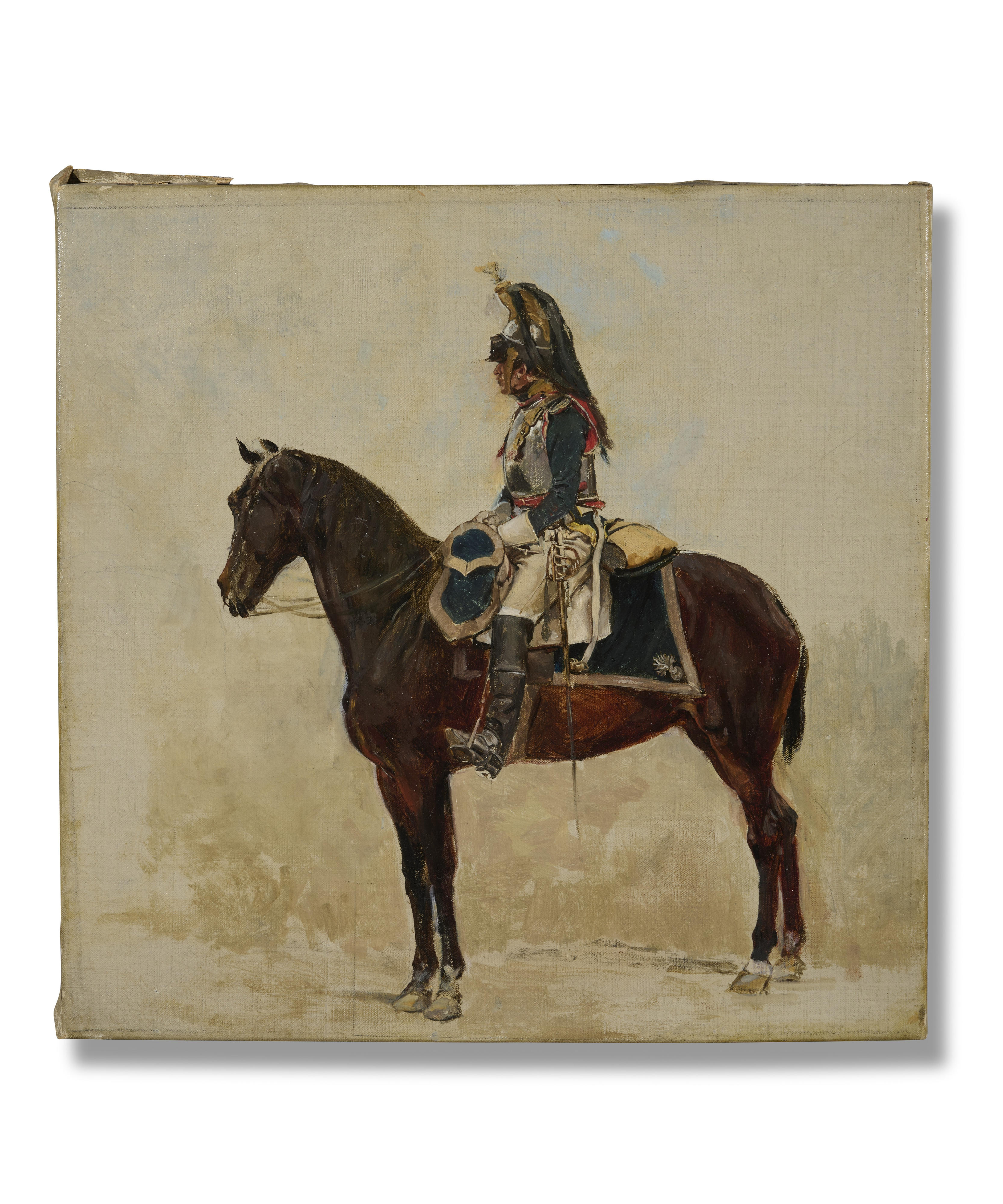
Un Cuirassier (A Cavalryman)
1876
Oil on canvas
24.4 x 24.8 cm (9 5/8 x 9 3/4 in.)
With frame: 46.5 x 46 cm (18 1/4 x 18 1/8 in.)
Provenance
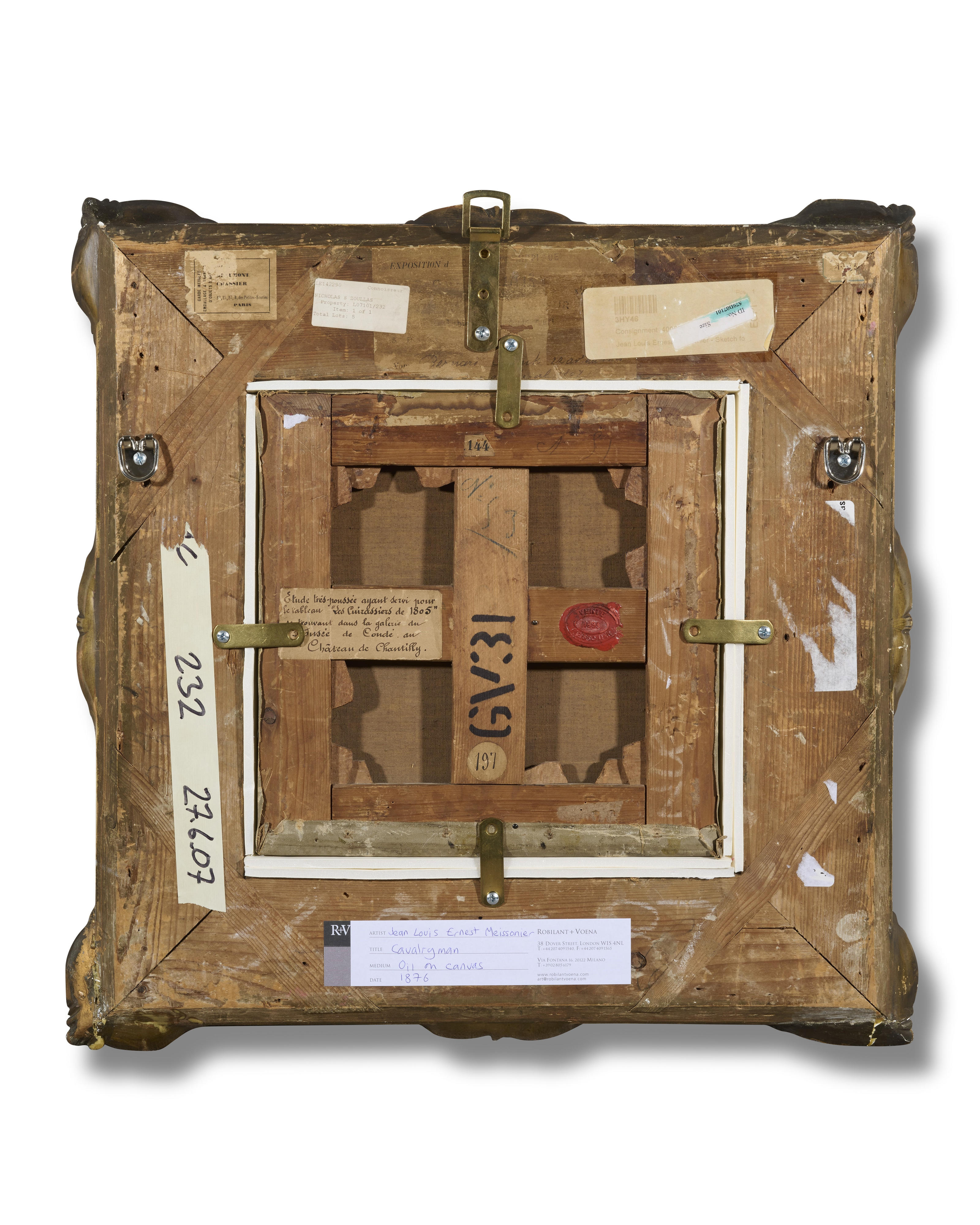
By 1913, Bernard Frank (according to a label on the reverse),
Christie’s, London, 26 March 1987, lot 36,
Stanley J. Seeger, Surrey; Sotheby’s, London, 27 June 2007, lot 232,
Private collection,
Sotheby’s, New York, 1 February 2018, lot 783.
Description
A largely self-taught artist, Ernest Meissonier was best known for his exquisitely rendered genre scenes, which drew inspiration from the Dutch masters such as Gabriel Metsu and Gerard ter Borch, and were praised by critics such as Théophile Gautier for their ‘microscopic’ perfection and meticulously rendered details of costumes and accessories. In his early life he gained experience designing wood-engravings for book illustrations, creating small-scale yet highly detailed works that influenced the format of his later paintings for which he became well-known. During his lifetime, his small genre scenes were in such great demand among the elites of the July Monarchy (1830–48) and Second Empire (1852–72) that they reached disproportionately high prices for their small scale, with collectors competing for works directly from the artist and at auction.
Alongside his genre scenes, Meissonier was also a serious student of military subjects, mostly drawn from historical episodes of the Revolutionary and Imperial eras. His most ambitious and celebrated body of work of this type was a series of canvases on significant moments from Napoleon I’s military career. Several of these paintings are now in public institutions, including Campagne de France, 1814 (1864, Musée d’Orsay), 1807, Friedland (c. 1861-75, Metropolitan Museum of Art, fig. 1 – purchased in 1876 by American businessman Alexander T. Stewart for a huge sum of $60,000), and 1805, The Cuirassiers before the Charge (1878, Musée Condé, Chantilly, fig. 2). The present work, executed in 1876, is a study for this last painting, which was exhibited at the Exposition Universelle of 1878, where it was purchased by a Belgian collector for the impressive sum of 275,000 francs. Our cavalryman, or cuirassier, is almost exactly replicated in the Chantilly painting (fig. 3), showing the keen attention that the artist paid to details in his larger compositions. Indeed, in preparation for such grand battle paintings, Meissonier often fashioned wax sculptures and made small oil sketches of horses and military figures, which were based on painstaking research undertaken by the artist.
At the time this painting was executed, Meissonier was very much an establishment figure; having been elected to the Académie des Beaux-Arts in 1861, he was elected President of the Académie in 1876, the same year as this work (he was elected again in 1891). He was, in 1889, the first artist to be awarded the Grand-croix in the Légion d’Honneur, the highest order of merit in France.
Fig. 1 – Ernest Meissonier, 1807, Friedland, c. 1861–75, oil on canvas, 135.9 x 242.6 cm (53 1/2 x 95 1/2 in.). The Metropolitan Museum of Art, New York.
Fig. 2 - Ernest Meissonier, 1805, The Cuirassiers before the Charge, 1878, oil on canvas, 125 x 198 cm. Musée Condé, Chantilly.
Fig. 3 – detail of 1805, Cuirassiers before the Charge, showing cavalryman for which this work was a study.