
Étienne Moreau-Nélaton
b. 1859, Paris
d. 1927, Paris
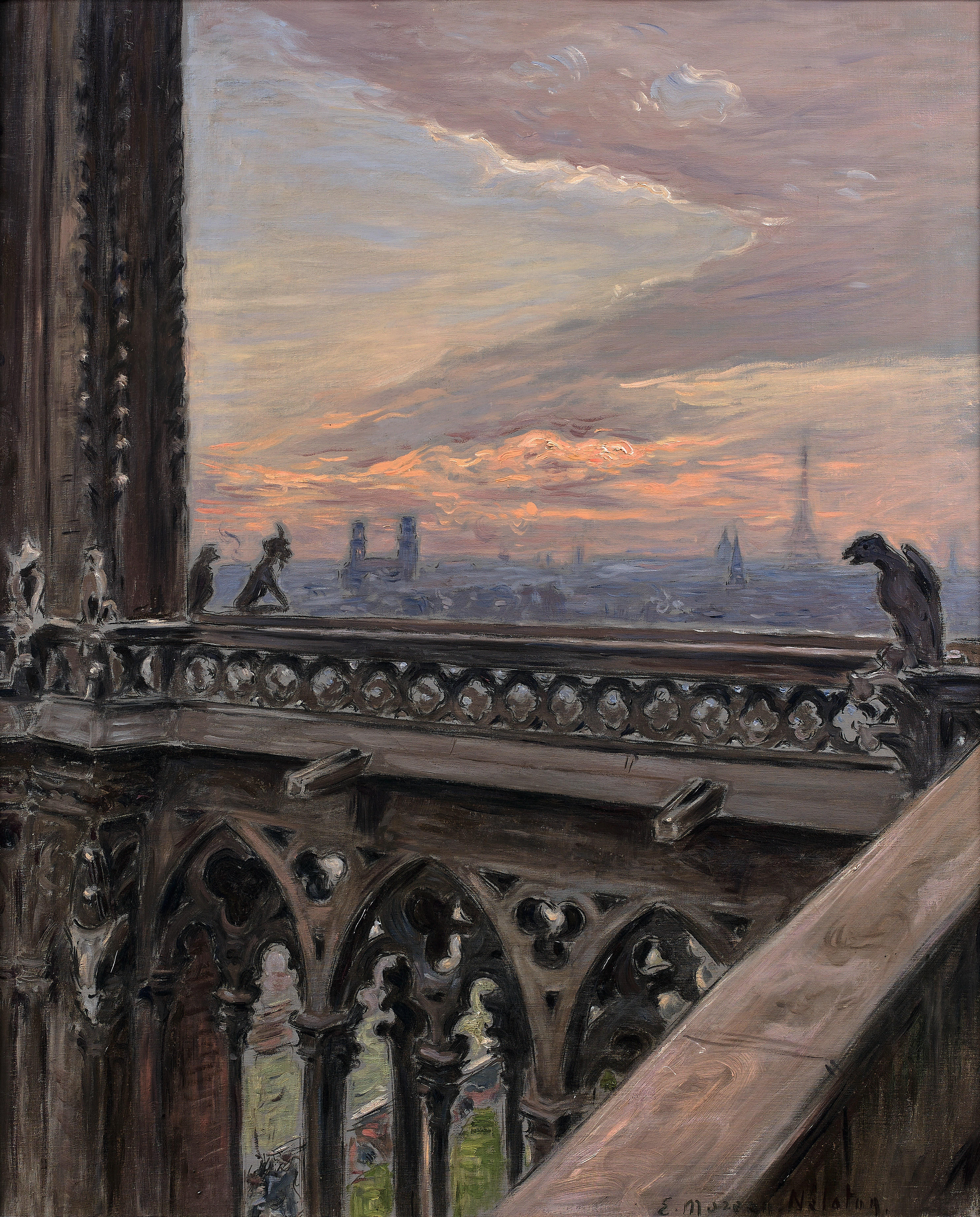
Vue depuis les tours de Notre-Dame (View from the towers of Notre-Dame)
1898
Oil on canvas
77 x 63 cm (30 1/4 x 24 3/4 in.)
Provenance
Private collection, acquired from the above in 2007.
Literature
V. Pomarede, Etienne Moreau-Nelaton, Un collectionneur peintre ou un peintre collectionneur, Paris, 1988, p. 137 to 143.
Éditions de la Réunion des musées nationaux, De Corot aux Impressionistes. Donations Moreau-Nelaton, exhibition catalogue, Paris, 1991, p. 311-312, n°446 and 447.
Description
Etienne Moreau-Nélaton has, for more than a century, been recognized only for his activity as a collector. However, beyond this fame, Moreau-Nélaton was also a painter of great talent and immense delicacy. Vincent Pomarède's monograph published in 1988 and the exhibition at the Grand-Palais in 1991 greatly contributed to give him back his laurels as a painter. Known for his donations of masterpieces of Romanticism and Impressionism to the Louvre Museum, the present painting demonstrates another aspect of the esthete he was.
View of the towers of the Saint-Sulpice church from Notre-Dame de Paris, beyond the tremendous romanticism of this work and its great gentle execution, is part of the very tragic context of a period in the life of Moreau-Nélaton during which he was mourning the double loss of his mother and his wife. Indeed, in 1897, they both were both present at the Bazaar of Charity when it burned down, and tragically perished in the fire.
Devastated by this immense ordeal, Moreau-Nélaton exiled himself to the gallery of chimeras on the western facade of Notre-Dame de Paris, between the two bell towers. He painted many views of Paris there, the change in the weather allowed him a great diversity of atmospheres and lighting at the end of winter 1898. View from the towers of Notre-Dame de Paris is a work that is part of this period of torment but also of great inspiration for the artist. The painting is full of softness and sensitivity, the light is very well distributed and diffuses in a large coat of matter and colors in the heart of the canvas. The whole part sketched at the bottom of the painting is highly accomplished and the palette is very well balanced by the orange of the sunset, the gray of the zinc roofs and the green of the René-Viviani square below. The wide delicacy of the movements of the brush could only be the fruit of an immense emotion.
Etienne Moreau-Nélaton reworks a subject that takes its roots in Romanticism, in the lithograph Le Stryge by Charles Meryon (1849), in the photographs of Charles Nègre (1853). We are here among the Victor Hugo's novel, when Quasimodo throws from the top of the balustrade the priest Frollo, who has climbed up there to see the execution of Esmeralda on the forecourt. Moreau-Nelaton chooses a composition in twist where one perceives the influence of the off-center and dynamic framing of the Japanese prints. In the center, the quadrilobed balustrade bars the entire width, above the Gothic warheads, offering a whole abstract play of solids and voids and allowing a glimpse of the ground in a vertiginous shortcut. In the distance, in an elusive fog, emerge the towers of Saint-Sulpice and the Eiffel Tower.