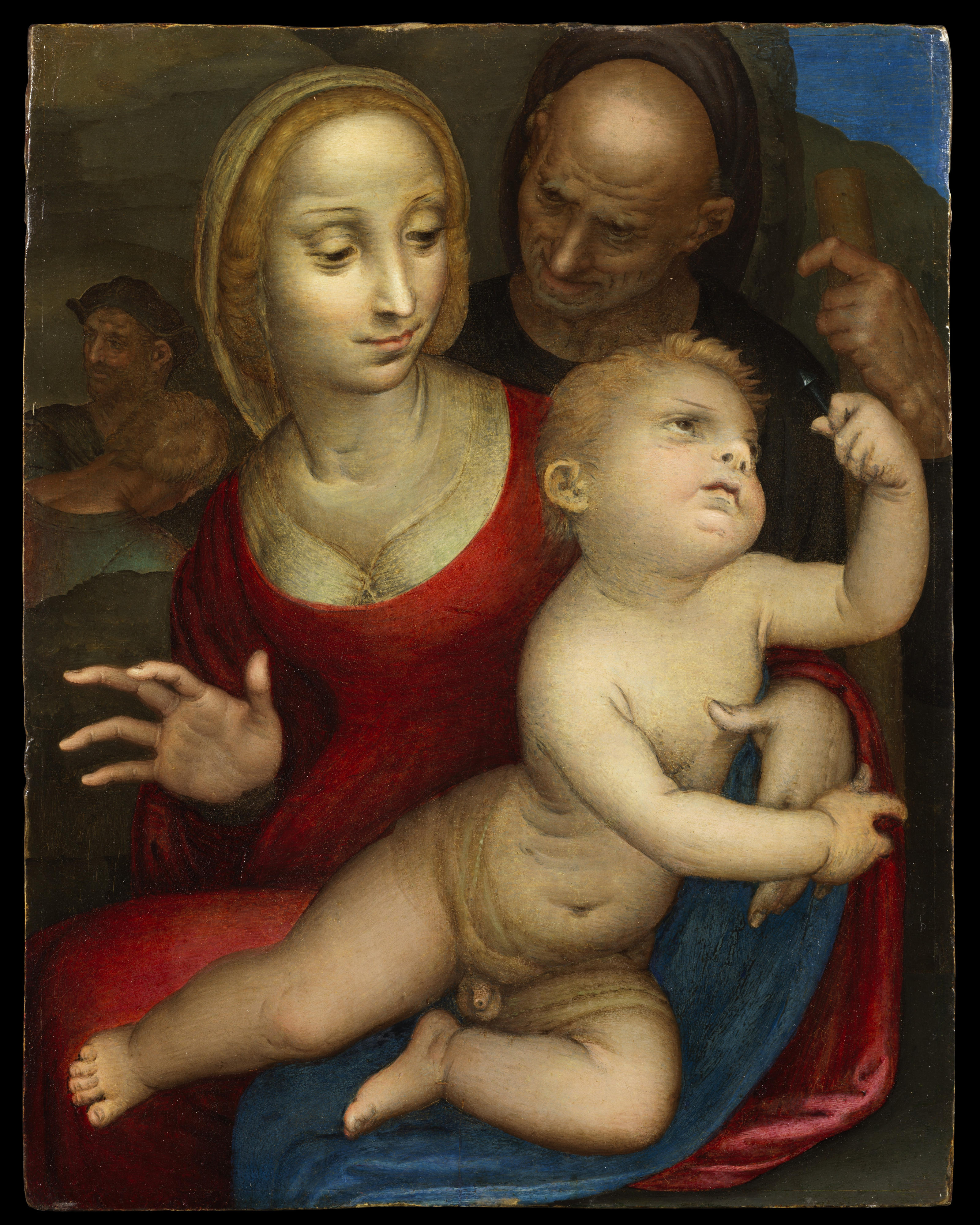
Fernando Yáñez de la Almedina is a key figure in the introduction of the Italian High Renaissance style into Spain. Born in Almedina around 1475, the young Yáñez travelled to Italy in the first years of the sixteenth century. He visited Florence, where he studied the works of Raphael, Perugino and Leonardo, and perhaps also spent time in northern Italy.
A document of 1505 lists among Leonardo’s assistants for the mural depicting the Battle of Anghiari in Palazzo Vecchio in Florence one “Ferrando Spagnolo”, usually identified as Yáñez rather than his compatriot Fernando Llanos, with whom he often collaborated upon his return to Spain. The earliest secure documentation for Yáñez is a record of September 1506, and thus after his Italian sojourn, and this places him in Valencia and working together with Llanos on an altarpiece depicting Saints Cosmas and Damian in the city’s cathedral.
The following year the two artists executed a second altarpiece for the same church. Ground-breaking in its time, the altarpiece attests to the two artists’ introduction of a new Leonardesque idiom into Spanish art. In the years that followed, Yáñez worked in Barcelona, Murcia, and Cuenca before returning to Valencia, where he died in 1536.
In their works, from large altarpieces to more intimately scaled pieces made for use in private devotional practices, Yáñez and Llanos were able to present an alternative to the Flemish models that had dominated Valencian art since Jan van Eyck’s stay in the city in 1428, introducing Leonardo’s highly original compositions as well as his pioneering sfumato technique into the lexicon of Spanish painting.