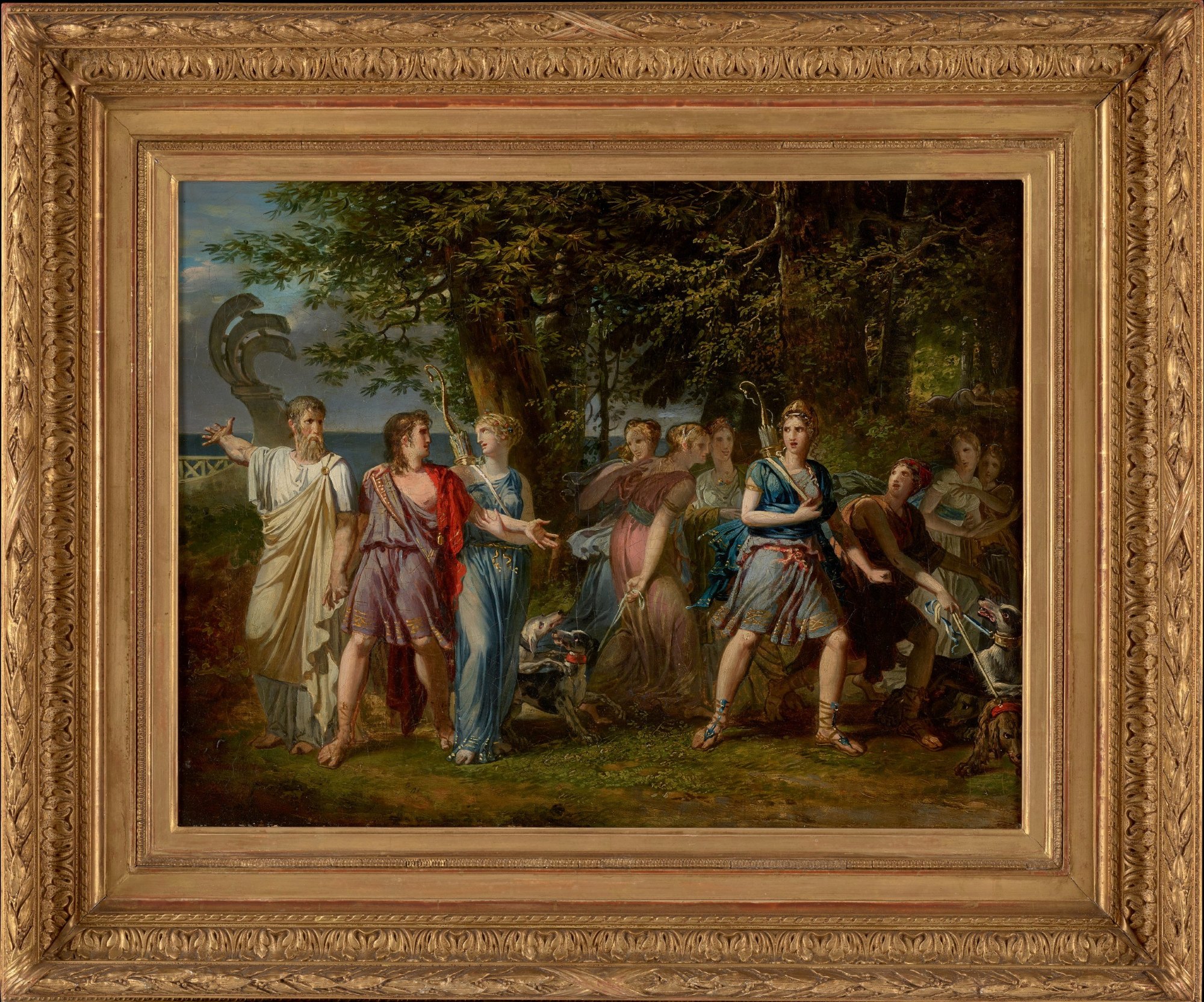
Robilant+Voena is delighted to announce that the Louvre Abu Dhabi has acquired an important painting by French Neoclassical artist Charles Meynier (1763–1832) from Robilant+Voena.
Telemachus, urged by Mentor, leaving the island of Calypso (c. 1800) depicts an episode from the popular 18th-century novel The Adventures of Telemachus by François Fénelon (1651–1715), which was based on Homer’s Odyssey. This work is the only known oil study for a painting that Meynier presented at the Paris Salon of 1800, The Farewell of Telemachus and Eucharis, often considered to be his greatest masterpiece. The painting is a significant and apposite acquisition for the Louvre Abu Dhabi, whose collection also includes Meynier's finished Salon picture.
Further information about the painting
At the Salon of 1800, Meynier presented the ambitious painting The Farewell of Telemachus and Eucharis, for which the artist was awarded a first-class prize of 6000 francs, and which at the time was hailed as a masterpiece, by both critics and the public. Purchased by the Lyonnais banker Joseph Fulchiron, the high regard of the painting is testified by its selection for inclusion in the Louvre’s Decennial Exhibition in 1810. Following this exhibition, the painting was not seen for more than 200 years, before being rediscovered in a private collection in Nantes in 2018. Prior to this, the work was only known through two engravings, and by two preparatory drawings, one in the Cleveland Museum of Art and the other in a private collection.
Telemachus, urged by Mentor, leaving the island of Calypso, recently discovered, is the only known painted modello for the finished masterpiece; signed and dated, it could be what Meynier presented to the patron for approval of the final commission. It provides valuable insights into the artist’s process and exhibits many of the same precise details and expert compositional devices that characterise the final painting, as well as showing discrepancies where the artist changed his design. Moreover, in an excellent state of conservation, it has survived intact on its original canvas and stretcher. The impastos are well preserved, allowing us to appreciate the artist’s assured and expressive brushwork, and his delicate and varied palette.
With this beautiful oil study joining the finished painting in the Louvre Abu Dhabi's collection, these historic works will allow for a fuller appreciation of Meynier's creative process and of the decisions he made when preparing his ambitious painting for the Salon.