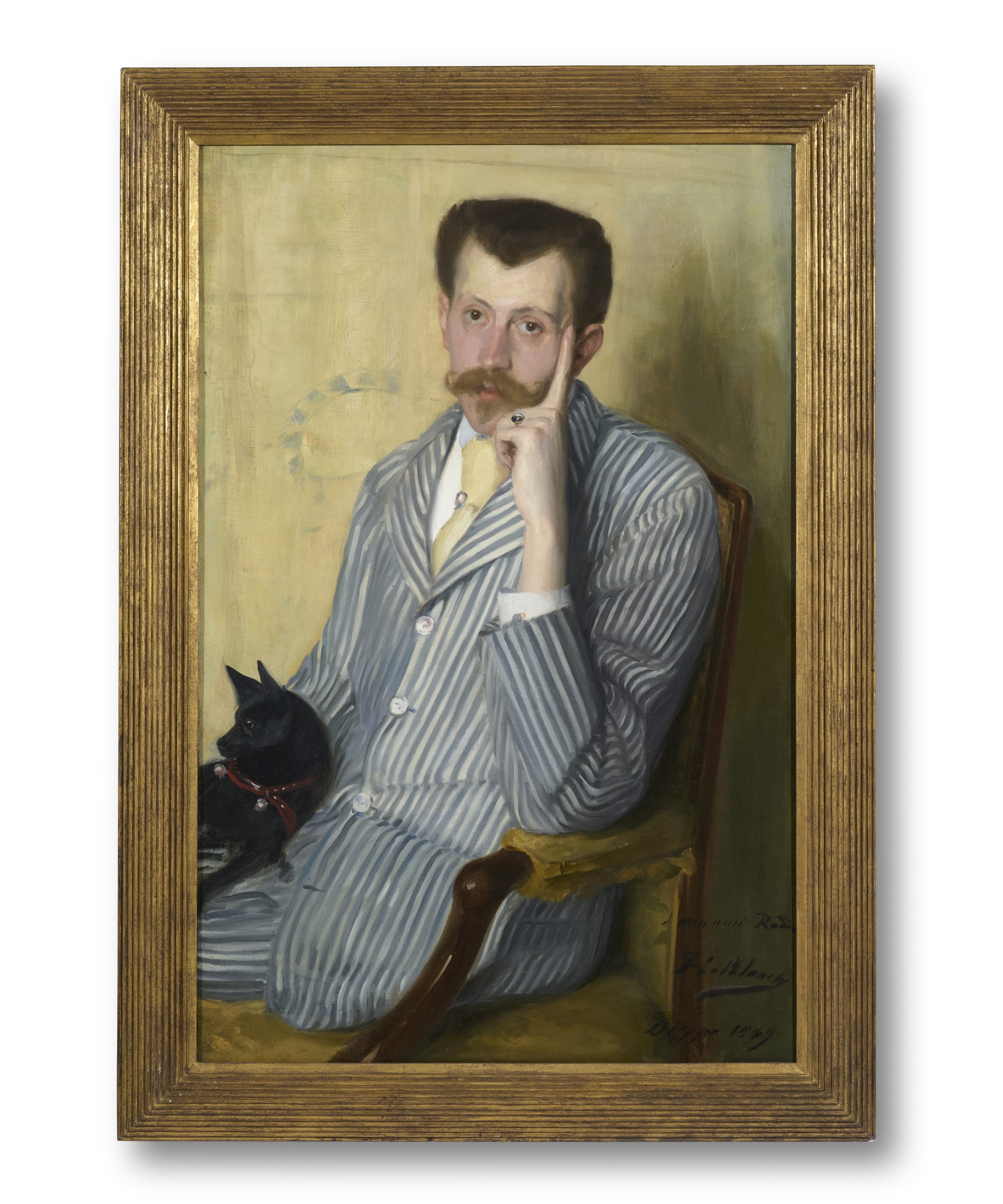
Robilant+Voena is pleased to announce the acquisition by the Musée d’Orsay of an important portrait by Jacques-Émile Blanche. Executed in early in the artist’s career, the work demonstrates the important influences of Édouard Manet and James Abbott McNeill Whistler in these years, especially through the tonal clarity and the fluency of the brushwork. This stylistic connection likely stems from Blanche’s encounters with these artists (and the likes of Henri Fanton-Latour, Pierre-Auguste Renoir and Edgar Degas) while training in the atelier of Henri Gervex in the early 1880s.
The sitter in the portrait has recently been identified as George Rodier, an occasional artist who moved in the same cultured circles as Blanche, believed to be the inspiration for the character of Legrandin in Marcel Proust’s À la recherche du temps perdu. Painted in 1889 at the popular seaside resort of Dieppe, the work has a nonchalant intimacy, Rodier’s casual pose alluding to the friendship between the two men; indeed, the canvas bears the dedication, ‘à mon ami Rodier / J. E. Blanche / Dieppe 1889’. With his striped suit and thoughtful expression, Rodier epitomises the ideal of the dandy or flaneur that was associated with the late 19th-century Belle Époque.
This work is a significant addition to the Musée d’Orsay’s collection, joining other examples by the celebrated portraitist, including depictions of the writer Marcel Proust (aged just 21) and the composer Igor Stravinsky. Proust’s portrait was painted just a few years after that of Rodier, in 1892; the earlier work however offers a stark contrast, filled with summer light and air, whereas that depicting Proust is painted in dark tones, the sitter’s form almost melting into the shadowy background. Blanche’s portrait of Rodier allows an insight into the artistic and cultural milieu of the young painter, on the cusp of becoming one of the greatest portraitists of the Belle Époque.
Read More