
Vincenzo Cabianca
b. 1827, Verona
d. 1902, Rome
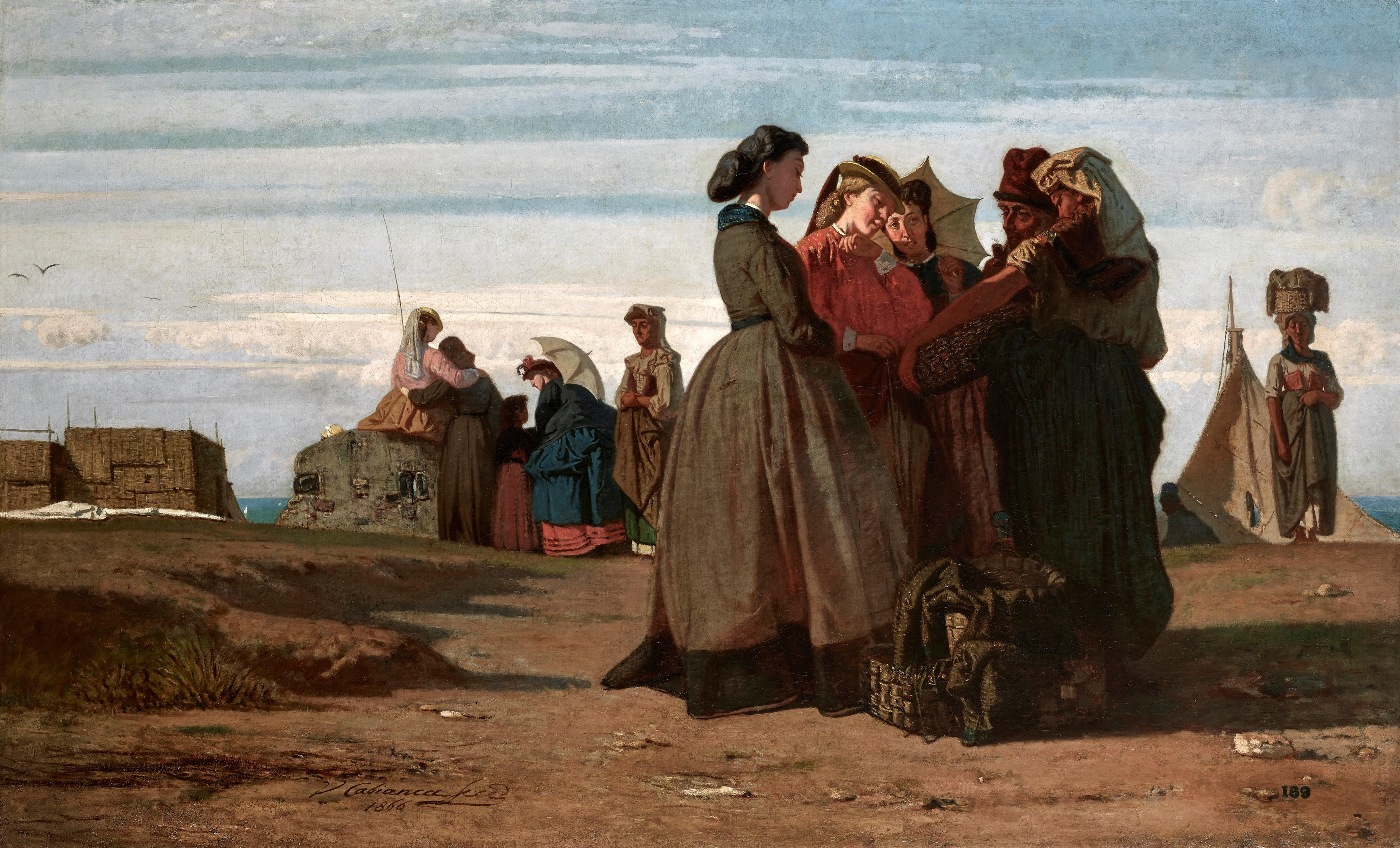
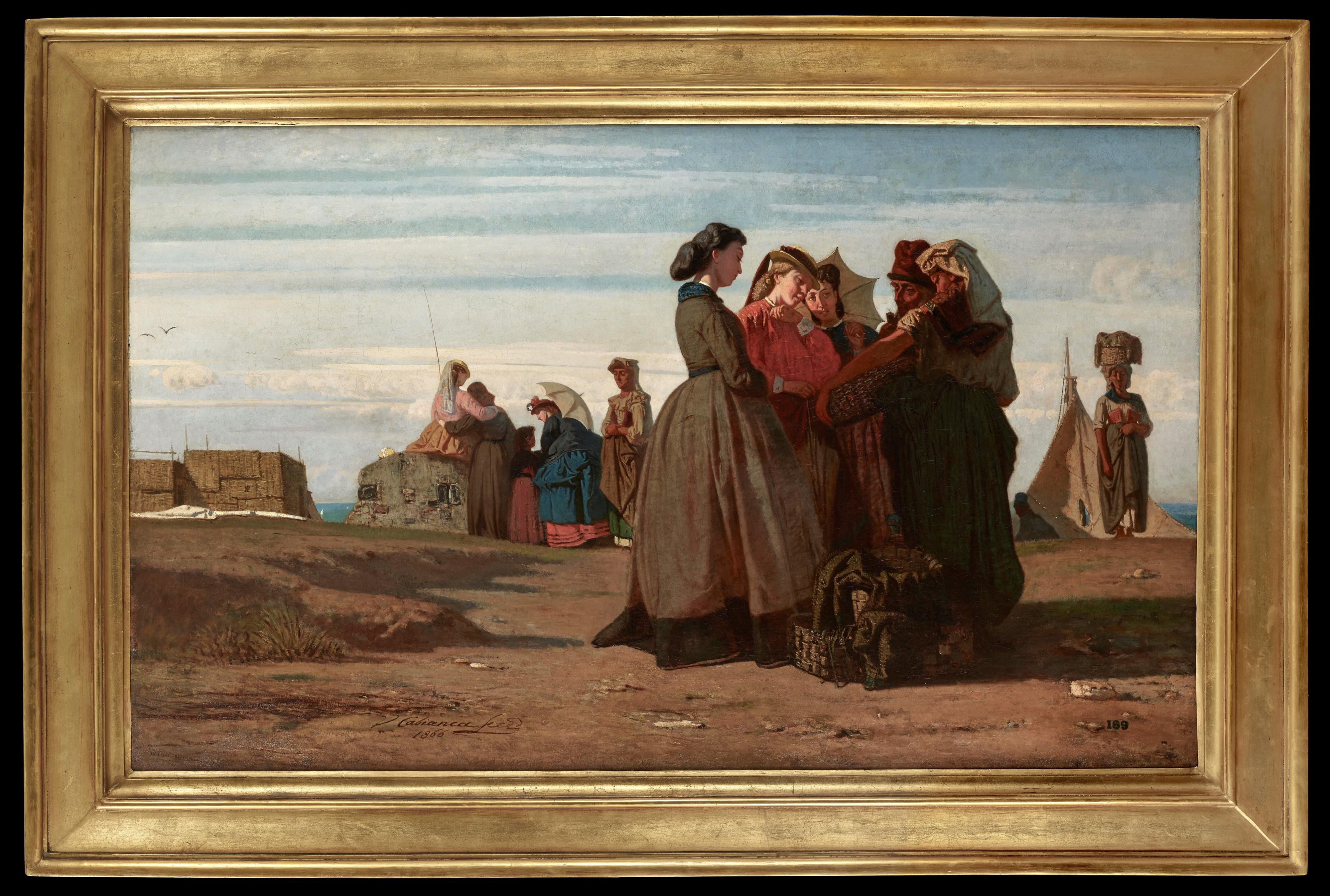
Ai bagni di Viareggio (At the baths of Viareggio)
1866
Oil on canvas
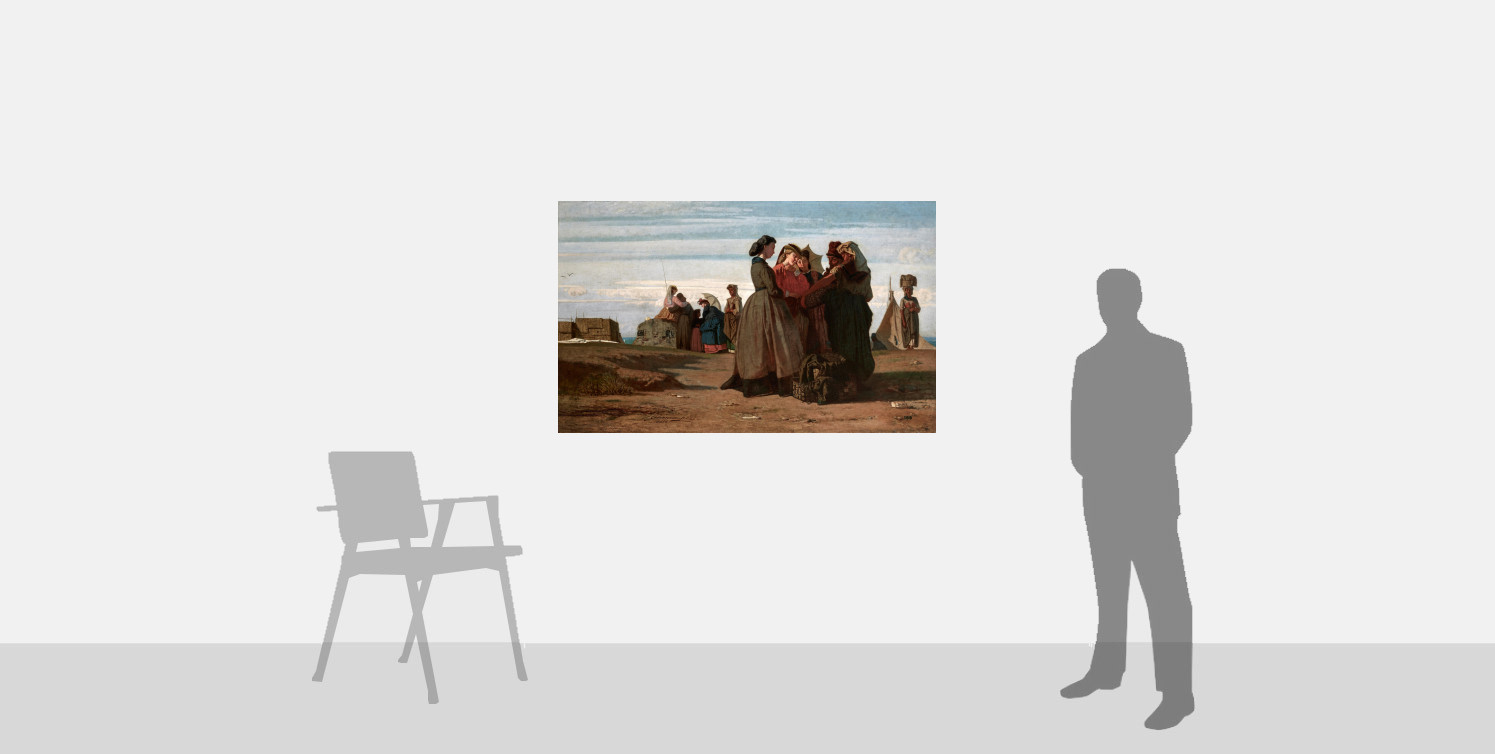
103.2 x 168.3 cm (40 5/8 x 66 1/4 in.)
With frame: 132 x 197 x 9.5cm (52 x 77 1/2 x 3 3/4 in.)
Provenance
Private collection, United States of America,
Sotheby's, London, 5 July 2023, lot 49.
Literature
F. Dini, Vincenzo Cabianca, Catalogo ragionato, Milan, 2020, pp. 91, 235.
Description
Born in Verona, Vincenzo Cabianca undertook his artistic training at the Verona Academy and then the Venice Academy, where he developed an admiration for Giuseppe Mazzini and became associated with the Young Italy movement. In the political turbulence of 1848, Cabianca was taken prisoner while participating in the defence of Bologna, following which he returned to Venice, where he lived until 1853, when he moved to Florence.
In Florence, he became part of a group of artists that included Adriano Cecioni, Telemaco Signorini, and Odoardo Borrani, and who became known as the Macchiaioli, a group of artists active throughout Tuscany in the second half of the nineteenth century who, before the French Impressionists, strayed from academic conventions to celebrate subjects taken from everyday life, often painting outdoors to capture the fleeting effects of light and colour. The name of the group comes from macchia (spot or stain), so these artists were literally ‘spot-‘ or ‘stain-makers’. In the 1850s, Cabianca’s style moved from genre subjects to a bolder realism, always paying utmost attention to the effects of light in his works. Cabianca travelled to Paris in 1861, and on returning to Italy settled in Parma, where he remained until 1868. At this point, he moved to Rome, which would be his main home for the rest of his life.
Long thought to be lost, the present painting is one of the pinnacles of the Veronese painter's career; painted in early 1866 at the Viareggio baths, it was sent in the spring of 1866 to the 25th Exhibition of the Società Promotrice delle Belle Arti in Turin. There, it was purchased by a collector and handed down to his heirs until its recent sale. Confirming its importance, in 1866 the painting was sold for the impressive sum of 1,800 lire, when other works of the same period ranged from 250 to 500 lire.
In 1863, Cabianca left Florence where he had worked closely with other members of the Macchiaioli goup, moving to Parma where he married Adelaide Laschi in 1864. Despite leaving the artistic hub of Florence, he maintained his relationships with his Florentine colleagues: indeed, the city itself and the coast of Tuscany, from Versilia to the Maremma, remained among Cabianca’s preferred destinations, providing inspiration for some of his most beautiful works, including the present painting. The presence of Diego Martelli, the art critic associated with the Macchiaioli, in Castiglioncello, was also a reason for frequent visits to the region.
The series of works of subjects from the Tuscan coast began with Canale della Maremma of 1862, (private collection, fig. 1) presented by Cabianca at the Exhibition of the Società Promotrice delle Belle Arti in Turin that year, and sold there for 500 lire. As Francesca Dini and Giuliano Matteucci have pointed out, this is a work in which the influences of the French artists that Cabianca had met the previous year, namely Corot and especially Daubigny, are still evident (as comparisons, see figs. 2 and 3). Following the model of the latter who painted on board his small boat ‘Le botin’ while sailing along the Seine, Cabianca also painted en plein air, probably in a small vessel along the Cecina River, as indicated in this work by the low vantage point, almost at the level of the water.
This first view of the Maremma was followed by others, often of small format; the views of the Maremma alternated with those of Versilia and, in particular, Viareggio. The town had opened its bathing establishments in 1853, immediately gaining fame in part due to the waters that were thought to have therapeutic properties. Within a few years, Viareggio had become a fashionable centre, and in the 1860s and 1870s, impressive bathing establishments were built, as can be seen on postcards of the time (fig. 4).
In the first large painting Cabianca dedicated to Viareggio, Spiaggia di Viareggio (Viareggio Beach) of 1865 (fig. 5), the artist chose to depict the beach in its wildest aspect, without the imposing structures of the bathing establishments, with just two children walking along it at sunset. The painting was presented with great success at the Promotrice in Genoa in 1865, arousing the admiration of Prince Odone of Savoy, the fourth son of King Victor Emmanuel II, who bought it and later donated it with his collection to the Galleria d’Arte Moderna in the Ligurian capital.
A different air is breathed in the two paintings of the following year, Al sole (private collection, fig. 6) and our Ai bagni di Viareggio. Here, the beach, which Cabianca again chose to represent in its wildest and most picturesque aspect, is traversed by elegant female figures dressed in the latest fashions of the day. In this work, the teachings of the Barbizon painters are absorbed into a completely personal language, made up not only of patches of colour but also of delicate passages of light, with a modernity that anticipates by a few years the famous innovations of Édouard Manet. The group of women engaging with the sellers in the foreground are reminiscent of Courbet’s paintings, situating contemporary figures in a landscape, for example Young Ladies of the Village (1851-52, fig. 7), now in The Metropolitan Museum of Art, New York. While the French painter – whose paintings were often motivated by contemporary issues and offered somewhat subversive commentaries, unlike the Macchiaioli – was not one of Cabianca’s main direct influences, the younger artist would likely have encountered such paintings by the renowned realist during his trip to France in 1861.
For the two paintings, Cabianca carried out numerous preparatory studies, mainly of the female figures and their elegant dresses, but also a study for the entire composition (fig. 8). It is interesting to note that alongside studies from life and of figures in contemporary dress, Cabianca produced a considerable number of studies of Renaissance painters during the Parma years, especially of Parmigianino's frescoes at La Steccata. These studies were to be used by Cabianca in the last masterpiece that he dedicated to the coastline between Liguria and Tuscany in 1868, Un bagno fra gli scogli (or The Bathers, fig. 9) before moving to Rome. The painting, now in the Galleria d'Arte Moderna in Palazzo Pitti, depicts three completely nude women bathing and, when it was first shown, provoked violent criticism from his Macchiaioli friends Signorini and Cecioni, who were surprised by such a direct and realistic painting.
This painting is an extremely rare example of a masterpiece by a member of the Macchiaioli available outside Italy, due to the defence of this pioneering school by the Italian authorities and their consequent efforts to prevent export of such works. Only six paintings by Cabianca, all of smaller dimensions, have appeared at auction outside Italy in the last ten years. A painting by Signorini dating from c. 1865 of comparable quality but considerably smaller in height, L’alzaia (The Tow-path), was sold at Sotheby’s in London in 2003, for over $4,700,000 (fig. 10).
Fig. 1: Vincenzo Cabianca, Canale delle Maremma toscana, 1862, private collection.
Fig. 2: Jean-Baptiste Camille Corot, Une Soirée. Batalier amarré à la rive, c. 1850-70, Paris, Musée du Louvre.
Fig. 3: Charles François Daubigny, Ferry-Boat near Bonnières-sur-Seine, 1861, Cincinnati, Taft Museum of Art.
Fig. 4: Postcard showing Viareggio ‘Il Bagno Oceano’, late 19th century.
Fig. 5: Vincenzo Cabianca, Spiaggia di Viareggio, 1865, Genoa, Galleria d’Arte Moderna.
Fig. 6: Vincenzo Cabianca, Al sole, 1866, private collection.
Fig. 7: Gustave Courbet, Young Ladies of the Village, 1851-52, New York, The Metropolitan Museum of Art.
Fig. 8: Vincenzo Cabianca, Study for ‘Ai Bagni di Viareggio’, pencil and ink on paper, second Parma sketchbook, folio 12r.
Fig. 9: Vincenzo Cabianca, Un bagno tra gli scogli, 1868, Florence, Galleria d’Arte Moderna di Palazzo Pitti.
Fig. 10: Telemaco Signorini, L’alzaia, c. 1865, Sotheby’s London, 18 November 2003 (sold for £2,805,600 / $4,768,709).