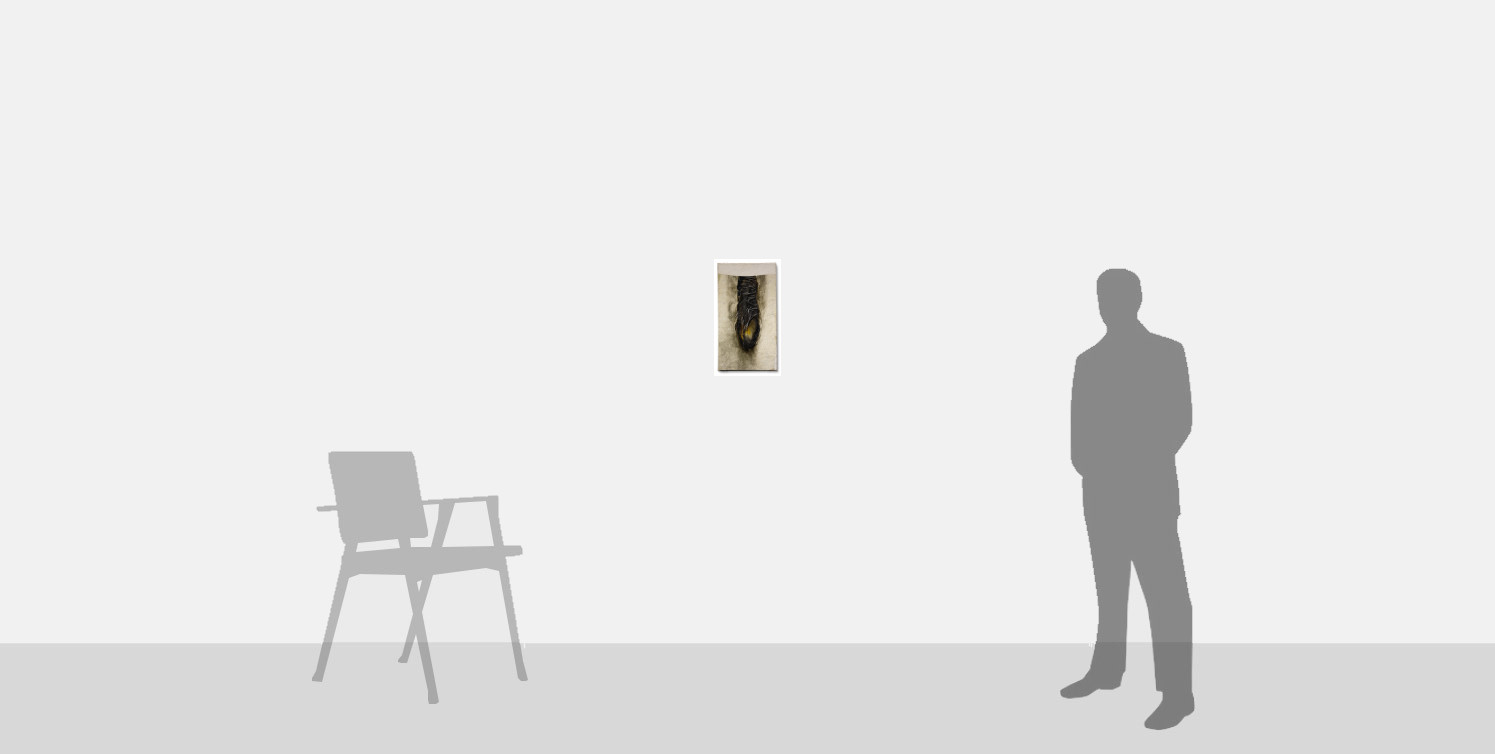

Alberto Burri
b. 1915, Città di Castello, Italy
d. 1995, Nice, France
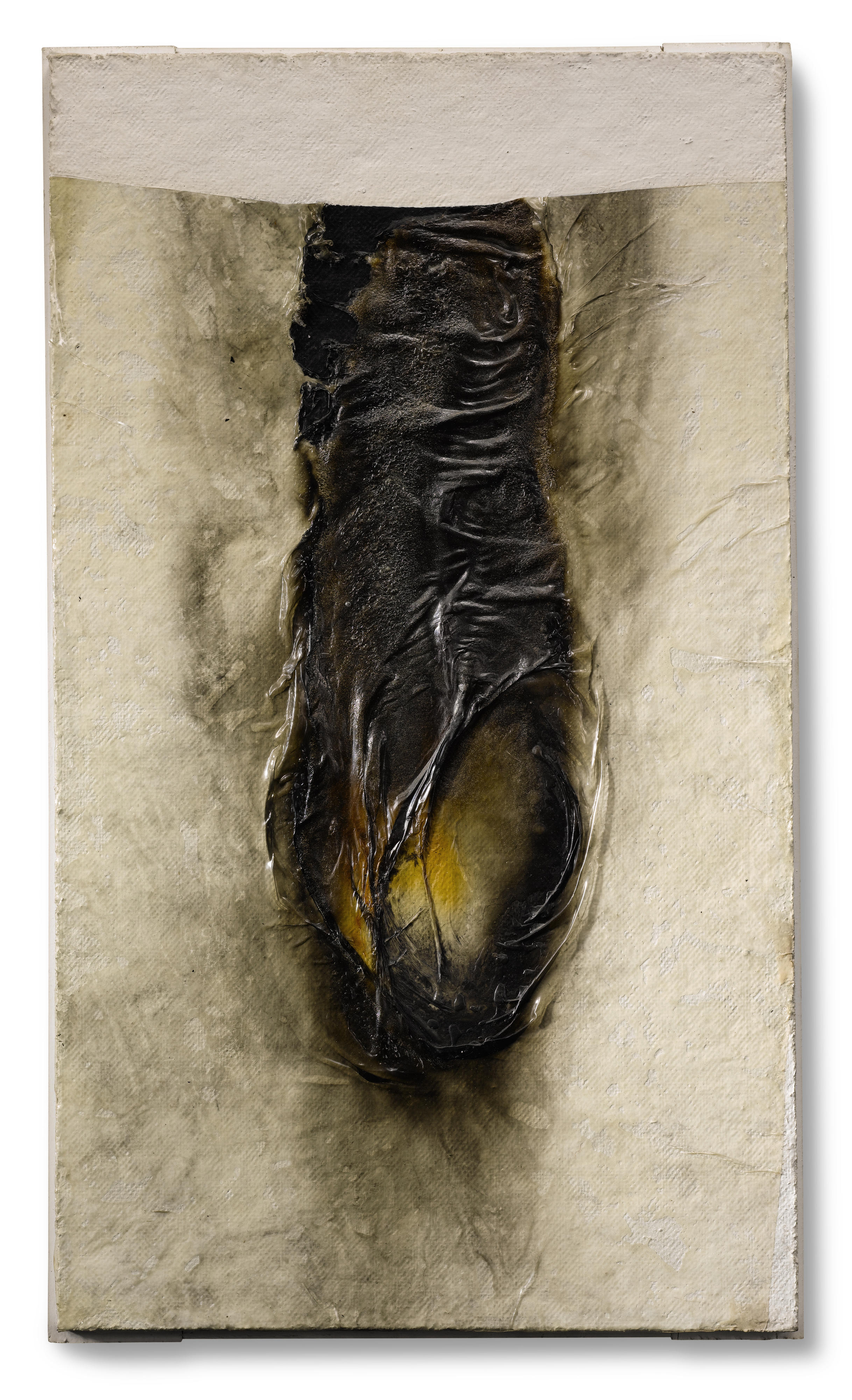
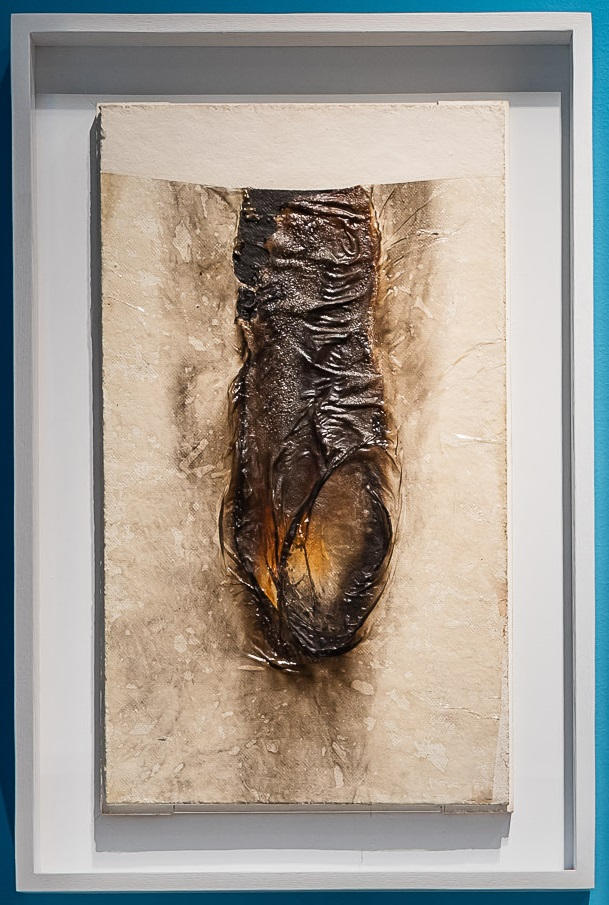
Combustione (Combustion)
1968
Plastic, vinavil, and combustion on cellotex
52 x 30 cm (20 1/2 x 11 3/4 in.)
With frame: 65 x 43 cm (25 1/2 x 17 in.)
Provenance
Purchased directly from the artist,
Private collection.
Private collection.
Literature
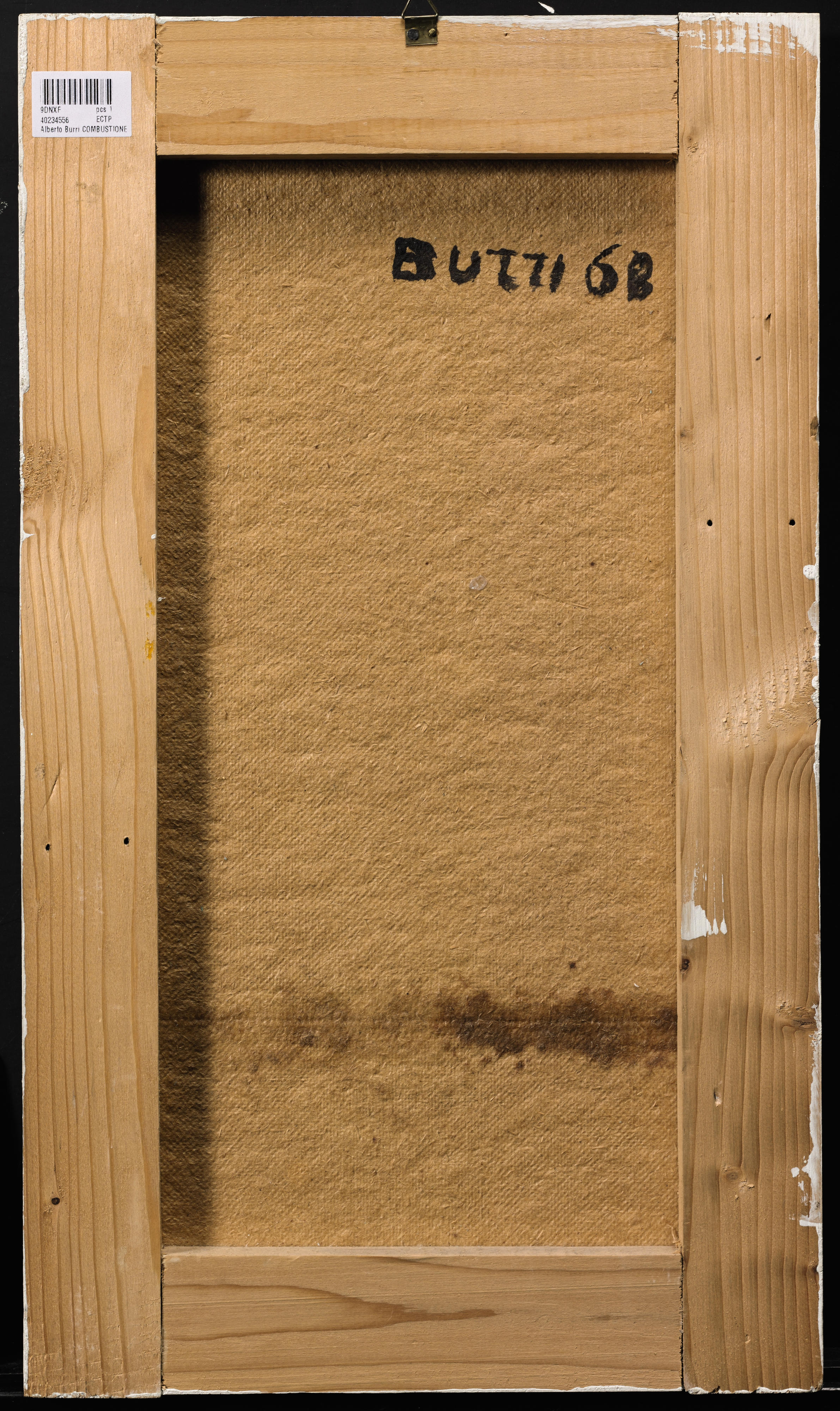
Bruno Corà, ed., Burri: catalogo generale, Città di Castello, 2015, vol. 2, p. 239, no. 1261, illustrated, and vol. 6, p. 180, i.6867, illustrated.
Description
"Burri made medium, not form, the content of his pictures.”
—Emily Braun, Alberto Burri: The Trauma of Painting, exh. cat. Solomon R. Guggenheim Museum, New York, and Kunstsammlung Nordrhein-Westfalen, Düsseldorf, 2015–16, p. 61.
From the very outset of his artistic practice, Alberto Burri eschewed traditional oil on canvas in favour of alternative materials. It was during his internment in a prisoner-of-war camp in Texas at the end World War II that Burri took up painting, using the limited media available to him. As Cesare Brandi reported in an early portrait of the artist’s life, “It was then that painting, which until then had stood at the remotest horizon of his life, suggested itself to him. Painting was a leisure occupation and amusement at first. Little by little, however, it became a substitute for action, then action itself, involving an ethical position in which his past and present converged. Originally painting thus signified for Burri as catharsis through action…Painting, by intruding into this compulsory situation, opened a completely new path for him: it was as though he had walked into a mirror” (Cesare Brandi, “Burri,” in Gerald Norland, ed., Alberto Burri: A Retrospective View, 1948–1977, exh. cat. Frederick S. Wight Art Gallery, University of California, Los Angeles, 1977, p. 12). Soon after returning to Italy in 1946, Burri abandoned his studies in medicine to pursue painting full time. Conversations with Robert Rauschenberg in the winter of 1953, when the American artist was with Cy Twombly in Rome, were fortuitous for both artists who would go on to develop material innovations in postwar art with their Combines and Combustions, respectively.
Burri began his Combustioni Plastiche (Plastic Combustions) after first applying fire to the paper, wood, fabric, and iron he had used in works from other series. As the artist himself said of his materials, “Wood, iron, burlap—for me, these are the most direct and easiest materials, because they do not require the use of color or brushes” (Alberto Burri, quoted in New York and Düsseldorf 2015–16, p. 60). In the late 1950s, Burri turned to plastic. As Braun explains: “Burri’s choice to work in plastic sheeting may not be as surprising as it initially seems, for here he found his signature red and black pigments already embedded in the mass-production state. The highly saturated yet reflective color fields came straight from the factory. The black Plastiche, churned and carved out of molten polyethylene sheets, fuse the painterly and the sculptural in baroque undulations…The thick black substance confounds in a surreal comingling of opposites, it is hard and polished to the eye like obsidian, yet pliant to the touch like a soft rubber tire. The red and transparent Plastiche have entirely different effects. When they were first exhibited in 1962, critics identified the material as supermarket cellophane, and noted how Burri exploited the ‘look but don’t touch’ seduction of diaphanous packaging that both protects for hygienic reasons and lures with the shiny promise of something new” (Braun in New York and Düsseldorf 2015–16, p. 67).
For the artist, “combustion” refers not to the fire from the torch itself, but rather to the process of burning, which transforms one flammable material into another. Listed as a material and reinforced in the titles of Burri’s works from this period, “combustion” suggests metamorphosis rather than simply being an agent of change. As Gerland Norland, the curator of Burri’s 1977 retrospective in San Francisco, has explained, “Burri’s first Combustione works were made in response to a visit to an oil field with Emilio Villa. He had been as interested as most educated persons in the ancient’s four elements: earth, air, fire, and water. The idea of using fire, a terrible force of nature as a creative property excited him…There is an element in Burri’s fire paintings that reach backwards to primordial feelings and speaks to every person’s experience of watching fires and of knowing the danger and pain in burning. The Combustione series is an aggressive statement which communicated to all but on the basis of simple materials and common experiences” (Norland in Los Angeles 1977, p. 44).
Burri first exhibited his Combustioni at the Galleria dell’Obelisco in Rome in 1963. His work would later be introduced to American audiences in an exhibition that travelled to the Carnegie Institute in Pittsburgh, the Arts Club of Chicago, the Albright Knox Art Gallery in Buffalo, and the San Francisco Museum of Modern Art. A large-scale reconsideration of his work as an artist over fifty years was presented at the Guggenheim Museum in New York in the fall of 2015.
—Emily Braun, Alberto Burri: The Trauma of Painting, exh. cat. Solomon R. Guggenheim Museum, New York, and Kunstsammlung Nordrhein-Westfalen, Düsseldorf, 2015–16, p. 61.
From the very outset of his artistic practice, Alberto Burri eschewed traditional oil on canvas in favour of alternative materials. It was during his internment in a prisoner-of-war camp in Texas at the end World War II that Burri took up painting, using the limited media available to him. As Cesare Brandi reported in an early portrait of the artist’s life, “It was then that painting, which until then had stood at the remotest horizon of his life, suggested itself to him. Painting was a leisure occupation and amusement at first. Little by little, however, it became a substitute for action, then action itself, involving an ethical position in which his past and present converged. Originally painting thus signified for Burri as catharsis through action…Painting, by intruding into this compulsory situation, opened a completely new path for him: it was as though he had walked into a mirror” (Cesare Brandi, “Burri,” in Gerald Norland, ed., Alberto Burri: A Retrospective View, 1948–1977, exh. cat. Frederick S. Wight Art Gallery, University of California, Los Angeles, 1977, p. 12). Soon after returning to Italy in 1946, Burri abandoned his studies in medicine to pursue painting full time. Conversations with Robert Rauschenberg in the winter of 1953, when the American artist was with Cy Twombly in Rome, were fortuitous for both artists who would go on to develop material innovations in postwar art with their Combines and Combustions, respectively.
Burri began his Combustioni Plastiche (Plastic Combustions) after first applying fire to the paper, wood, fabric, and iron he had used in works from other series. As the artist himself said of his materials, “Wood, iron, burlap—for me, these are the most direct and easiest materials, because they do not require the use of color or brushes” (Alberto Burri, quoted in New York and Düsseldorf 2015–16, p. 60). In the late 1950s, Burri turned to plastic. As Braun explains: “Burri’s choice to work in plastic sheeting may not be as surprising as it initially seems, for here he found his signature red and black pigments already embedded in the mass-production state. The highly saturated yet reflective color fields came straight from the factory. The black Plastiche, churned and carved out of molten polyethylene sheets, fuse the painterly and the sculptural in baroque undulations…The thick black substance confounds in a surreal comingling of opposites, it is hard and polished to the eye like obsidian, yet pliant to the touch like a soft rubber tire. The red and transparent Plastiche have entirely different effects. When they were first exhibited in 1962, critics identified the material as supermarket cellophane, and noted how Burri exploited the ‘look but don’t touch’ seduction of diaphanous packaging that both protects for hygienic reasons and lures with the shiny promise of something new” (Braun in New York and Düsseldorf 2015–16, p. 67).
For the artist, “combustion” refers not to the fire from the torch itself, but rather to the process of burning, which transforms one flammable material into another. Listed as a material and reinforced in the titles of Burri’s works from this period, “combustion” suggests metamorphosis rather than simply being an agent of change. As Gerland Norland, the curator of Burri’s 1977 retrospective in San Francisco, has explained, “Burri’s first Combustione works were made in response to a visit to an oil field with Emilio Villa. He had been as interested as most educated persons in the ancient’s four elements: earth, air, fire, and water. The idea of using fire, a terrible force of nature as a creative property excited him…There is an element in Burri’s fire paintings that reach backwards to primordial feelings and speaks to every person’s experience of watching fires and of knowing the danger and pain in burning. The Combustione series is an aggressive statement which communicated to all but on the basis of simple materials and common experiences” (Norland in Los Angeles 1977, p. 44).
Burri first exhibited his Combustioni at the Galleria dell’Obelisco in Rome in 1963. His work would later be introduced to American audiences in an exhibition that travelled to the Carnegie Institute in Pittsburgh, the Arts Club of Chicago, the Albright Knox Art Gallery in Buffalo, and the San Francisco Museum of Modern Art. A large-scale reconsideration of his work as an artist over fifty years was presented at the Guggenheim Museum in New York in the fall of 2015.