

George Romney
b. 1734, Dalton-in-Furness
d. 1802, Kendal
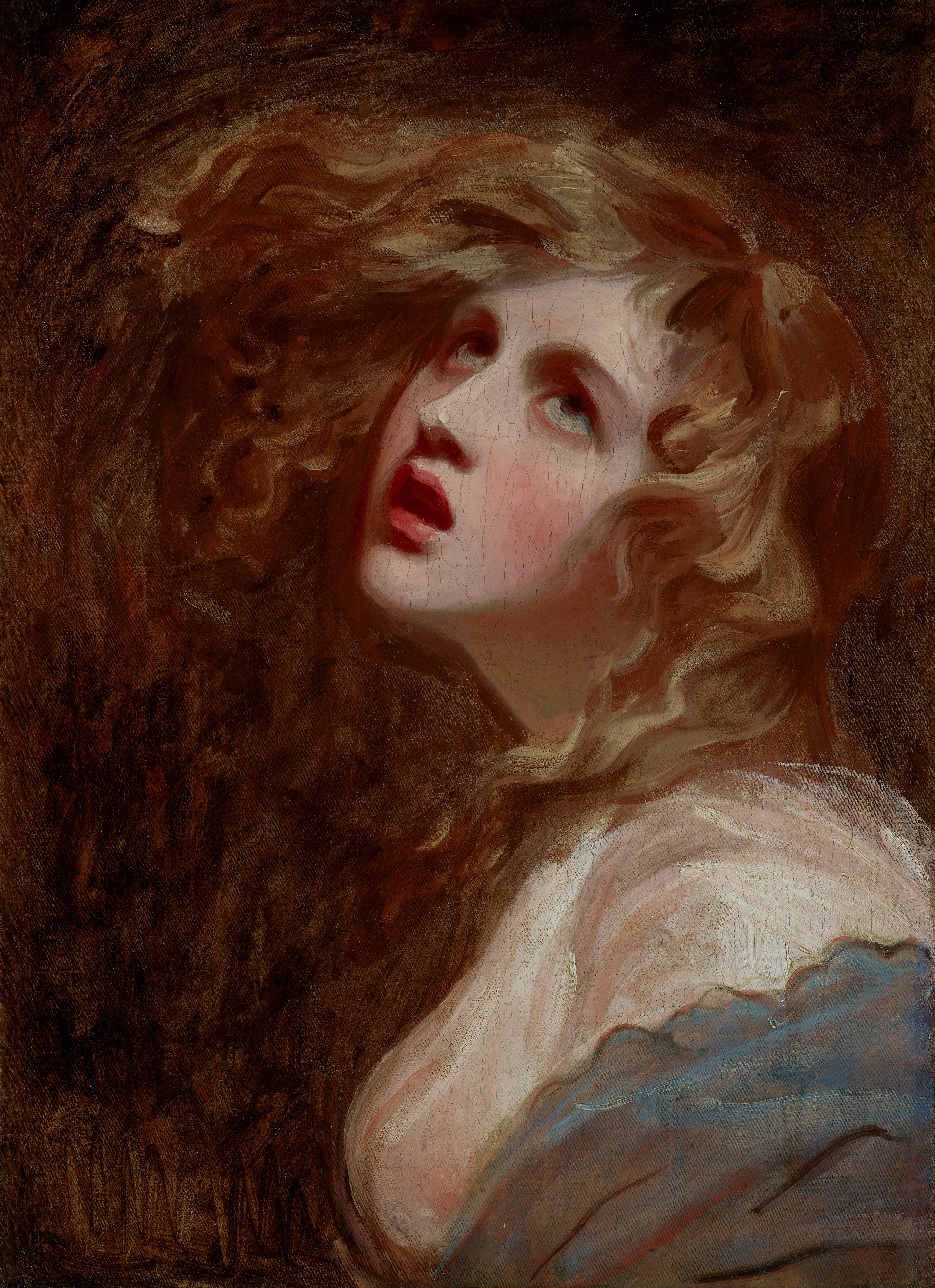
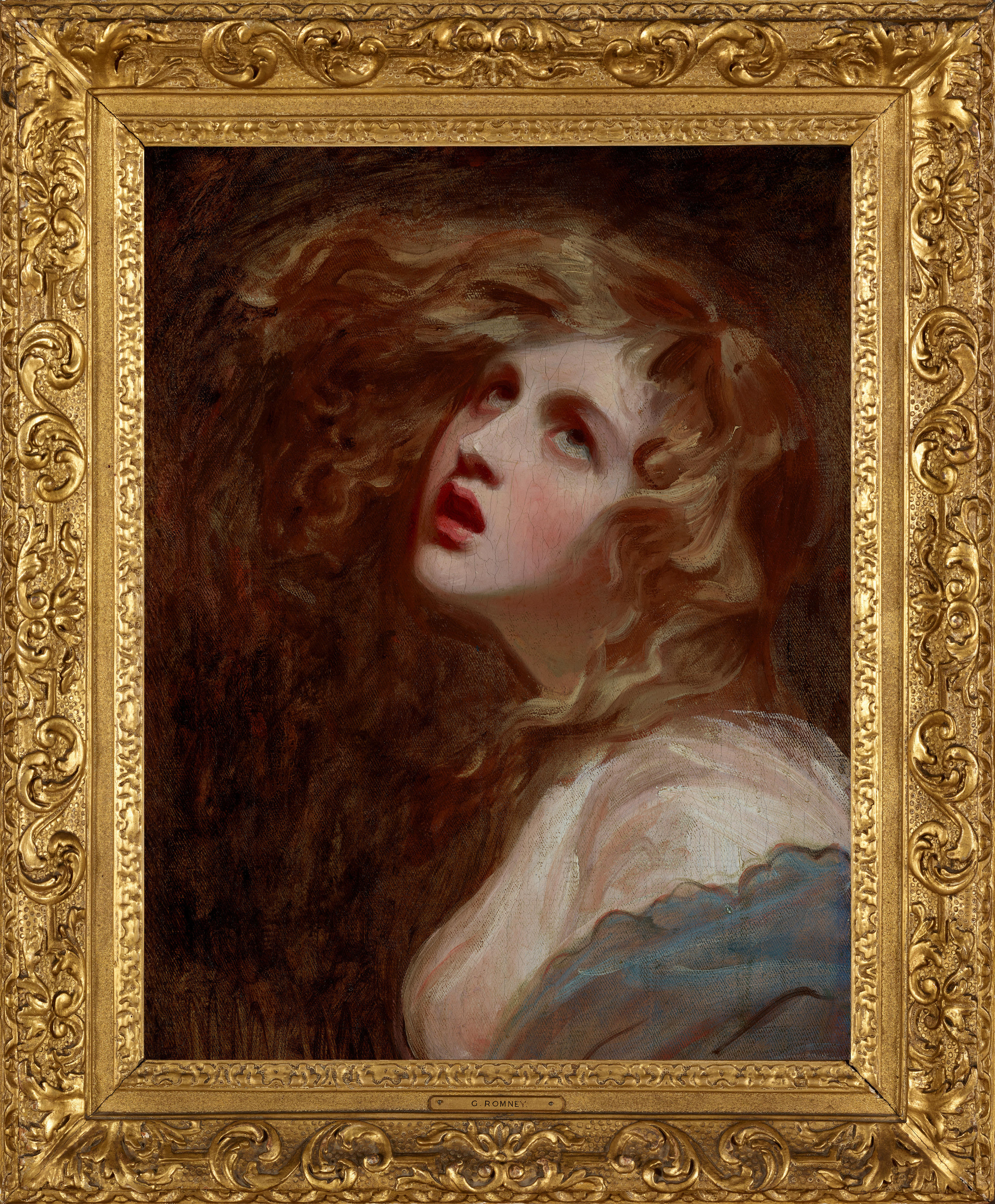
Emma Hart (later Lady Hamilton, c. 1765–1815) as Miranda
c. 1786
Oil on canvas
48.9 x 38.1 cm (19 1/4 x 15 in.)
Framed: 70 x 55.5 x 4.5 cm (27 1/2 x 21 7/8 x 1 3/4 in.)
Provenance
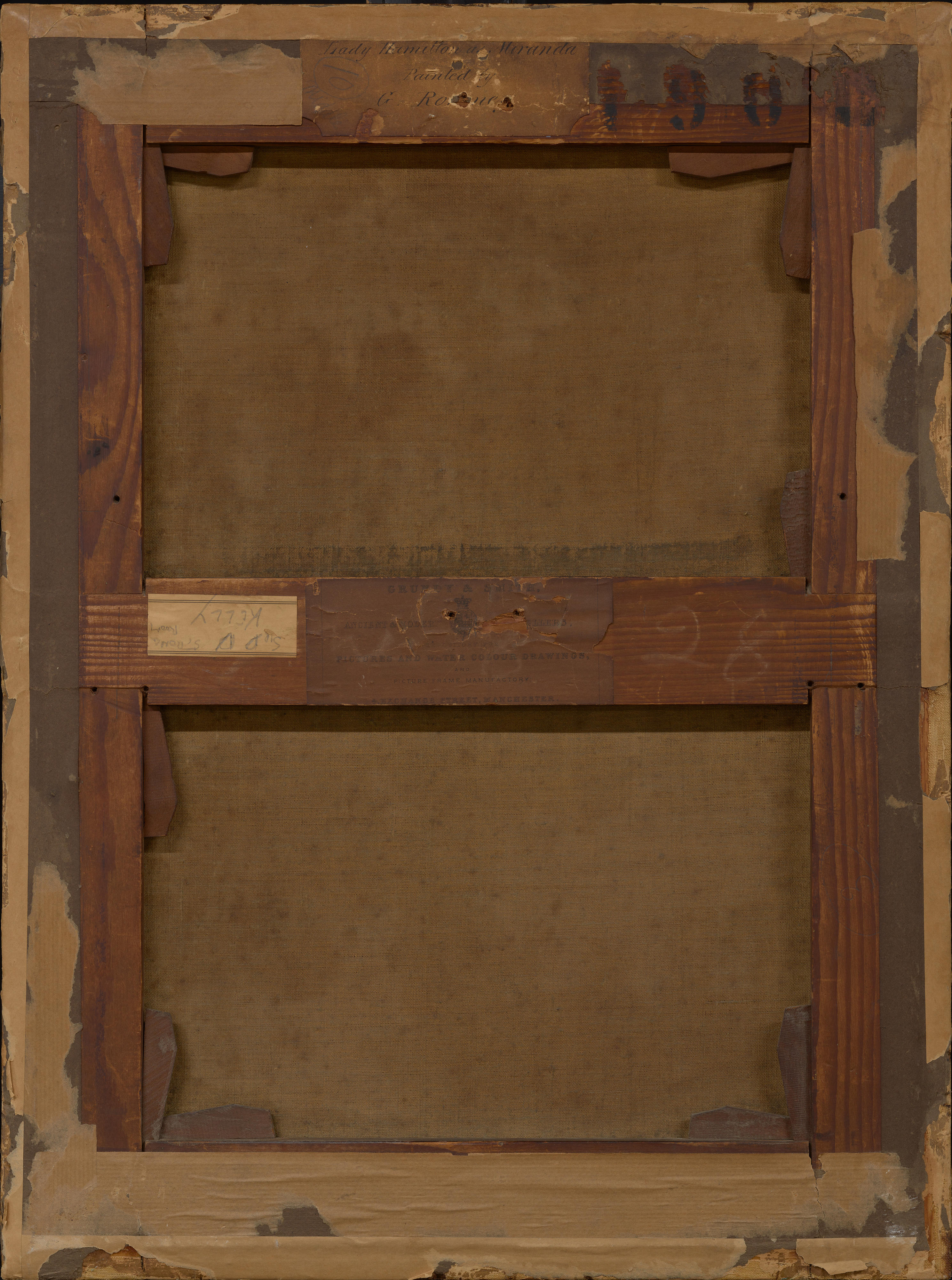
Richard Johnson of Manchester (? d. 1877),
by descent to his grandson Richard Johnson Walker,
by inheritance to Mrs Walker,
Christie's, 8 June 1928, Lot 126;
by descent to her grandson, Bernard Kelly.
Literature
Jennifer Watson, The Paintings of Emma Hart (Lady Hamilton) by George Romney: A Study of their Significance in Relation to the Historical Works, M.A. Thesis, Oberlin Collection, 1974 (appendix no. 20x).
Richard Dorment, British painting in the Philadelphia Museum of Art, Philadelphia, 1986, p. 326 (no.5).
Alex Kidson, George Romney, A Complete Catalogue of his Paintings, vol. III, New Haven, 2015, p. 793, no. 1736q (49.5 x 38.5 cm).
Description
By the 1780s, George Romney’s position as one of the most successful portrait painters working in Britain was firmly established, owing much to his flattering style and prolific output. In April 1782, he was introduced to Emma Hart (c. 1765–1815, née Amy Lyon) by the Hon. Charles Greville (1749-1809), who had recently taken the young Hart as his mistress. She, ambitious from an early age, had taken the name ‘Emma Hart’ in order to distance herself from her humble beginnings as daughter of a Cheshire blacksmith. Greville had organised for Hart to sit for Romney for a portrait; this meeting was in fact the beginning of one of the most significant artist-model relationships of Georgian Britain. Over the next nine years, Romney and Hart would work together in a mutually beneficial creative partnership, resulting in around 60 paintings featuring Hart as the subject or key protagonist.
The present painting is a fine embodiment of Romney and Hart’s famed relationship as artist and muse. Styled in the guise of Miranda from Shakespeare’s The Tempest, Hart appears both beguiling and tormented. From their first contact, Romney developed an almost obsessive focus on Hart, deeming the combination of her physical characteristics – namely her classical even features and voluminous chestnut hair – to constitute the ideal of beauty. Moreover, Hamilton’s theatrical countenance and ability to hold poses as well as any professional model led Romney to style her as various well-known literary, mythological or allegorical figures, as is the case in the present picture. Romney portrays Hart in what appears almost like a moment of ecstasy, dramatically lit from above, her hair billowing away from her and rouged lips contrasting with her smooth skin. The Miranda that Romney presents us with is both innocent and sensuous, beautiful and otherworldly.
This picture relates to a larger composition of Act I (a conflation of Scene I and II) from The Tempest that Romney produced for John Boydell’s Shakespeare Gallery, a project launched in the 1780s. Although now destroyed (there are fragments at Bolton Museum and Art Gallery, UK), the painting was at the time Romney’s largest canvas by far. Its composition is today known through an engraving dating from 1797 by Benjamin Smith (active 1786–1833, fig. 1). Here we can see Miranda at the far right, in a pose similar to that of Hart in our picture. Romney conveys Miranda’s distress at the plight of the ship’s crew, pleading with her father to halt the storm that he had conjured to destroy the vessel. Romney made several comparable head studies in oil of Hart for the final composition, many of which are today untraced. Notable examples are in the collection of the National Maritime Museum, Greenwich, London (fig. 2), and on long-term loan to Lakeland Arts, Abbot Hall, Kendal, from a private collection (fig. 3). Our painting is notable as it extends downwards to include the bust (most other studies only show her head and shoulder), with the shape of the figure bearing resemblance to the type of female society portrait that Romney developed in the 1770s, where the outline of the figure traces a sinuous s-curve down the centre of the composition. Further drawings relating the lost painting include an example preserved in the National Gallery of Art, Washington DC and in the Art Institute of Chicago (figs. 4 and 5).
Boydell’s Shakesperian venture clearly appealed both to Romney’s ambitions as a history painter, and to his fascination with Shakespeare, and particularly with personifying Emma as the character of Miranda, as he enthusiastically contributed the final work to the project. Indeed, for a painter who largely avoided literary themes in his work, Romney showed a particular preference for Shakespearian subjects – in his sale of 1807, there was a high volume of sketches of subjects by the bard.
Fig. 1 – Benjamin Smith after George Romney, The Enchanted Island, Before the Cell of Prospero - Prospero and Miranda (Shakespeare, The Tempest, Act 1, Scene 1), engraving, first published 1797. The Metropolitan Museum of Art, New York.
Fig. 2 – George Romney, Head Study of Emma as Miranda, c. 1786, framed: 45.5 x 40.2 cm. National Maritime Museum, Greenwich, London.
Fig. 4 – George Romney, A study of Miranda for ‘The Tempest’, c. 1786, pen and black ink with grey wash over graphite on laid paper, 50.2 x 31.3 cm. The National Gallery of Art, Washington DC.
Fig. 5 – George Romney, Prospero, Miranda and Caliban, from ‘The Tempest’, 1786, graphite on laid paper, 39 × 57.4 cm. The Art Institute of Chicago.