

Fernando Yáñez de la Almedina
b. Almedina de la Mancha, active from 1505
d. 1536, Valencia
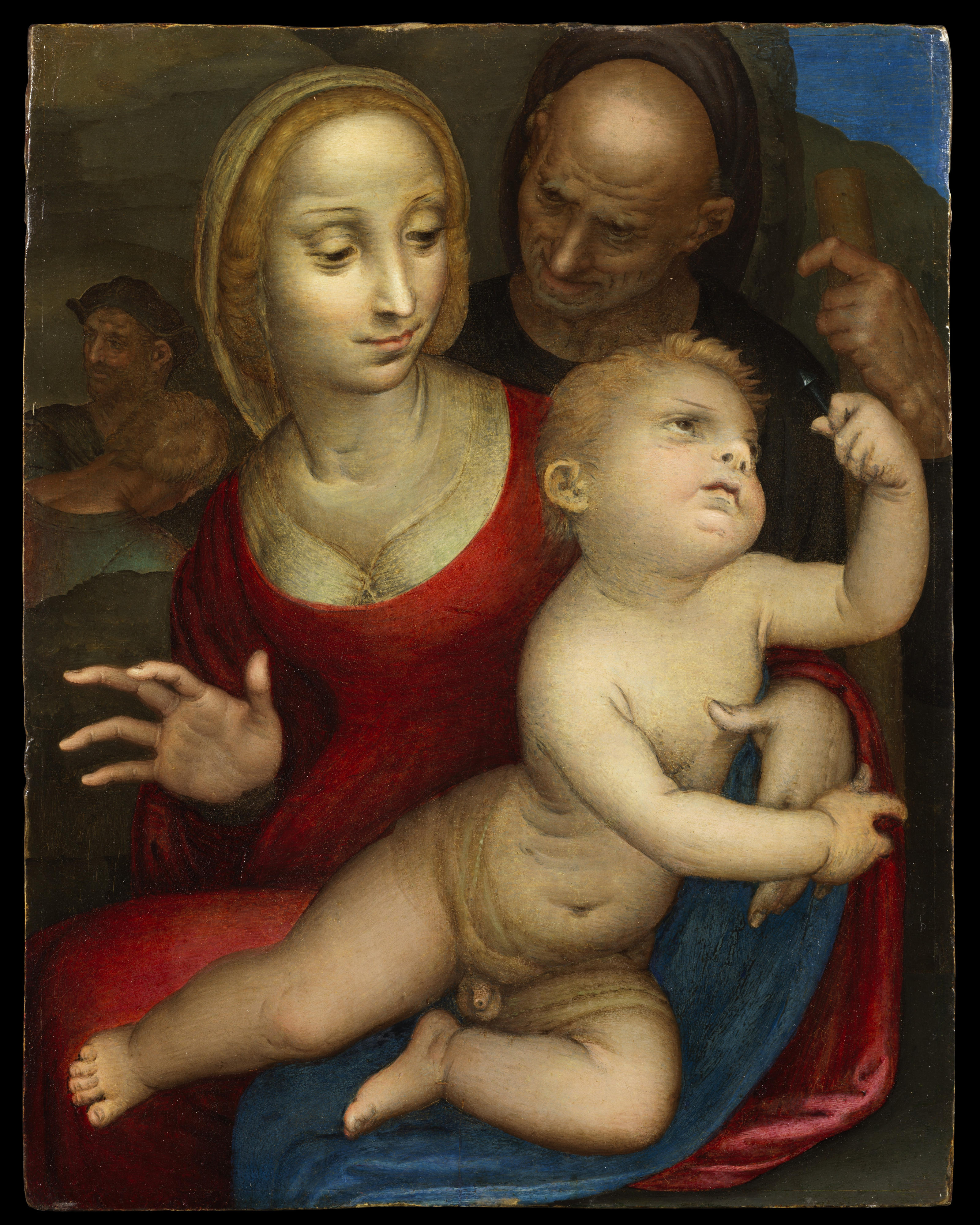
The Holy Family
c. 1523
Oil on wood panel
36.5 x 30 cm (14 3/8 x 11 3/4 in.)
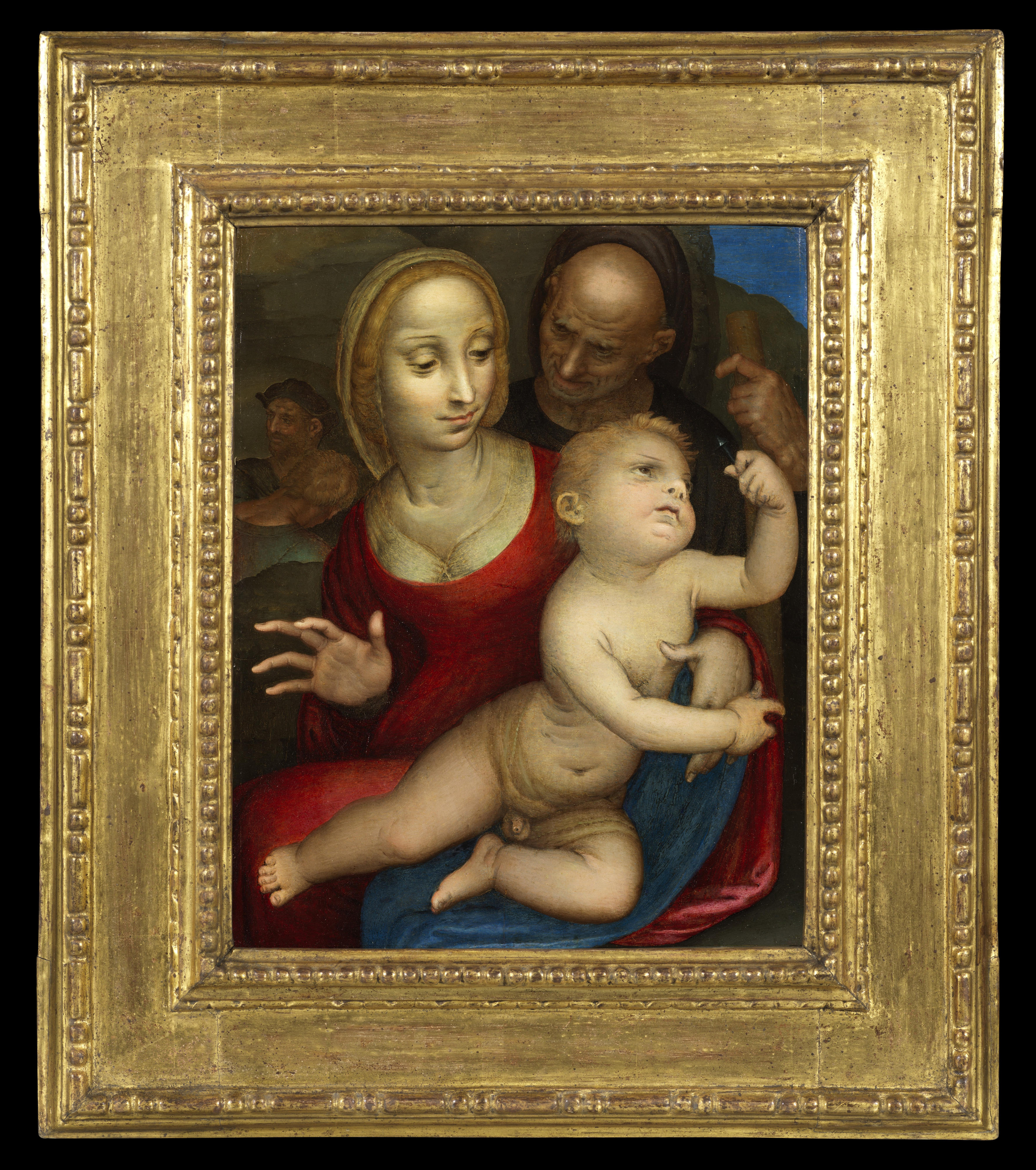
With frame: 55.5 x 48.5 cm (21 7/8 x 19 in.)
Provenance
Literature
V. Delieuvin, I “ritratti” nella bottega di Leonardo. il caso della Madonna dei fusi, in Leonardo and his Circle: painting technique in the light of restorations and scientific studies, Rome 2022, pp. 79–91.
Description
Fernando Yáñez is a key figure in the introduction of the Italian High
Renaissance style into Spain. Born in Almedina around 1475, the young Yáñez
travelled to Italy in the first years of the sixteenth century. He visited
Florence, where he studied the works of Raphael, Perugino and Leonardo, and
perhaps also spent time in northern Italy. A document of 1505 lists among
Leonardo’s assistants for the mural depicting the Battle of Anghiari in
Palazzo Vecchio in Florence one “Ferrando Spagnolo”, usually identified as
Yáñez rather than his compatriot Fernando Llanos, with whom he often
collaborated upon his return to Spain. The earliest secure documentation for
Yáñez is a record of September 1506, and thus after his Italian sojourn, and
this places him in Valencia and working together with Llanos on an altarpiece
depicting Saints Cosmas and Damian in the city’s cathedral (the work was lost
during the Spanish Civil War in 1936). The following year the two artists
executed a second altarpiece with the stories of the life of the Virgin for
the high altar of the same church (fig. 1). Ground-breaking in its time, the
altarpiece attests to the two artists’ introduction of a new Leonardesque
idiom into Spanish art.
In the years that followed, Yáñez worked in Barcelona, Murcia, and Cuenca
before returning to Valencia, where he died in 1536. In their works, from
large altarpieces to more intimately scaled pieces made for use in private
devotional practices, Yáñez and Llanos were able to present an alternative to
the Flemish models that had dominated Valencian art since Jan van Eyck’s stay
in the city in 1428, introducing Leonardo’s highly original compositions as
well as his pioneering sfumato technique into the lexicon of Spanish
painting.
The present work offers a clear homage to Leonardo da Vinci, and is clearly
modelled on the famous Madonna of the
Yarnwinder. That painting is today known in two versions, the one most
accredited by scholars being the Buccleuch
Madonna (fig. 2), on permanent loan to the National Gallery of Scotland,
Edinburgh, from the collection of the Duke of Buccleuch. The Madonna of the
Yarnwinder was commissioned from Leonardo in 1499 by Florimond Robertet, the
secretary of King Louis XII of France, around the time that the French
conquered the Duchy of Milan. Leonardo was still working on the painting in
Florence in 1501, as noted in a letter from Fra Pietro da Novellara, the head
of the Carmelites in Florence, to Isabella d’Este, and the work was probably
not delivered to Robertet until 1507. It seems highly likely that Yáñez had
direct access to Leonardo’s painting while he was in Florence, and that he
thus had ample opportunity to study and copy the composition.
The tender interaction between the three figures, Madonna, Child and Saint
Joseph is accentuated by the works triangular composition, a device that not
only guides the viewer’s gaze but also reinforced a sense of spiritual unity
and balance. Echoing the compositional strategies employed by Leonardo in The Virgin of the Rocks (fig. 3),
Yáñez constructs a classically balanced artwork that embodies the Renaissance
principles of naturalism and humanism, which were central to both in the period and
Leonardo’s broader oeuvre. Moreover, Yáñez’s subtle use of sfumato and his departure
from the decorative excesses typical of early sixteenth-century Spanish painting,
serves to humanise this the holy figures. This naturalistic rending
reinforces and the paintings didactic purpose, humanising Christ within a
relatable familial context, Yáñez affirms the Holy Family as a sacred
institution and a model of virtue, piety, and obedience to God. Indeed, Yáñez
returned to this model many times over the course of his career, quoting it
in a number of different works, including the high altarpiece for Valencia
cathedral, mentioned above, paintings in the collections of the National
Gallery of Scotland and the National Gallery of Art, Washington (fig. 4), and
in the present work and a related version recently on the art market
(Christie’s, New York, 30 January 2014, lot 225, fig. 5). In these last two
paintings, Yáñez in fact combined two different Leonardesque prototypes—while
the Madonna of the Yarnwinder offered a model for the Virgin and the Child,
Leonardo’s physiognomic studies offered inspiration for the expressive and
naturalistic head of the elderly Saint Joseph. A similarly craggy visage also
appears in the Adoration of the Kings painted by Yáñez for the cathedral of
Cuenca (fig. 6). An inscription on the back of the painting formerly at
Christie’s dates that work to 1523, and a similar date might also be suitable
also for the present painting, to which the artist added two figures of
shepherds at the left-hand side.
Paintings by Yáñez attest to the deep impact that Leonardo’s revolutionary
art upon every significant European school of painting, and indeed well
beyond the Milan, Florence, and the court of France, where he lived and
travelled in his lifetime. Furthermore, as noted by Jonathan Brown (Painting
in Spain: 1500-1700, New Haven, 1998, pp. 10–11), Yáñez's fidelity to
Leonardo's prototypes, so evident in the present painting, made him, along
with Llanos, the first non-Italian artist to paint in the High Renaissance
style outside of Italy, even before the French followers of Leonardo.
The attribution of the present painting has been confirmed by Professor José
Gomez Frechina on 19 January 2019, whose expertise is available for
consultation in addition to this sheet.
Fig. 1. Fernando Yáñez de la Almedina, Doors of the High Altarpiece, (the
Life of the Virgin), c. 1506–1510, temper and oil on panel, Valencia
Cathedral, Valencia.
Fig. 2. Attributed to Leonardo da Vinci, The Madonna of Yarnwinder (Buccleuch
Madonna), c. 1501, Oil on panel, Scottish National Gallery, Edinburgh.
Fig. 3. Leonardo da Vinci, The Virgin of the Rocks, c. 1491/2-9 and 1506-8,
Oil on wood, The National Gallery, London.
Fig. 4. Fernando Yáñez de la Almedina, The Virgin with Child and Infant Saint
John the Baptist, c. 1505, oil on panel, National Gallery of Art, Washington.
Fig. 5. Fernando Yáñez de la Almedina, The Virgin and Child with Saint
Joseph, c. 1523, Oil on panel, (Christie’s, New York, 30 January 2014, lot 225).
Fig. 6. Fernando Yáñez de la Almedina, detail from the Adoration of the Kings, c. 1510, oil on panel, Cuenca Cathedral.