
Artemisia Gentileschi
b. 1593, Rome
d. after 1654, Naples
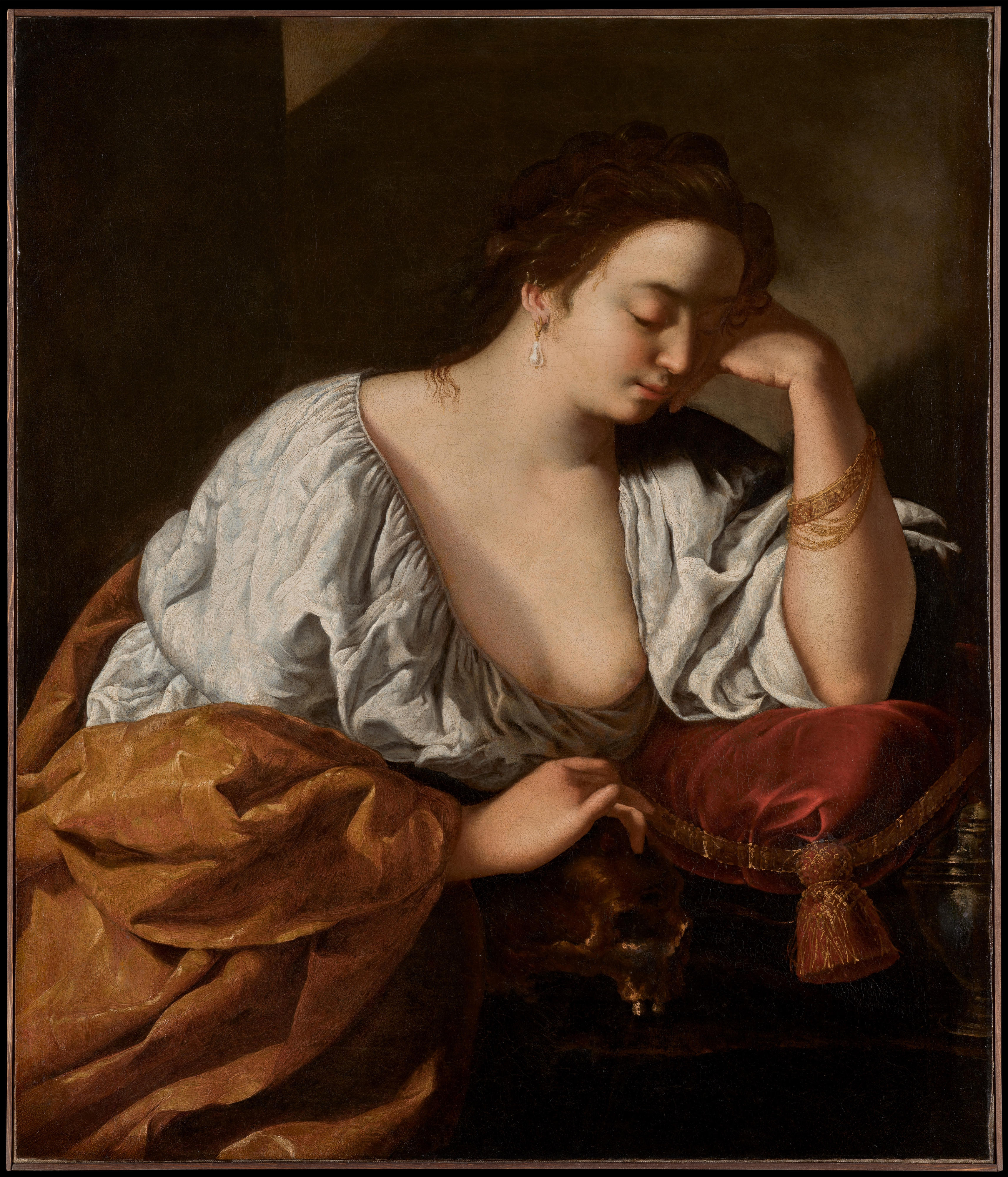
The Penitent Magdalene
c. 1625–30
Oil on canvas
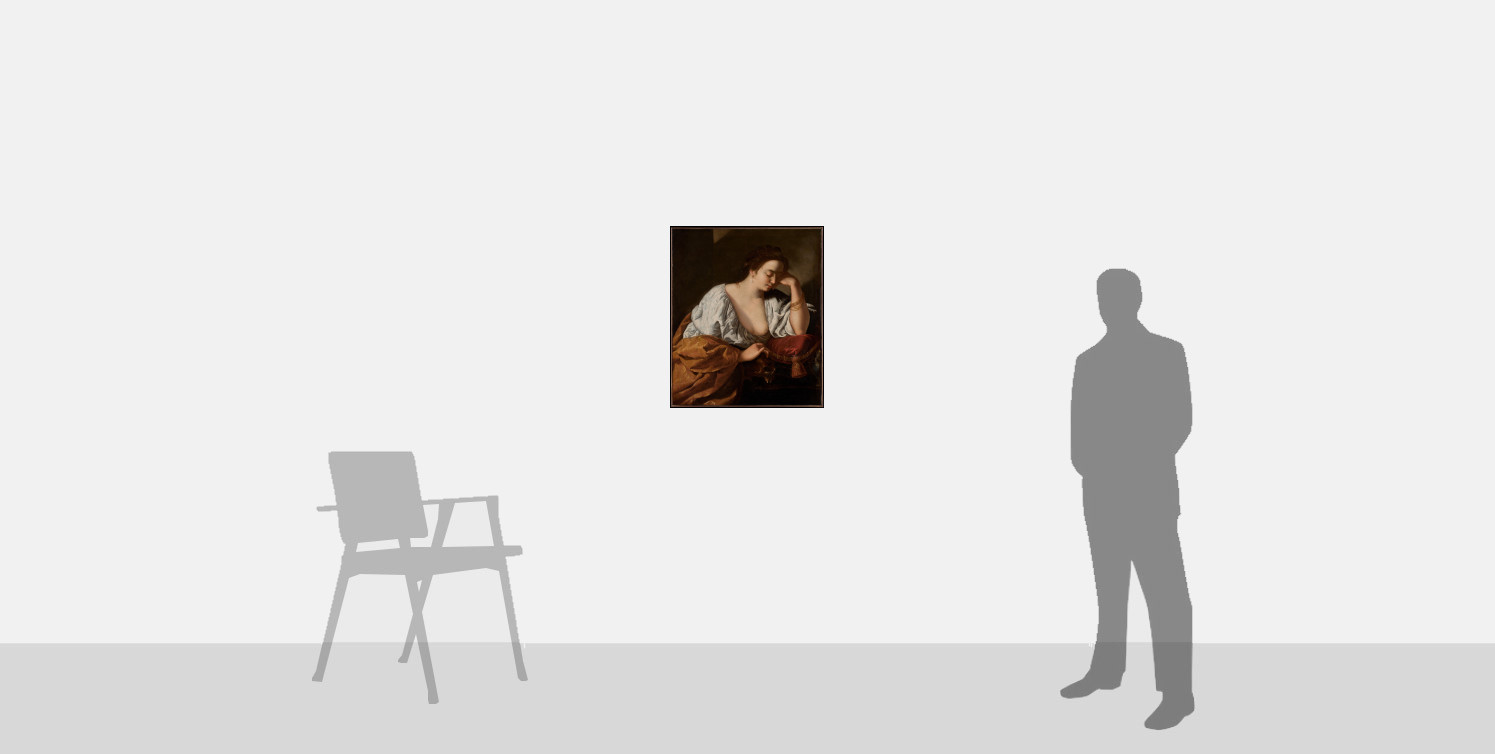
81 x 68.5 cm (31 7/8 x 27 in.)
Framed: 110.5 x 96 x 6 cm (43.5 x 37 4/5 x 2 1/3 in.)
Provenance
Literature
M. C. Terzaghi, 'Artemisia Gentileschi, The Penitent Magdalene', in Same Time, Different Stories. Fede Galizia, Orsola Maddalena Caccia, Artemisia Gentileschi, Milan, 2023, pp. 8–9, 26–37.
M. Gerlis, 'The Art Market | Female Old Masters out in force', The Financial Times, 9/10 December 2023, p. 14.
B. Grosvenor (ed.), Artemisia. Heroine de l'art, exh. cat., Paris, 2025, p. 59, cat. 26, 74-75, 158.
Description
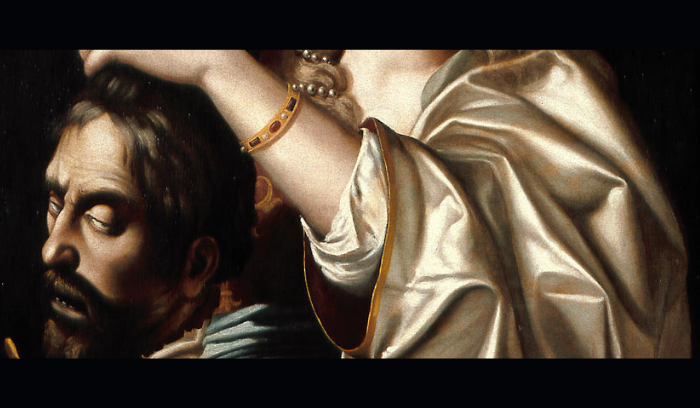
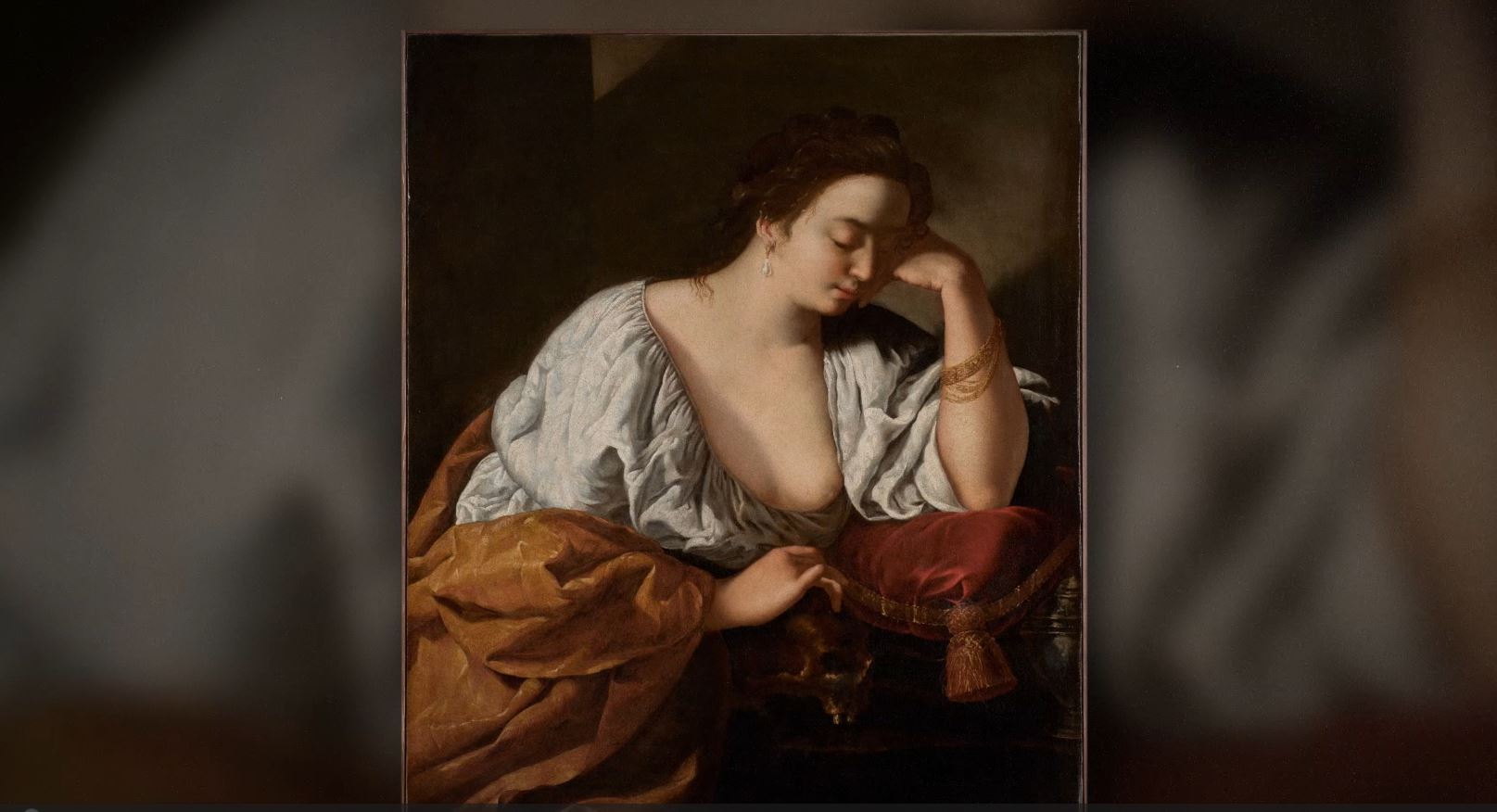
Depicted in three-quarter view, her head resting on her left elbow, poised on a red velvet pillow, the beautiful Magdalene meditates melancholically upon her past. Her right hand caresses a brown-coloured skull, a painterly choice that dilutes the macabre force of the iconographic detail, as it blends with the painting’s setting to the point of rendering it an almost decorative object. The saint, cloaked in sumptuous robes, voluptuously uncovers her generous décolletage and is furthermore adorned with gold bracelets on one wrist and pearl earrings, both emblems of her past as a courtesan.
Nothing is known about the provenance of the work, discovered by its current owners in a private collection in Florida. It is therefore worth consulting various seventeenth-century sources to ascertain the possible history of the painting. Indeed, in old inventories there are several records of Magdalenes by Artemisia yet to be matched to any specific canvas. Two of these records relate to Neapolitan collections. The earliest of the two dates to 20 March 1659 and relates to the estate of Ettore Capecelatro, marquis of Torella, in which there appears a “Una Madalena di Artemisia di 4 e 5 con cornice d’oro D. 26.”4 According to the measurements reported in the inventory, the work must have been horizontal in format and therefore cannot correspond to the present canvas. Moreover, the Neapolitan palmo measures around 26.3 cm; therefore the canvas including the frame must have been about 105 x 131 cm, dimensions different to those of the present painting.
The second citation is dated 20 June 1672 and relates to the property of Davide Imperiale located in his palace in Naples; there is recorded “Una Madalena d’Artemisia Gentileschi alta cinque larga quattro.”5 The painting has the same dimensions as the Capecelatro painting, only the format is vertical instead of horizontal. Ward Bissell, who first noted these entries in relation to the lost works of Artemisia, speculated as to whether this might in fact be the same painting that passed from one collection to another, but with an error in one in terms of recording the format of the work.6 In any case, the Imperiale painting measured about 50 cm more than the present canvas, precluding the possibility of identifying the two as the same painting.
In 1767, another Magdalene attributed to Artemisia Gentileschi appears in the collection of Francesco Emanuele Pinto, prince of Ischitella at Riviera di Chiaia. A square-format painting of about 66 cm per side, this too cannot be the present canvas.7
Also passing through Naples was probably the “Magdalena sentada en una silla durmiendo sobre el braço de Artemissa Gentilesça pintora romana”, which is recorded in Seville in the inventory of the possessions of Fernando Enríquez Afán de Ribera (1583–1637), duke of Alcalà, who served as the Spanish ambassador to Rome (1625–26) and was later the Spanish viceroy of Naples (1629–31). During his Italian sojourns the Duke became well acquainted with Artemisia, whose work he favoured from his time in Rome onwards.8 The Magdalene mentioned is in all likelihood the beautiful canvas preserved in the cathedral of Seville and known in several versions,9 which can be dated to the first half of the 1620s.10
Finally, there are two further inventory notations, which are of greater interest in relation to the present painting. These are paintings included in a list of works, dated to February 1621, that Artemisia herself was selling to her Florentine lover Francesco Maria Maringhi. Well known is the great scandal at the Medici court precipitated by this extramarital affair; left unprotected by the Grand Duke, to whom Artemisia was in debt for some paintings, the painter and her husband, Pier Antonio Stiattesi, were forced to leave Florence in haste, heading first for Bologna, then opting for Rome, where they arrived in the spring of 1620. In Florence, Artemisia left in the custody of her lover both much of her property as well as her own children, who later joined her in Rome, once she and her husband were settled there.11
In February 1621 Artemisia settled some accounts with Francesco Maria Maringhi, selling him paintings including a “quadro alto 2 braccia di una Maddalena abbilata” and a “quadro d’una Maddalena cominciato alto 2 braccia.”12 Maringhi was not only the painter’s lover but also evidently acted as her agent or dealer, and the two remained in contact throughout their lives, as Maringhi also later moved to Naples. It is possible to imagine that Gentileschi had a way to finish the Magdalene cominciato—how else could Maringhi have sold it? The Florentine braccio corresponds to about 58 cm, and therefore the measurements of these two Magdalenes (net of their frames) seem much more compatible with the present work than all the others mentioned above.13
Although it is impossible to be certain about the provenance of the canvas, stylistic elements seem to support the hypothesis of its execution during Artemisia’s second Roman period, and therefore the possibility that one of the two paintings owned by Maringhi was the present canvas. Echoes of the lively Roman artistic milieu of the 1620s reverberate throughout the work. In particular, the sumptuousness of the voluminous draperies, rendered in silken or brocaded fabrics, together with the great sensuality of the saint’s soft, snow-white complexion, denote the evolution of Artemisia’s style away from the strict Caravaggism of her youthful works. During this second Roman period, the example of the French painters active in the capital, particularly Simon Vouet and Nicolas Régnier, proved an important source of inspiration for Gentileschi’s painting. Vouet in particular held a leading role in Rome’s artistic scene, so much so that in 1624 he was appointed principe of the painter’s guild, the Accademia di San Luca. The close relationship between the two painters is documented, among other things, by the Portrait of Gentileschi (Palazzo Blu, Pisa) by the French painter.
There are close parallels between the present painting and works by Vouet, including the beautiful Woman Playing a Guitar (Metropolitan Museum of Art, New York, fig. 3) as well as the Magdalene (Los Angeles County Museum of Art, fig. 4), in which Vouet appears to have immortalised his wife Virginia da Vezzo, herself a painter, in the role of the saint. Both works share similar compositions, in which female figures are shown enrobed in luxurious silks, with their abundant décolletages in full view.
Equally intriguing are comparisons with Nicolas Régnier’s Penitent Magdalene (private collection, fig. 5); both saints are similarly posed, though Régnier’s Magdalene wipes away her tears with a handkerchief. Régnier’s trajectory is in many ways akin to that of Gentileschi in these years, as he likewise moved to Venice in 1626 to continue the brilliant career he had begun in Rome; achieving great success there, he remained in Venice for the rest of his life. Artemisia is documented in Venice in 1627, but she probably moved to the Lagoon city some time earlier and remained there only until the end of 1629 or the beginning of 1630, next heading directly for Naples without returning to Rome.14
Although Artemisia’s success in Venice is well documented by literary sources, virtually no paintings can be associated with this period, save the Esther and Ahasuerus in the Metropolitan Museum, New York (fig. 6), which is clearly indebted in terms of its composition to Paolo Veronese’s rendering of same subject now in the Louvre. Esther and Ahasuerus is among the works by Artemisia closest to the present Magdalene. Indeed, if one compares the profile of King Ahasuerus with the beautiful head of the saint (fig. 7 and 8), one notices the same soft rendering of the complexions, and a kindred manner of diluting shadows. If Esther and Ahasuerus is a work of the painter's Venetian period, the present Magdalene seems to constitute a very close prelude.
Meanwhile, one further element appears crucial to this discussion: the iconographic overlap between the Magdalene and the Allegory of Melancholy. From Dürer onward, and furthermore in prominent examples like Michelangelo’s Medici tombs, the woman with her head supported by one arm denoted a melancholic meditation upon one’s own existence. In the early seventeenth century one work in particular brought to the fore the possible overlapping of the allegorical theme with the religious one, becoming justifiably famous: the so-called Meditation by Domenico Fetti, known in many versions and made around 1618 (fig. 9). The canvas by Fetti, who was active between Rome, Mantua, and Venice, was seen by Guercino in Mantua, who reproduced its invention in the Casino Ludovisi (fig. 10). This work was well known to Artemisia, who in 1622 almost certainly made for Ludovico Ludovisi the Susanna now in Burghley House. Although it is possible that she knew Fetti’s canvas, Artemisia was most certainly able to ascertain its compositional and iconographical inventions via Guercino’s Roman version.
All these elements taken together suggest a date for the present canvas around 1626. Probably coming after the beautiful Magdalene of Seville, which also combines the theme of meditation with that of a penitent saint. This dating does not exclude a possible identification of the painting with the Magdalene begun in 1621 and sold still unfinished in that year to Francesco Maria Maringhi—Artemisia may have completed the painting a few years later, updating it to reflect the most modern works and styles that Rome and Venice could offer.
Thus this magnificent Magdalene is suggestive of Artemisia’s constant receptiveness to the different artistic environments in which she worked. Her extraordinary ability to understand and develop upon the artistic talents that surrounded her at any given moment says much about her exceptional pictorial gifts, which are fully appreciable in the beautiful Magdalene that is the focus of this study.
Maria Cristina Terzaghi, Rome 14 July 2023 (updated January 2025, translated from Italian)
1. See the unpublished technical study by A. Illán Gutiéerrez and R. Romero Asenjo, 6 February 2023, conserved at the Robilant+Voena archive.
2. M.C. Terzaghi, ‘Artemisia Gentileschi, The Penitent Magdalene’, in M.C. Terzaghi et al., Fede Galizia, Orsola Maddalena Caccia, Artemisia Gentileschi. Same time, different stories, Milan 2023, pp. 29-37.
3. Attributed to Artemisia in 1975 by Raffaello Causa and reaffirmed to the painting by F. Solinas, in R.P. Ciardi, R. Contini, F. Solinas (ed.), Artemisia (1573-1654), exhibition catalogue (Paris Musée Maillol), Paris, 2012, pp. 130-131.
4. G. Labrot, Documents for the History of Collecting Italian Inventories 1, Collections of Paintings in Naples 1600–1780 (Munich, 1992), pp. 101–4, available online via the Getty Provenance Index https://piprod.getty.edu/starweb/pi/servlet.starweb#
5. G. Labrot, Documents for the History of Collecting Italian Inventories 1, Collections of Paintings in Naples 1600–1780 (Munich, 1992), pp. 101–4, available online via the Getty Provenance Index https://piprod.getty.edu/starweb/pi/servlet.starweb#
6. R. W. Bissell, Artemisia Gentileschi and the Authority of Art. Critical Reading and Catalogue Raisonné (University Park, Pennsylvania, 1999), pp. 381–82, cats. L-80 and L-81.
7. R. W. Bissell, Artemisia Gentileschi and the Authority of Art. Critical Reading and Catalogue Raisonné (University Park, Pennsylvania, 1999), p. 382, cat. L-82.
8. On this theme see D. Garcia Cueto and R. Japón, “Artemisia Gentileschi e Giovanna Garzoni, due pittrici al servizio del II Duca di Alcalá” in Artemisia Gentileschi a Napoli, exhibition catalogue, Palazzo Zevallos Stigliano, Naples, 2022–23, pp. 50–59.
9. This hypothesis was formulated by J. Brown and R. L. Kagan, “The Duke of Alcalà. His Collection and its Evolution” The Art Bulletin, 69, 1987, pp. 239–40 and 248.
10. M. Garrard, Artemisia Gentileschi around 1622. The Shaping and Reshaping of an Artistic Identity (Berkeley, California, 2011).
11. All of these events are documented in correspondence between Artemsia, her husband, and her lover Francesco Maria Maringhi (F. Solinas, ed., Lettere di Artemisia (2nd edition: Rome, 2021)).
12. R. Contini and F. Solinas, “Artemisia Gentileschi in Florence: Inventory of Household Goods and Working Materials” in Orazio and Artemisia Gentileschi, exhibition catalogue, Museo del Palazzo di Venezia, Rome, Metropolitan Museum of Art, New York, and the Saint Louis Art Museum, 2001–2, pp. 447–48.
13. It seems impossible to identify one of the two paintings sold to Maringhi with the Magdalene privately owned but now exhibited in the Palazzo Ducale in Venice, because of the difference in format.
14. As emerges from the research conducted for the recent exhibition in Naples, cited above n. 5.