
Joseph Mallord William Turner
b. 1775, London
d. 1851, London
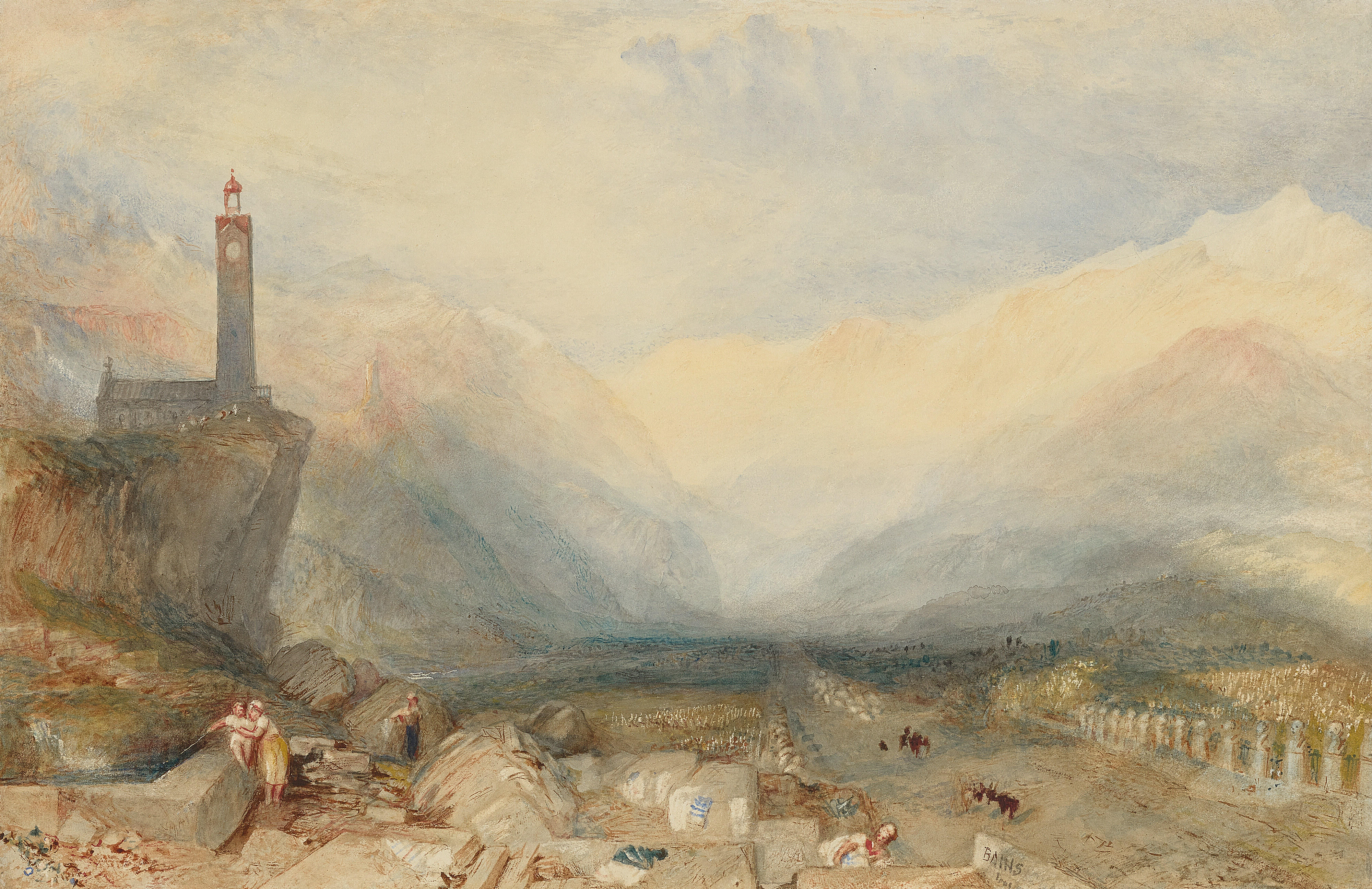
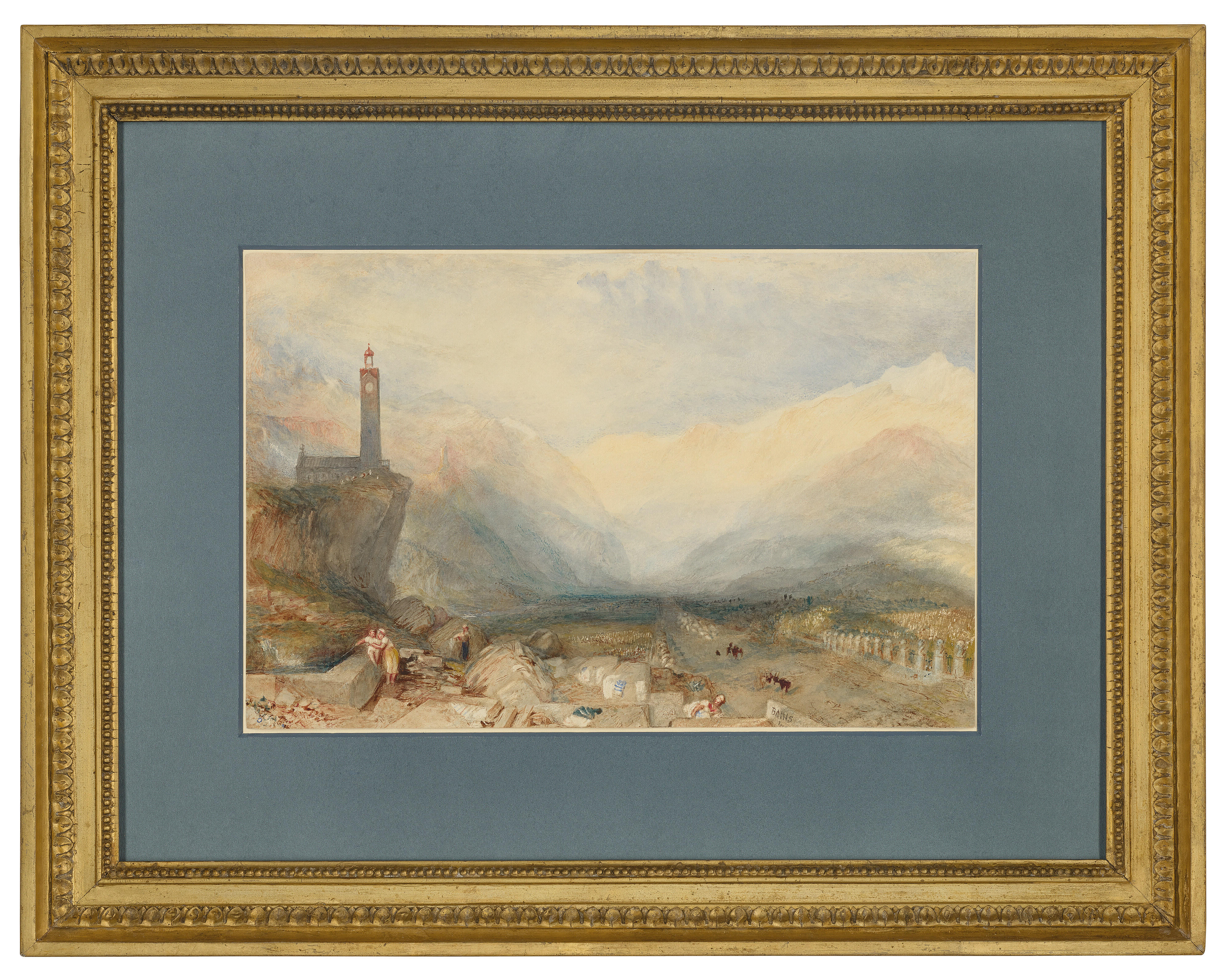
The Splügen Pass
c. 1842–43
Pencil and watercolour heightened with bodycolour and with scratching out on paper
29 x 45 cm (11 3/8 x 17 3/4 in.)
Framed: 55.5 x 70.6 cm (21 7/8 x 27 3/4 in.)
Provenance
H.A.J. Munro of Novar,
Christie's, 6th April 1878, lot 83 (1,000 gns to Agnew as ‘Baths of Pfeffers’).
Alfred William Hunt, by whom given to
John Ruskin, May 1878, by whom bequeathed to
Arthur Severn,
with Agnew's, London,
Alexander T. Hollingsworth, March 1923,
Christie's, 19 April 1929, lot 79 (1,800 gns. to Leggatt),
F.J. Nettlefold, and by descent,
with Marlborough Fine Art, London,
with Agnew's, London, where purchased by
James Biddle,
Anonymous sale; Sotheby's New York, 29th February 1984, lot 100,
Anonymous sale; Christie's, London, 14th July 1992, lot 85,
Anonymous sale; Sotheby's, London, 14 June 2001, lot 24,
Private collection.
Literature
J. Ruskin, Notes by Mr Ruskin on his Drawing by the late J.M.W. Turner, R.A., Exhibited at the Fine Art Society’s Galleries, March 1878, pp. 71-80.
J. Ruskin, Epilogue to 'Modern Painters', II, 1883 ed.
J. Ruskin, Praeterita, vol. II, chapter IV, sections 71-73, 1886-7.
J. Ruskin, Notes...on his Water-Colours by J. M. W. Turner, RA, 1900, pp. 50-1, no. 50, 58-65.
F. Wedmore, Turner and Ruskin, 1900, p. 298.
E. Dillon, ‘Turner’s Last Swiss Drawings’, Art Journal, 1902, p.332.
Sir W. Armstrong, Turner, London, 1902, pp. 134 and 273.
E.T. Cook and A. Wedderburn, Works of John Ruskin, IV, 1903, p. 344, and XIII, 1904, pp. 475-85, 487-8, 519, pl. 25 (opposite p.480), and XXXV, 1908, pp. 309-310.
C.R. Grundy and F. Gordon Roe, Catalogue of the Pictures and Drawings in the Nettlefold Collection, IV, 1938, pp. 36-37.
A.J. Finberg, The Life of J. M. W. Turner, R.A., Oxford, 1939, and 2nd ed. 1961, pp. 389, 400.
J. Evans and J.H. Whitehouse (ed.), The Diaries of John Ruskin, London, 1956-59, p. 273.
K. Clark, Ruskin and his circle, Arts Council catalogue, 1964, p. 30, no. 101
M. Hardie, Watercolour Painting in Britain II The Romantic Period, London, 1967, p. 39-40.
E. Joll, Agnew's 150th Anniversary Loan Exhibition of Paintings and Watercolours by J. M. W. Turner, R.A., 1967, no. 86, p. 92-93.
L. Herrmann, Ruskin and Turner, London, 1968, pp. 20-21.
J. Russell and A. Wilton, Turner in Switzerland, London, 1976, pp. 19, 20, 27, 109, 138.
A. Wilton, The Life and Work of J. M. W. Turner, Fribourg, 1979, pp. 105, n. 21 and 483, no. 1523.
S. Whittingham, 'News & Sales Information', Turner Studies, vol. 2, n° 1, Summer 1982, p. 60.
Country Life, 9 February 1984, supplement p. 35, illustrated.
S. Whittingham, 'News & Sales Information', Turner Studies, vol. 4, n° 1, Summer 1984, p. 62.
T. Hilton, John Ruskin. The Early Years 1819-1859, New Haven and London, 1985, pp. 65-7.
A. Wilton, Turner and his Time, London, 1987, pp. 223-225.
K. Wanner, ‘William Turner und Robert Browning – zwei Engländer im Passdorf Splügen’, Bündner Monatsblatt, Chur, 1, 1988, pp. 33-62, fig. 6.
Christie's Review of the Season 1992, London, 1992, p. 53.
I. Warrell, Through Switzerland with Turner, London, 1995, pp. 121-122, fig. 37 and pp. 149-151.
J.S. Dearden, ‘John Ruskin and the Splügen’, Turner Society News, No.74, December 1996, pp. 3-5.
T. Hilton, John Ruskin. The Later Years, New Haven and London 2000, pp. 391-392.
R. Hewison (ed.), Ruskin’s Artists. Studies in Victorian Visual Economy, Aldershot, 2000, pp. 4, 6, 13.
I. Warrell in R. Hewison, I. Warrell and S. Wildman, Ruskin, Turner and the Pre-Raphaelites, London, 2000, p. 129, no. 112.
Description
The present work is among J.M.W. Turner’s most atmospheric depictions of a Swiss subject, and indeed was hailed by John Ruskin as ‘the noblest Alpine drawing Turner had ever till then made’ and ‘the best Swiss landscape yet painted by man’ (E.T. Cook and A. Wedderburn, Works, XIII, p.480; and XXXV, p.309). The watercolour’s finesse is perhaps matched only by its extraordinary provenance, infamously being the object of intense envy by Ruskin himself, before entering into the great critic’s collection where it was treasured as one of his most prized pieces. It is one of the few examples of Turner’s Swiss subjects still in private hands, and has only recently returned to the market after being in a private collection for over twenty years.
The subject of The Splügen Pass is a slight misnomer, as the location of this watercolour is in fact the village of Andeer, about 10 kilometres from that of Splügen, from which the Pass travels over the mountains and drops down towards Lake Como. Ian Warrell, former curator at Tate Britain has suggested that a more accurate title for the work would in fact be Andeer on the Route to the Splügen Pass. Andeer was, during Turner’s day, an established coaching stop on the way to Splügen, and was a popular, and picturesque, route for travellers from the north for their journeys to Italy. Andeer itself was a destination for travellers as it boasted thermal mineral baths, which continue to be an attraction to this day. The inscription on the surface of a rock lower centre, ‘BAINS’, alludes to the bathing opportunities of the village, as does Turner’s inclusion of the woman and child at the left of the composition at the edge of a pool. The precariously positioned building in the middle-ground above these figures is the Evangelical Reformed church of Andeer, seemingly keeping watch over the mountain road below.
Turner renders the scene in a serene, almost dreamlike manner, evoking the falling dusk as the sun lets the valley fall into shallow. The depth of the scene is created with successive layers of wash, the heights of the far mountains still illuminated by the setting sun.
Although the exact date is not certain, the work was created as part of Turner’s suite of works that reflect his increased interest in Swiss subjects, mainly mountains and lakes, in the early 1840s. The artist undertook a sketching tour of Switzerland in 1841, and was documented in the south-east of the country in 1842 and 1843. Indeed, Turner was certainly present in Splügen in 1843, when he signed the guest book of the Bodenhaus on 10 September of that year. A related study drawing of this finished watercolour is in the Tate Collection, dated 1841–42 (fig. 1).
The first contemporary reference to the The Splügen Pass is found in Ruskin’s diary entry for 13 April 1844, when he viewed the watercolour in the London townhouse of H.A.J. Munro of Novar, a rival collector to Ruskin of Turner’s late watercolours. In this entry, Ruskin wrote of his passionate desire to own the work for himself, a longing that he reiterated in later writings.[1] He would also later write an account of his alleged first sighting of the work, which he stated took place in the spring of 1842, when Turner’s agent Thomas Griffith had shown a selection of Swiss sketches accompanied by selected finished watercolours, which included the present work, to a group of collectors to encourage commissions.[2] According to this account, Ruskin had desperately wanted to acquire the Splügen Pass on first sighting, yet had delayed, waiting for his father’s approval, thus missing the opportunity while the work was sold to his rival Munro.
It was only fourteen years after the death of Munro in 1864, that the work so coveted by Ruskin would finally enter the latter’s collection, continuing the astonishing history of its provenance. The Splügen Pass was part of the Christies sale of Munro’s unrivalled collection of Turner’s paintings and works on paper, that took place in April 1878. Ruskin, suffering from poor mental health at the time, was unable to bid for the work himself, yet in an incredible act, a group of his friends and supporters united to buy the work so it could be presented to him as a gift.[3] The subscribers to the fund were geographically and socially diverse, and correspondence relating to the initiative are today preserved in the Ruskin Library at Lancaster and the Morgan Library in New York.
Ruskin’s reaction to the gift was as effusive as expected, and swiftly ensured the work was included in the exhibition of Turner watercolours at the Fine Art Society in London in that same year. On return to Brantwood, Ruskin’s house in the Lake District, the work was displayed prominently in his study, and then in his bedroom (figs. 2 and 3), testifying to the writer’s deep affection for the piece.
Following Ruskin’s death in 1900, the work was bequeathed to Arthur Severn, who, along with his wife Joan, had looked after Ruskin in his later years. The Severns, despite being forced to sell several of the collection in order to maintain the upkeep of Brantwood, held onto The Splügen Pass until 1923, when they arranged a direct sale to the notable collector A.T. Hollingsworth. Subsequently the watercolour entered the Nettlefold collection, also important collectors of Turner’s works.
Building upon its eminent history, the work was also widely exhibited and published, in the second half of last century, but since 2001 it has remained quietly in private hands. One of his finest renderings of a Swiss subject, The Splügen Pass is almost unparalleled in the richness of its provenance, making it a rare and distinguished work by one of the most celebrated of English landscapists.
[1] See E.T. Cook and A. Wedderburn, Works, XXXV, pp. 309-10; J. Ruskin, Praeterita, vol. II, chapter IV, sections 71-73, 1886-7.
[2] Cook and Wedderburn, Works, XIII, pp. 475-485.
[3] See J.S. Dearden, ‘John Ruskin and the Splügen’, Turner Society News, No.74, December 1996, pp. 3-5.
Fig. 1: J.M.W. Turner, The Pass of the Splügen: Sample Study, c. 1841–2, graphite and watercolour on paper, 24.3 x 30.4 cm. Tate Collection, D36125, Turner Bequest CCCLXIV 277.
Fig. 2: Mr. Ruskin's study. After a drawing by Alexander Macdonald, showing the interior c. 1879–84, published in The Art Journal, n.d.. Turner’s The Splügen Pass is visible directly above the globe at the right.
Fig. 3: Arthur Severn, drawing of interior of Ruskin’s bedroom, Brantwood, October 1900. Ruskin Library, Lancaster. Selected works of Turner’s Swiss subjects from Ruskin’s collection are visible.